
Man with the Broken Nose
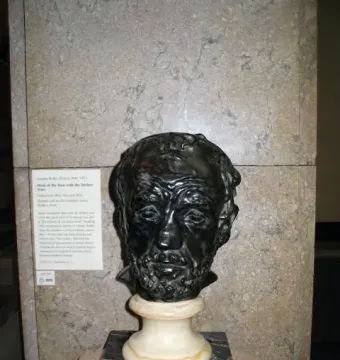
Man with the Broken Nose is an early bust by Auguste Rodin, created between 1864 and 1865. Rodin later regarded it, in his autobiography written at the end of 1883, as his first important work. The model was a laborer nicknamed Bibi, who cleaned artists’ studios for a small payment. Although the bust uses a traditional classical treatment, its asymmetrical face and rejection of ideal Greek beauty signal Rodin’s early move away from academic conventions. Rodin first showed a plaster version at the Paris Salon in 1865, but it was rejected. He later presented a similar version in Brussels in 1872 under the title Buste de M.B, and a marble version was accepted at the Paris Salon in 1875.
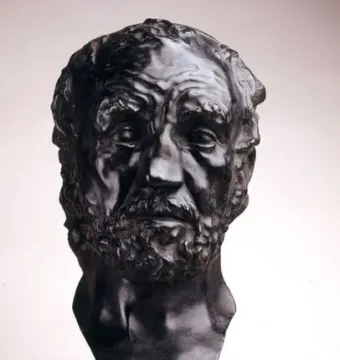
November 2007 © Museo Soumaya · Public domain
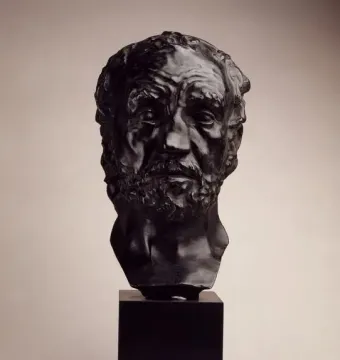
© Auguste Rodin · CC BY-SA 4.0
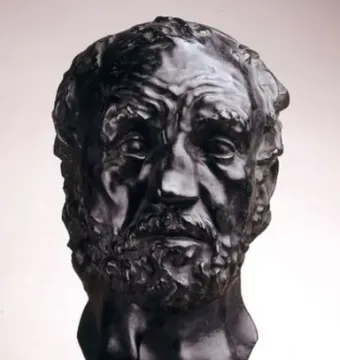
November 2007 © Museo Soumaya · Public domain
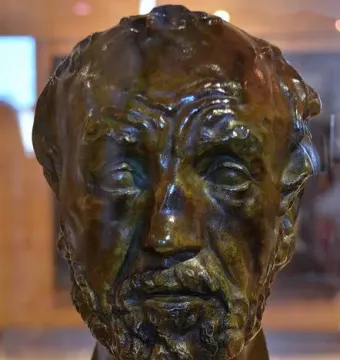
© Patrick · CC BY-SA 2.0
October 2004 © Юкатан · Public domain
Identification | |
| Title | Man with the Broken Nose |
| Original language title | L'Homme au nez cassé |
| Type | Bust |
Creator | |
| Artist | Auguste Rodin |
| Model | A laborer nicknamed Bibi, a well-known worker in Rodin's neighborhood who swept artists' studios for a small sum |
| Léon Fourquet | A friend Rodin met at the École gratuite de dessin et de mathématiques de Paris in 1856 |
Historical context | |
| Date created | 1863–1865 |
| Studio | A rented stable converted into Rodin's studio |
| Étienne Dujardin-Beaumetz | Rodin discussed the work with him in 1913 |
| Significance | Rodin considered it his first important work and his first major work |
| Exhibited at | Salon de Paris (Paris Salon) in 1865 and 1875; Salon de Bruxelles in 1872; Salon of 1878 |
Materials | |
| Original material | Plaster |
| Current material | Bronze |
| Patina | Black, brown, and green patina |
Physical characteristics | |
| Base dimensions | 12.5 x 15.1 x 15.3 cm (3.1 x 3.8 x 3.8 in) |
| Signature | Signed "Rodin" on the base |
Appearance | |
| Stylistic influence | Influenced by works in the Louvre |
| Stylistic treatment | Contoured modeling |
| Surface treatment | Deep grooves and pronounced wrinkles |
| Expression | Severe expression |
| Subject depicted | A man with a broken nose |
| Facial features | Strong, sharp, asymmetrical features |
| Hair treatment | The hair is held in a reticule |
| Style | Antique but traditional, with fidelity to contours |
Iconography and meaning | |
| Interpretive reading | Rodin identified with his model and represented his own fragility through the bust of a laborer whom he wanted to make immortal |
| Symbolic interpretation of hair reticule | Associated by the Greeks with immortality; possibly also a concrete accessory expressing the sculptor's desire for glory |
Discovery and provenance | |
| First plaster bust | Made in 1864 and lost in the winter of 1864 |
History and restoration | |
| Marble version | A marble version was made by Léon Fourquet for another attempt at the Paris Salon |
| Salon of 1872 presentation | Presented at the Salon de Bruxelles under the title "Buste de M.B" and accepted |
| First Salon presentation | Presented as a plaster bust under the title "Portrait of M.***" at the Paris Salon of 1865 and rejected |
| Salon of 1878 display | A bronze mask of Man with the Broken Nose was exhibited at the Salon of 1878 |
| Rodin's statement | Rodin said the mask determined all his future work and was the first modeled piece he made; afterward he tried to see and draw his work from all points of view and in every aspect |
| Rodin's 1913 account | In conversation with Étienne Dujardin-Beaumetz in 1913, Rodin said the fragmentary presentation was too innovative for the academic Salon jury and that he could present only a fragment in 1865 |
| Surviving part | The bronze mask was the only surviving part of the original bust |
| Accident affecting original plaster | Three years later, the back of the original plaster was damaged by an accident; Rodin later said the damage was due to frost from the start |
| Paris Salon approval | Accepted by the Paris Salon in 1875 as a marble work |
Location and ownership | |
| Current location of second bronze model | Museo Soumaya, Mexico City |
Significance | |
| Artistic significance | Seen as the beginning of Rodin's emancipation from academic constraints and as the first work in which life is represented over academic grace |
| Artistic importance | Crucial in the development of Rodin's sculptural aesthetics |
| Overall historical significance | A very early work, created at the end of Rodin's training, that reveals painful truths through clay |
| Later portrait influence | Rodin's later portraits have singular vitality and individuality, partly because he stayed faithful to contour modeling |