
Titanic Memorial in Belfast
Titanic Memorial in Belfast was erected to commemorate the lives lost in the sinking of the Titanic on 15 April 1912. Funded by contributions from public shipyard workers and the victims’ families, it was dedicated in June 1920. The memorial stands in Donegall Square in central Belfast, on the grounds of Belfast City Hall. Its design presents an allegorical scene: a female personification of death or fate holds a laurel crown above a drowned sailor, who is lifted above the waves by a pair of mermaids. It has long served as the site of annual Titanic disaster commemorations and is now the centerpiece of a small Titanic memorial garden opened on 15 April 2012.
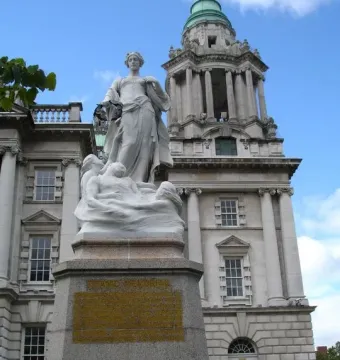
September 2006 © Lyn Gateley · CC BY 2.0
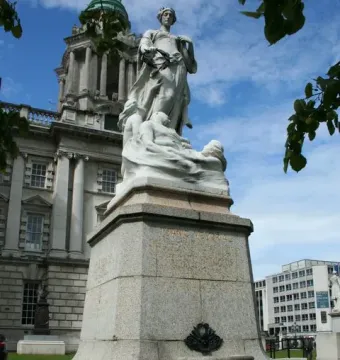
© Peter Clarke · Public domain
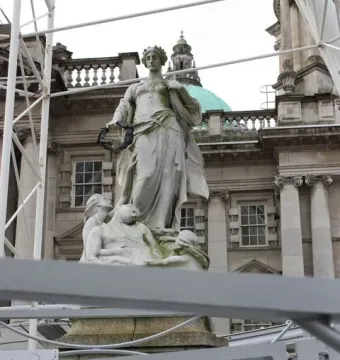
December 2009 © Ardfern · CC BY-SA 3.0
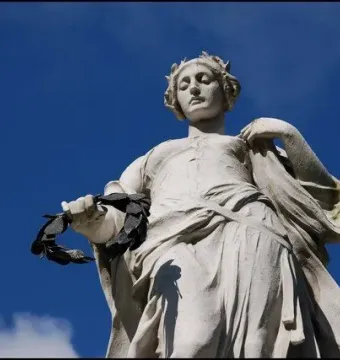
May 2007 © Albert Bridge · CC BY-SA 2.0
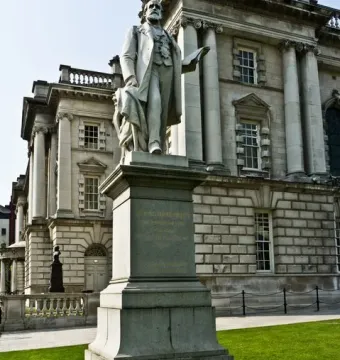
April 2011 © William Murphy · CC BY-SA 2.0
Identification | |
| Title | Titanic Memorial |
| Type | memorial sculpture |
| Alternative name | Titanic Memorial in Belfast |
Historical context | |
| Harland and Wolff employee contribution | £231.5s.11d |
| Delay cause | the outbreak of the First World War in August 1914 |
| Council approval date for final vote of confirmation | 2 January 1913 |
| Site suitability reported date | 6 August 1912 |
| Site selected | Donegall Square North |
| Site requested | Donegall Square North or Castle Junction |
| White Star Line contribution | £105 |
| Thomas Andrews family contribution | £360 |
| Work began | after the final vote of confirmation on 2 January 1913 |
| Public contribution to fundraising | about one third of the money |
| Historical context | Suggestions for a memorial were made within days of the Titanic disaster |
| Fundraising amount raised by end of May 1912 | £1,035.0s.4d |
| Purpose | to commemorate the lives lost in the sinking of the RMS Titanic on 15 April 1912 |
| Dedicated | June 1920 |
| Subject | the sinking of the Titanic and its victims |
| Proposal date | 3 May 1912 |
| Belfast City Council resolution date | 1 May 1912 |
| Commissioned by | Belfast City Council |
| Funding | financed by contributions from the public, shipyard workers, and the victims' families |
Creator | |
| Sculptor | Sir Thomas Brock RA |
| Commissioning context | Sir Thomas Brock had already contributed statues of Queen Victoria and Sir Edward Harland to Belfast and the Victoria Memorial in London |
Discovery and provenance | |
| Reason for relocation | it caused multiple accidents because drivers often did not see it or could not change lanes in time and collided with it |
| Original location | middle of the road on Donegall Square North, Belfast |
| Move date | 28 November 1959 |
| Move cost | £1,200 |
Location and ownership | |
| Commemorative use | used as the site for the annual commemorations of the Titanic disaster |
| Annual commemoration | an annual service for the Northern Irish victims of the Titanic sinking is held at the memorial each 15 April |
| City | Belfast |
| Country | Northern Ireland, United Kingdom |
| Location | Donegall Square, central Belfast, on the grounds of Belfast City Hall |
History and restoration | |
| Replacement elements | replacement bronze water-fountains were made to restore the memorial to its original appearance |
| Missing elements | the bronze water-fountains disappeared during the 1959 move |
| Restoration and repair commission | Consarc Design Group |
| Restoration date | 1994 |
| Renovation work | cleaning the statue; re-carving and repainting the lettering to make it more legible |
| Renovation date | 2011–2012 |
| Upper level features | five bronze plaques on a plinth |
| Memorial garden layout | set on two levels around and above the existing Titanic Memorial |
| Memorial garden opening ceremony participants | Lord Mayor of Belfast Niall Ó Donnghaile, Jack Martin (great nephew of Titanic victim John Simpson), and David McVeigh on behalf of Harland and Wolff |
| Memorial garden opening date | 15 April 2012 |
| Relocation decision date | 1959 |
| Wheel removal date | April 2010 |
| Opposition to wheel location | the Belfast Titanic Society objected to the wheel's location and proposed moving the memorial to the north eastern corner of the City Hall grounds |
| Belfast Wheel controversy | the memorial became the focus of controversy when the Belfast Wheel was built around and on top of it in November 2007 |
| Visibility history | for a time it was obscured by the Belfast Wheel, which was removed in April 2010 |
| Current setting | centrepiece of a small Titanic memorial garden |
| Alternative locations considered | various sites around Belfast, including a proposal from Portavogie in County Down |
| Memorial garden proposal | after the wheel's removal, a memorial garden was proposed to mark the centenary of the sinking of the Titanic |
| Relocation decision by | Belfast City Council |
Physical characteristics | |
| Composition | a group of four figures set on a plinth |
| Height | 6.7 meters |
| Pedestal height | 3.7 meters |
Materials | |
| Material | Carrara marble |
| Plinth material details | two small bronze water-fountains on the front and back faces |
Appearance | |
| Uncertain victim identities | two victims are thought to have travelled under false names; they are recorded with an asterisk next to their pseudonyms because their real names are still unknown |
| Commemoration gap | the names of the additional victims identified by later research were not included on the memorial |
| Breakdown of the additional victims identified later | four were crew members, one was a second-class passenger, and one was a third-class passenger |
| Later research on Northern Irish victims | later research showed there were twenty-eight victims from Northern Ireland |
| Original belief about Northern Irish victims | it was believed that there were only twenty-two victims from Northern Ireland |
| Belfast victims represented | nine were members of a Harland and Wolff guarantee party aboard Titanic to identify and fix problems spotted during her maiden voyage; the rest were crew members mostly employed in engineering roles |
| Name coverage | only the names of those victims are recorded on the memorial |
| Separate listing format | Harland and Wolff staff and crew members are listed separately on two faces of the plinth |
| Front inscription | an inscription about the bravery and manliness of those who died is carved in the center of the pedestal |
| Last listed group | the lowest-ranking crew members occupy the tail end of the list |
| First listed name | Thomas Andrews, listed first as a managing director of Harland and Wolff |
| Order of names | the names are listed according to rank or position rather than alphabetically |
| Names inscribed on the pedestal | the names of twenty-two people from Belfast who died in the disaster are carved on the other sides of the pedestal |
| Water-fountain design | gargoyle-like heads with recessed eyes, stumpy noses, and webbed antlers |
| Wave motif | the dead seaman and mermaids emerge from waves rising from the top of the plinth |
| Lower figures | two mermaids at her feet bearing a dead seaman |
| Pose of central figure | holds the wreath in her outstretched hand above the heads of the figures below |
| Object held by central figure | a black laurel wreath |
| Central figure | a standing female figure, interpreted as Death or Fate, or possibly Fame |
| Overall iconography | a standing female figure above two mermaids holding a dead seaman above waves |
Iconography and meaning | |
| Depicted figure action | holding a laurel wreath above the head of a drowned sailor |
| Additional depicted elements | the drowned sailor is raised above the waves by a pair of sirens |
| Central figure interpretation | thought variously to symbolize either Fame or a female version of Thanatos, the ancient Greek personification of death |
Significance | |
| Uniqueness | with the garden, it is the only monument in the world that commemorates all Titanic victims, passengers and crew alike |
| Significance claim | the first memorial anywhere in the world to record all of the names of the victims on one monument |