
Statue of Humanity
Statue of Humanity was a nearly completed statue in Kars, Turkey, also known as the monument of Armenian-Turkish friendship and reconciliation. Designed by Turkish artist Mehmet Aksoy, the thirty-meter monument stood on the summit of Kazyktepe, opposite the ancient Kars fortress, and was visible from neighboring Armenia. It depicted two halves of one person, each holding the other’s hand. The monument was demolished in April 2011, only a few months after then-Prime Minister Recep Tayyip Erdogan criticized it, calling it an "ugliness" or "monstrosity".
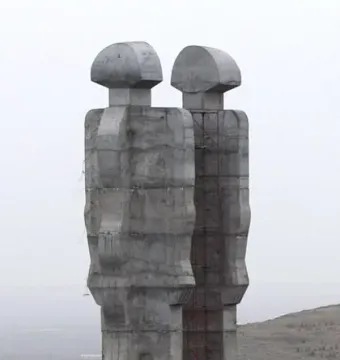
April 2011 © Ggia · CC BY-SA 3.0
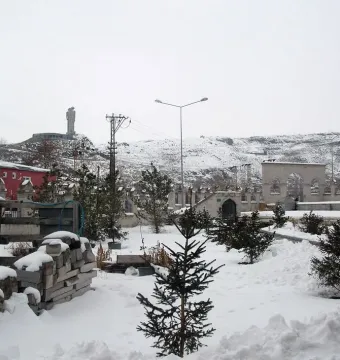
February 2011 © Surdurulebiliryasam · CC BY-SA 4.0
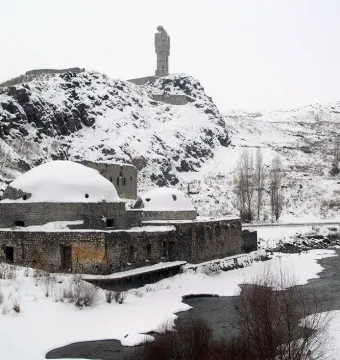
February 2011 © Surdurulebiliryasam · CC BY-SA 4.0
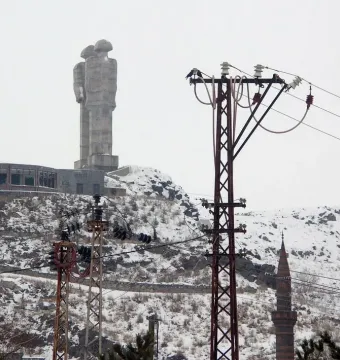
February 2011 © Surdurulebiliryasam · CC BY-SA 4.0
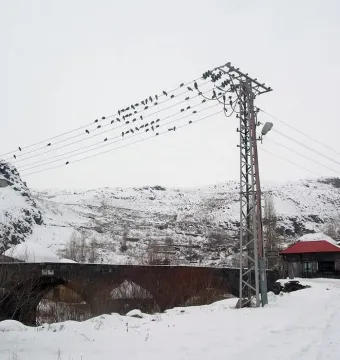
February 2011 © Surdurulebiliryasam · CC BY-SA 4.0
Identification | |
| Title | Statue of Humanity |
| Alternative names | Monument of Humanity; Monument of Armenian-Turkish Friendship; Monument of Armenian-Turkish Reconciliation |
| Type | Sculpture / monument |
Historical context | |
| Purpose | Gesture of reconciliation in Armenia–Turkey relations after the Zurich Protocols |
| Context | The Zurich Protocols were a 2009 accord to establish formal diplomatic recognition between Armenia and Turkey |
| Completion status | Nearly completed when demolished |
| Commissioned by | Municipality of Kars |
Creator | |
| Artist | Mehmet Aksoy |
| Artist nationality | Turkish |
Discovery and provenance | |
| Demolition context | Demolished a few months after criticism by Recep Tayyip Erdoğan |
| Removal decision | The city authority decided to remove the statue despite the protests |
| Public reaction | There were protests against the sculpture's removal |
| Demolition date | April 2011; demolition completed on 14 June 2011 |
| Demolition start date | 26 April 2011 |
| Year erected | 2006 |
| Year demolished | 2011 |
Physical characteristics | |
| Height | 30 meters |
| Material | Stone |
Appearance | |
| Depicted subject | A human figure split into two halves, each reaching for the other's hand |
Iconography and meaning | |
| Meaning of the location | Aksoy said the site near the Battle of Sarıkamış, where 90,000 people died, highlighted the inhumanity of war |
| Symbolism | Peace, brotherhood, and human conscience |
| Interpretation by the sculptor | A divided human being representing Turks and Armenians, with one figure realizing the irreconcilable situation and extending a hand to the other as an invitation to humanity |
Location and ownership | |
| Location | Kars, Turkey |
| Site | Kazıktepe, opposite the ancient fortress of Kars |
| Visibility | Visible from neighboring Armenia |
History and restoration | |
| Demolition completion | 14 June 2011; the last stones were transported away in June 2011 |
| Constitutional Court ruling | In July 2019, the Constitutional Court ruled that the demolition violated Aksoy's freedom of expression and that he should be compensated |
| Court rulings | A temporary injunction was issued against the demolition notice; on 3 March 2015 an Istanbul court fined Erdoğan 10,000 Turkish lira for insult; a local court later overturned the verdict |
| Legal action | Aksoy filed lawsuits against the demolition notice and later against Erdoğan for insult; he also sued before the European Court of Human Rights |
| Sculptor's reaction to demolition | Aksoy said, "I felt as if my children were being beheaded." |
| Armenian interpretation of head removal | Effectively a decapitation |
| Demolition method | The two heads were removed first; the statue was then to be cut into 20 pieces and removed by crane |
| Demolition order | The demolition began at Erdoğan's order |
| Erdoğan's visit and remark | 8 January 2011, during a visit to Kars |
| Criticism | Erdoğan called it an "ugliness," "monstrosity," "freak," and "strange thing"; critics also said it was erected without consultation with the Armenian community and was a unilateral imposition rather than reconciliation |
Significance | |
| Political interpretation | International observers saw the demolition as an attempt to appeal to nationalist sentiment ahead of the 2011 general elections; Aksoy also said Erdoğan was trying to consolidate his electoral base and win local Azerbaijani votes |
| Related public commentary | Opposition commentator Sibel Hürtaş praised the 2015 fine as a refreshing move by the Turkish judiciary |
Other | |
| Associated person | Recep Tayyip Erdoğan |
| Replacement plan | The Kars city administration said a new sculpture should be created at the site, with a proposed subject of a piece of cheese and honey |