
The Caress of a Bird
The Caress of a Bird is a painted, surrealist bronze sculpture by Joan Miró, created in 1967 in his studio in Cala Major, a suburb of Palma de Mallorca. It is now housed in the Miró Museum in Barcelona. The work measures 3.11 meters high, 1.11 meters wide, and 38 centimeters deep. It depicts a highly abstracted woman assembled from found objects later cast in bronze and painted. Her head is a straw hat for an donkey, her torso is a toilet seat, and her legs are an ironing board. The back features two small footballs as buttocks, while a turtle shell symbolizes the vulva. A bird, possibly also a woman’s hat, sits on her head.
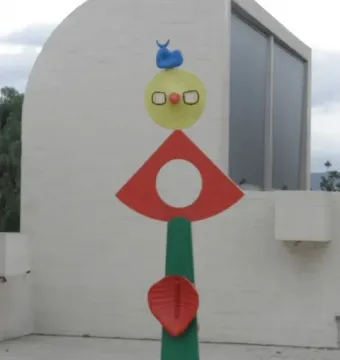
© Literat Tours · CC BY-SA 3.0
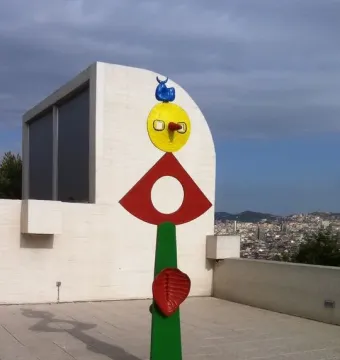
October 2011 © Kippelboy · CC BY-SA 3.0
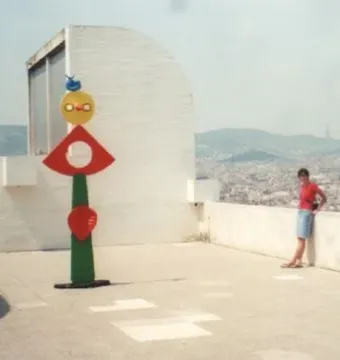
© Gpetrov · CC BY-SA 3.0
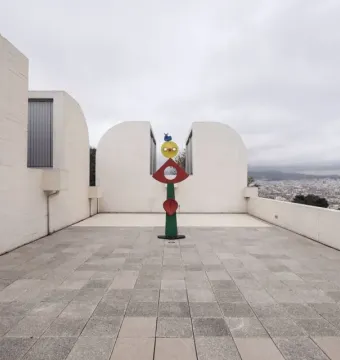
November 2014 © Severin.stalder · CC BY-SA 4.0
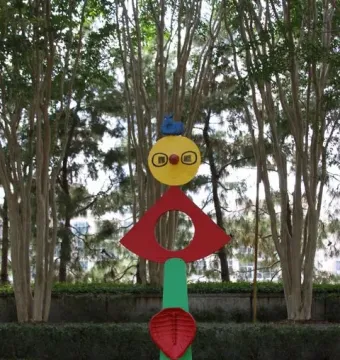
2009 © Taty2007 · CC BY 3.0
Identification | |
| Title | The Caress of a Bird |
| Type | sculpture |
| French title | La Caresse d'un oiseau |
Historical context | |
| Style | Surrealist |
Creator | |
| Artist | Joan Miró |
| Year created | 1967 |
Discovery and provenance | |
| Created in | his studio in Cala Major, a suburb of Palma de Mallorca |
| Origin | based on Miró's early object-sculptures made in Mont-roig del Camp with found objects |
| Historical context | developed during the Second World War, when Miró was isolated in Mont-roig del Camp and cut off from the art world, galleries, museums, and exhibitions |
Physical characteristics | |
| Dimensions | 3.11 metres high, 1.11 metres wide, 38 centimetres deep |
| Form | a highly abstracted woman |
Materials | |
| Material | painted bronze |
Technique | |
| Construction method | made from found objects cast in bronze |
| Creation process | the found objects were initially not placed in the correct position, and Miró rigorously assessed their placement during creation |
Appearance | |
| Top element | a bird atop the woman's head, possibly also a ladies' hat |
| Surface treatment | painted with bright colors |
| Torso and legs | an outhouse seat and an ironing board |
| Genital element | a tortoise shell representing female genitalia |
| Back elements | two miniature footballs representing the buttocks |
| Head element | a straw hat placed on a donkey's head |
Iconography and meaning | |
| Interpretation | compared to a totem of female sexuality |
| Found-object tradition | an assembly sculpture using easily identifiable found objects, transformed into something new while retaining their original forms |
| Quotation | "When I take a stone, it is just a stone. When Miró grabs a stone, it is a Miró." |
| Interpretive implication | the quote suggests Miró transformed ordinary found materials into something distinctly his own |
Location and ownership | |
| Current location | Miró Museum, Barcelona |
History and restoration | |
| Original version | an object sculpture made in Mont-roig del Camp from found materials |
| Condition of original version | by the mid-1960s it was deteriorating |
| Bronze version | recreated in bronze in Paris in the mid-1960s |
| Artist involvement in bronze version | Miró supervised the texture and controlled the patina |
| Patina | Miró considered the patina very important |
Other | |
| Associated person | Joan Prats, Miró's lifelong friend and collaborator |