
National Shrine of the Little Flower
National Shrine of the Little Flower is a church in Royal Oak, Michigan, in the United States, affiliated with the Roman Catholic Church as a parish church in the Archdiocese of Detroit. It was completed in two stages between the years given in the source text, and is located at 2100 West Twelve Mile Road. Pope Francis signed the decree making it a minor basilica, and it later became one. The United States Conference of Catholic Bishops designated it a national shrine, the fifth such shrine. Its construction was funded through Father Charles Coughlin’s radio broadcasts in the 1930s.
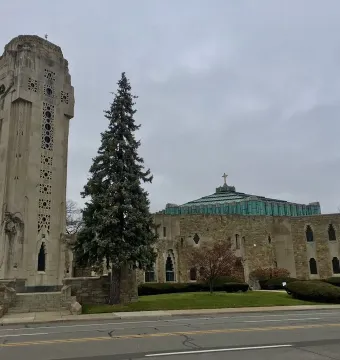
December 2020 © Andre Carrotflower · CC BY-SA 4.0
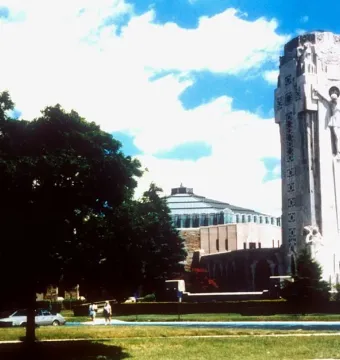
1995 © Unknown authorUnknown author or not provided · Public domain
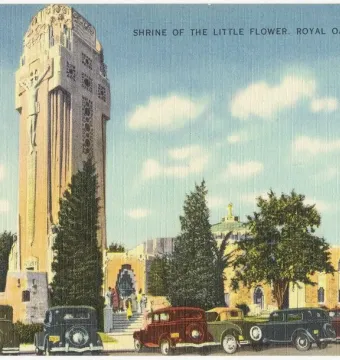
February 2011 © Boston Public Library · CC BY 2.0
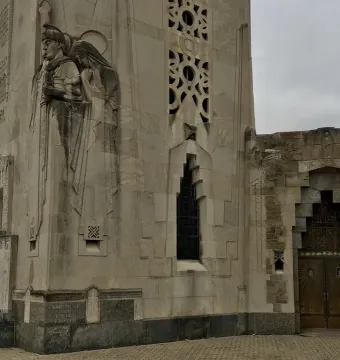
December 2020 © Andre Carrotflower · CC BY-SA 4.0
December 2020 © Andre Carrotflower · CC BY-SA 4.0
Identification | |
| Name | National Shrine of the Little Flower Basilica |
| Named after | Saint Thérèse of Lisieux, known as "the Little Flower" |
| Original language name | La Basílica Santuario Nacional de la Pequeña Flor |
| Type | Catholic church, parish church, minor basilica, and national shrine |
Historical context | |
| Founded | 1925 |
| Notable person | Father Charles Coughlin |
| Location context | Built in a largely Protestant area |
| Original construction date | 1926 |
Creator | |
| Architect's firm | Hamlin and McGill, New York |
| Designer | Rene Paul Chambellan |
| Sculptor | Corrado Parducci |
| Carver | Enrico (Harry) Liva, chief carver of the Ingalls Stone Company of Bedford, Indiana |
| Architect | Henry J. McGill |
Discovery and provenance | |
| Funding | Construction was financed through the proceeds of Father Charles Coughlin's radio ministry in the 1930s |
Physical characteristics | |
| Architectural style | Zigzag Art Deco |
| Materials of new building | Copper and stone |
| Material of original structure | Wood |
Location and ownership | |
| Location | Royal Oak, Michigan, United States |
| Address | 2100 West Twelve Mile Road at the northeast corner of Woodward Avenue |
| Ecclesiastical affiliation | Roman Catholic Archdiocese of Detroit |
| Associated tower | Charity Crucifixion Tower |
| Associated structure | Charity Tower |
History and restoration | |
| Minor basilica designation | Pope Francis designated it a minor basilica on January 31, 2015 |
| Papacy-related designation | Pope Francis signed the basilical decree; the designation took effect the following day |
| Completion | Completed in two stages |
| Early hostility | The Ku Klux Klan burned a cross in front of the church within two weeks of opening |
| Construction period | 1931 to 1936 |
| Destruction of original structure | The original wooden structure was destroyed by a fire on March 17, 1936 |
Significance | |
| Designation as national shrine | Designated by the United States Conference of Catholic Bishops as its fifth national shrine |
Appearance | |
| Balcony | Includes a small balcony that can serve as a pulpit |
| Illuminated feature | The sides and rear have windows inside the crucifix that can be lit from within |
| Terrace wall figure | Saint Thérèse of Lisieux carved into the surrounding wall across the terrace facing the crucifix |
| Flanking figures | John the Apostle and the Virgin Mary on the left; a Roman centurion holding a spear and Mary Magdalene on the right |
| Front carvings | Depictions of the Archangels Jophiel, Raphael, Michael, Gabriel, and Uriel |
| Doorframe decoration | Depictions of items associated with the Passion |
| Doorway inscription | "Charity" and "Christ Crucified" carved above the doorway |
| Inscription below Christ | The Seven Last Words from the Cross |
| Upper corner decorations | Symbols of the Four Evangelists |
| Main figure | A large figure of Christ on the cross |
Iconography and meaning | |
| Purpose | Built as a response to the Ku Klux Klan as a "cross they could not burn" |
| Dedication | Named in honor of Saint Thérèse of Lisieux, also known as "the Little Flower" |
| Depicted elements | St. John and the Blessed Virgin Mary |
| Other related elements shown | Christ's last words from the Cross; tabernacle; ambo; altar of Saint Thérèse Chapel; Queen of All Saints shrine; interior of the church |
Other | |
| Historical image | Postcard from the 1940s |
| Radio broadcast location | From the tower in the 1930s |
| Reaction after opening | Within days of opening, the Ku Klux Klan burned a cross in front of the church |