
Muttergottesbrunnen (Heidelberg)
Muttergottesbrunnen (Heidelberg), also known as the Kornmarkt Madonna or Mariensäule, is a fountain sculpture in the Kornmarkt in Heidelberg’s Altstadt. Mary is shown wearing a gilt crown of rays and stars, holding a lily sceptre and the Christ Child. She stands on a gilded globe encircled by a monstrous snake, supported by four putti on clouds with rays of golden light emerging from them. The Christ Child raises his hand in benediction and thrusts a lance into the snake’s head. The sculpture’s iconography reflects Counterreformation themes and Marian symbolism, including the Immaculate Conception, the Woman of the Apocalypse, and the Assumption of Mary.
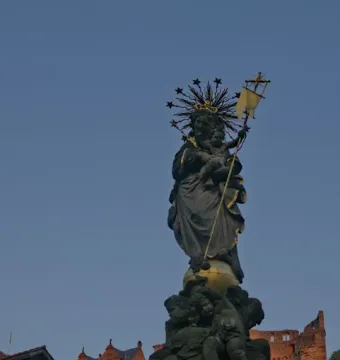
April 2025 © Polibil · CC BY-SA 4.0
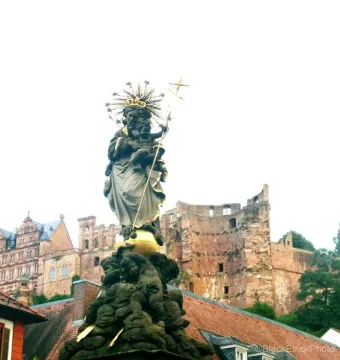
© Etrick · CC BY 3.0
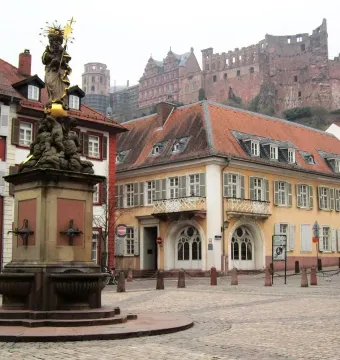
January 2012 © Corradox · CC BY-SA 3.0
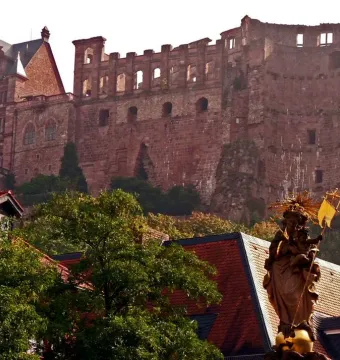
October 2005 © Heribert Pohl --- Thanks for half a million clicks! · CC BY-SA 2.0
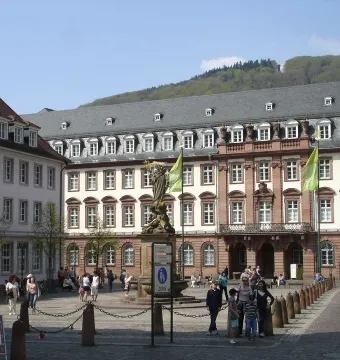
April 2009 © Ulises Estrada · CC BY 2.0
Identification | |
| Title | Kornmarkt-Madonna |
| Type | Fountain sculpture; Marian statue used as a fountain figure |
| Alternative titles | Cornmarket Madonna; Muttergottesbrunnen (Heidelberg); Mariensäule; Mother of God Fountain |
Location and ownership | |
| Current location | Kornmarkt, Altstadt, Heidelberg |
| Original statue location | Kurpfälzisches Museum |
Creator | |
| Artist | Peter van den Branden |
Historical context | |
| Religious role in Heidelberg | Promoted mainly by the Jesuits in Heidelberg |
| Reception | Seen as a provocation by Heidelberg's Reformed population |
| Religious context | Part of the Counter-Reformation and Catholic imagery of Mary and the saints |
| Historical background | Created in the context of conflict between Heidelberg's Reformed majority and Catholic Elector Karl Philipp |
| Date placed | 1718 |
Discovery and provenance | |
| Earlier fountain on site | Milchbrunnen ('Milk Fountain') in the northwest corner of the Kornmarkt |
History and restoration | |
| Relocation | Moved to the center of the Kornmarkt around 1830 during the widening of Hauptstraße |
| Fountain integration | The statue was integrated as the fountain figure when it was moved to the center of the square |
| Basin replacement | Between 1870 and 1890 the large basin was replaced by a block-like pedestal with three smaller shell basins |
| Landscape change | After 1900 the small surrounding green area was removed and the ensemble was framed by a stepped platform |
| Copy | A copy of the statue was made for the Kornmarkt between 1938 and 1940 |
Physical characteristics | |
| Pedestal inscription | NON STATUAM AUT SAXUM SED QUAM DESIGNAT HONORA / NOCH STEIN NOCH BILD NOCH SÄULEN HIER / DAS KIND UND MUTTER EHREN WIR |
| Fountain basin | Originally surrounded by an octagonal basin |
| Inscription language | Latin and German |
| Placement | On a pedestal in the middle of the square |
Iconography and meaning | |
| Depicted figure | Mary with the Christ Child |
| Iconographic type | Mary of Victory (Maria vom Siege) |
| Composition | Mary stands on a gilded globe wrapped by a dragon serpent, carried by four putti on clouds |
| Mary's attributes | Gilded radiant crown with twelve stars, lily sceptre |
| Christ Child attributes | Raises his right hand in blessing and thrusts a cross-topped lance into the serpent's head with his left hand |
| Symbolism | The crown and lilies refer to the Immaculate Conception; the crown and sceptre symbolize Mary as Queen of Heaven; the serpent and crescent moon at her feet allude to the Woman of the Apocalypse; the putti represent the Assumption of Mary; the golden rays in the clouds are rays of grace from Mary to the world |
| Local interpretation | In Heidelberg the struggle against the serpent was intended as an allegory for the struggle against Protestant false belief |