
Seated Woman of Çatalhöyük
The Seated Woman of Çatalhöyük is a baked-clay figurine from around 6000 BC, found at Çatalhöyük, an ancient Neolithic and Chalcolithic settlement in Anatolia, now Turkey. It depicts a nude woman or mother goddess seated on a throne and flanked by two leopards, and is believed to symbolize fertility because of its exaggerated female features and birthing pose. Only about twelve centimeters tall, it is one of several similar figures found at the site and is associated with Paleolithic Venus figures such as the Venus of Willendorf. Discovered by James Mellaart in 1961, the sculpture is now in the Museum of Anatolian Civilizations in Ankara.
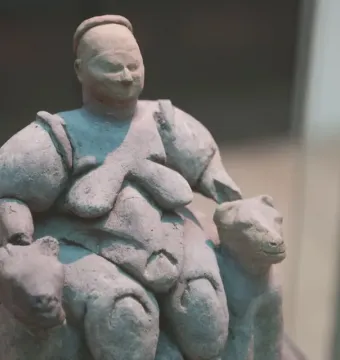
September 2011 © Dosseman · CC BY-SA 4.0
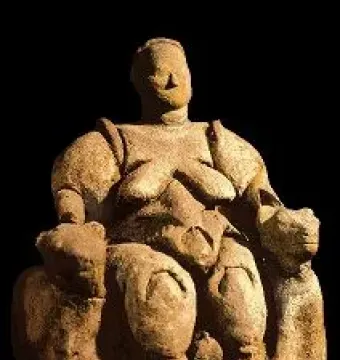
February 2018 © Nina Paley · CC0
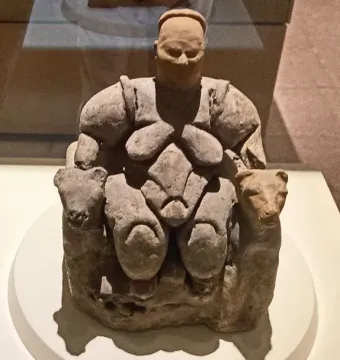
September 2023 © Volker Höhfeld · CC BY-SA 4.0
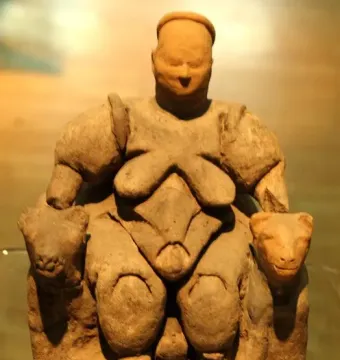
December 2008 © Frank K. · CC BY 2.0
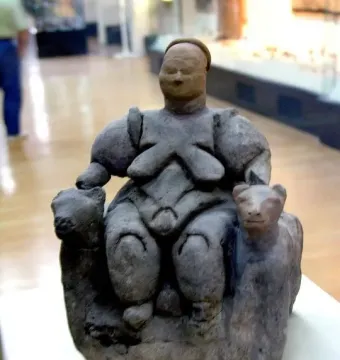
October 2005 © Dennis G. Jarvis · CC BY-SA 2.0
Identification | |
| Title | Seated Woman of Çatalhöyük |
| Original-language name | Mujer sentada de Çatalhöyük |
| Type | figurine |
Historical context | |
| Period | Neolithic |
| Cultural context | Chalcolithic periods |
Creator | |
| Artist | Unknown |
Discovery and provenance | |
| Discovery year | 1961 |
| Discoverer | James Mellaart |
| Discovery location | Çatalhöyük, Anatolia (present-day Turkey) |
| Discovery context | Found inside a grain storage container in the settlement's residential area |
| Condition at discovery | The woman's head, her right hand, and one of the leopard heads were missing |
History and restoration | |
| Restoration | The missing parts are modern replacements |
Physical characteristics | |
| Weight | 1 kg (2.2 lb) |
| Dimensions | 17 cm long, 11 cm wide, 12 cm high |
| Height | about 12 cm |
Materials | |
| Material | fired clay |
Appearance | |
| Subject | Nude female figure |
| Pose | Seated, giving birth |
| Seating | Seated on a throne with two hand rests |
| Arm-rest motif | Feline heads, variously described as lioness, leopard, or panther heads; Mistress of Animals motif |
| Associated animals | Two leopards flanking her on both sides |
Iconography and meaning | |
| Depicted figure | a naked woman or Mother Goddess |
| Interpretation | a symbol of fertility |
| Interpretation basis | the exaggerated limbs of the female figure |
| Interpretation by Mellaart | Represented a fertility goddess worshipped by the people of Çatalhöyük |
| Possible function | May have been a figurine used in domestic cult worship |
| Comparative examples | Associated with the so-called Paleolithic Venuses, especially the Venus of Willendorf; one of several iconographically similar figures found at the site |
Other | |
| Alternative name | Çatal Höyük |
Location and ownership | |
| Current location | Museum of Anatolian Civilizations, Ankara, Turkey |