
Škloŭ Idol
Škloŭ Idol was found by boys from a village on the bank of a river at the Kukushkin Rov site. Adults dug up the sculpture and jokingly nicknamed it “olukh.” It was later transported to Minsk by archaeologist Leonid Davydovich Pobol, during which it suffered damage in the back of a truck: the surface was badly rubbed and the face was slightly chipped. The idol’s date and cultural attribution remain unresolved. Proposed datings range from the 5th to the 13th century, with no theory securely proven. It is often linked to Slavic population, though similarities have also been noted with Baltic idols from Riga and pillar-like idols from sanctuaries in the Smolensk region. Its closed eyes and phallic form suggest possible associations with the world of the dead, fertility, and fruitfulness.
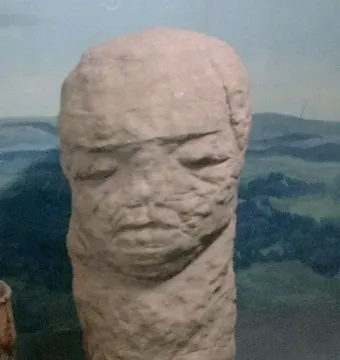
2015 © Раман Плавінскі · CC0
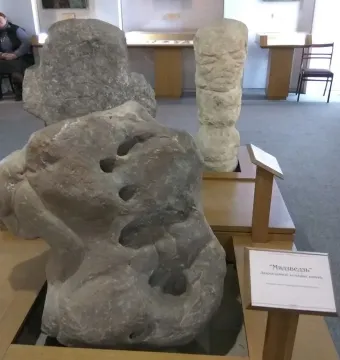
January 2018 © Чаховіч Уладзіслаў · CC BY-SA 3.0
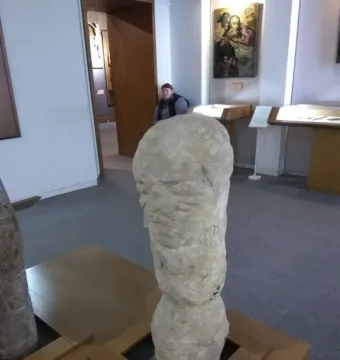
January 2018 © Чаховіч Уладзіслаў · CC BY-SA 3.0
Identification | |
| Title | Škloŭ Idol |
| Object type | Idol |
Historical context | |
| Proposed date | Hypotheses range from the 6th to the 13th century; specific proposals include the 6th–7th, 6th–10th, 10th, and 12th–13th centuries |
| Likely cultural attribution | Zabashta leans toward a Slavic origin |
| Alternative cultural affiliation | There is also a noted similarity to Baltic idols |
| Dating basis | R. Zabashta dated it to the 12th–13th centuries using archaeological monuments near the findspot and comparisons with similar pagan idols |
| Date discovered | 1963 |
Discovery and provenance | |
| Nickname given by locals | Oluh |
| Alternative name given by locals | yolop |
| Transported to | Minsk |
| Transported by | archaeologist Leonid Davydovich Pobel |
| Nearby archaeological monuments used for dating | A settlement of the 12th–17th centuries, a kurgan burial ground of the same period, and a nearby hillfort and settlement dated to the 10th–16th centuries |
| Excavated by | adults |
| Discovery location | on the bank of the Serebryanka River in the Kukushkin Ravine area |
| Discovered by | boys from the village of Stary Škloŭ |
| Comparative objects | Similar pagan idols from Tumu, Poland; Riga, Latvia; and possible idols from sanctuaries at Tushemlya, Gorodok, and Prudky in Smolensk region |
History and restoration | |
| Damage during transport | It was badly worn during transport, and its face was slightly chipped or abraded |
Physical characteristics | |
| Form | Cylindrical pillar-like figure with a pedestal-shaped lower part and cylindrical torso |
| Height | 1.2 m |
| Weight | About 250 kg |
| Type | Bust of a man |
Materials | |
| Material | Sandstone |
Appearance | |
| Facial features | Defined face with individual traits, clearly visible closed eyes, a mouth, and a moustache |
| Body shape | Phallic outlines |
Creator | |
| First public presentation | Georgy Vasilyevich Shkhtov |
| Introduced into scientific circulation by | H. V. Shtykhov |
Iconography and meaning | |
| Associated population | Unknown |
| Associated deity | Cannot be linked to a specific deity |
| Possible religious association | May be associated with the chthonic world and the world of the dead ancestors |
| Possible function | Its phallic form may indicate fertility and fecundity functions |
Significance | |
| Assessment of dating and attribution | All dating and attribution versions are hypothetical and lack reliable justification; the sculpture's attribution is problematic because it lacks suitable diagnostic features |
| Scholarly discussion | An overview of the main theories was presented in a report by R. Zabashta |