
Bust of Philip the Arab
The Bust of Philip the Arab, preserved in the Vatican Museums, is one of the rare Roman portraits of the emperor Philip the Arab, who ruled from 244 to 249. The bust is 0.71 metres high and shows him wearing the contabulata toga, a garment typical in the third century for consular office. The head is rendered with strong portrait character, emphasizing the emperor’s “barbaric” features associated with his origin in the recently annexed province of Arabia Petraea. The face is broad and heavy, with deep cheek folds, narrow elongated eyes, a large aquiline nose, and full lips. Short hair and a close beard are indicated by fine marks, adding to the work’s intense expressiveness.
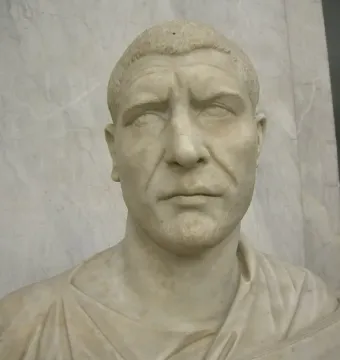
April 2010 © sailko · CC BY-SA 3.0
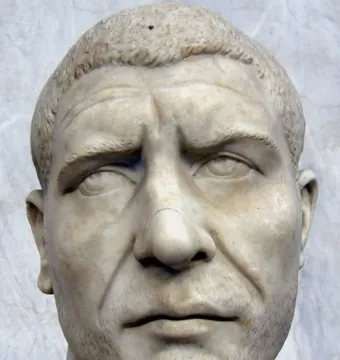
April 2010 © sailko · CC BY-SA 3.0
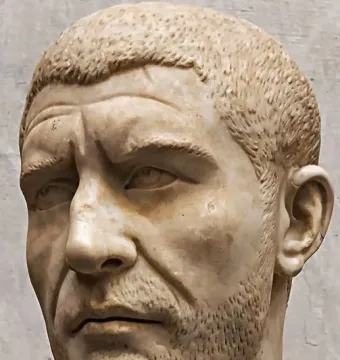
November 2018 © Rabax63 · CC BY-SA 4.0
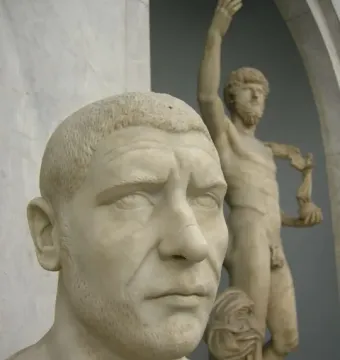
April 2010 © sailko · CC BY-SA 3.0
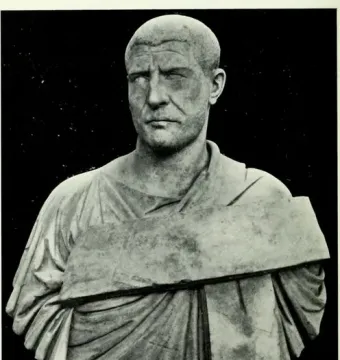
1907 © Internet Archive Book Images · No restrictions
Identification | |
| Subject | Philip the Arab (Philip I the Arab), Roman emperor |
| Rarity | One of the rare Roman portraits depicting Philip the Arab |
| Type | Portrait bust |
Historical context | |
| Date of creation | 245–249 |
| Reign depicted | Philip the Arab reigned from 244 to 249 |
| Origin of subject | Arabia Petraea, a province recently annexed at the time |
Creator | |
| Artist | Anonymous |
Discovery and provenance | |
| Discovery date | 1778 |
| Discovery context | Found during excavations carried out by Nicola La Piccola on the estate of Prince Sigismondo Chigi della Rovere in Castel Porziano |
| Ownership history | Acquired by Robert Fagan in 1798; sold to the Vatican Museums in 1804 |
Materials | |
| Material | Marble |
Physical characteristics | |
| Current collection | Museo Chiaramonti |
| Height | 94.5 cm |
| Height | 0.71 m |
Location and ownership | |
| Display location | Braccio Nuovo |
| Inventory number | MV.2216.0.0 |
Appearance | |
| Portrait style | Strongly characterized portrait head with strong expressionism |
| Facial features | Massive features with deep folds on the cheeks; narrow elongated eyes; large aquiline nose; full lips |
| Hair and beard | Short-cropped hair and closely adhering beard, both indicated by short incisions; hair cap accentuates the volume of the head |
| Costume | Figure wearing a wrapped contabulata toga, typical in the 3rd century for consular rank; richly draped and tightened between two boards, forming a smooth diagonal band across the chest |
Iconography and meaning | |
| Interpretation | The emperor's facial traits were probably perceived as oriental and emphasize his 'barbaric' traits |
| Comparative references | Compared with Maximinus Thrax; later expressiveness is seen in the portraits of Decius and Trebonianus Gallus |
History and restoration | |
| Later reception | In later portraiture, this expressiveness was further accentuated |