
Doctor's Lady
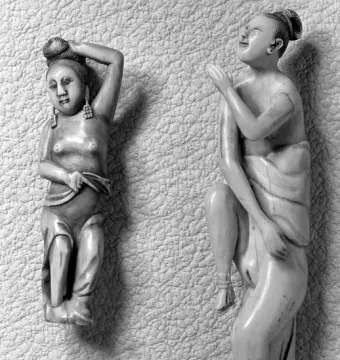
Doctor's lady is a type of pain doll, also called an "Arztweibchen," used by women of the Chinese upper class as a medium to communicate with healers of Traditional Chinese Medicine. Between about 1300 and 1700, during the Ming and early Qing dynasties, women were not allowed by social custom to undress before a doctor, and male healers were not permitted to touch female bodies. A patient would send the doll home, mark the painful area on it, and return it by servant so the doctor could make a remote diagnosis. These figures were carved from materials such as ivory, bone, alabaster, resin, soapstone, amber, and jade, often shown as polished, partly nude women in elegant reclining poses.
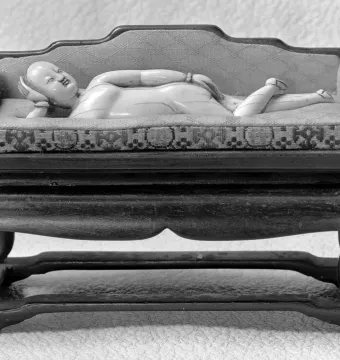
· CC BY 4.0
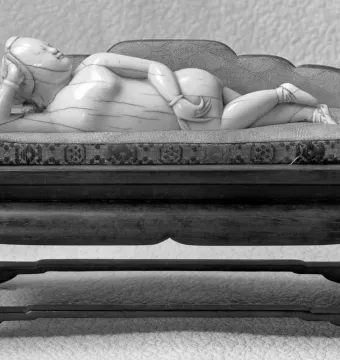
· CC BY 4.0
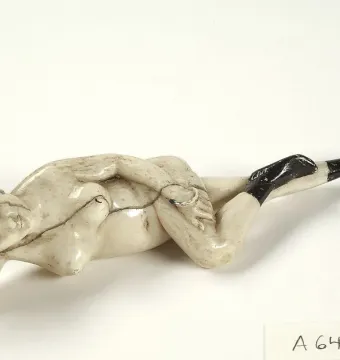
· CC BY 4.0
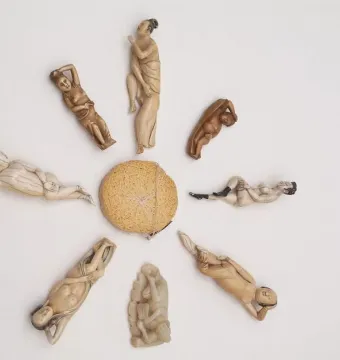
· CC BY 4.0
· CC BY 4.0
Identification | |
| Title | Doctor's lady |
| Object type | sculpture |
| Type | pain doll (Arztweibchen) |
Historical context | |
| Method of use | The patient had the doll brought home, marked the painful body part on it, and sent it back to the doctor via a servant |
| After diagnosis | A messenger returned to the patient with appropriate medicine after the remote diagnosis |
| Anonymity | The method preserved anonymity from the doctor |
| Doctor status in text | Doctors were often described as coming from a potentially low, if not despised, social class |
| Cultural restriction | Chinese women were not allowed by standards of propriety and decency to undress before a doctor, and it was considered unthinkable for traditionally male healers to touch women's bodies |
| Purpose | To communicate pain or symptoms to Traditional Chinese Medicine practitioners when the patient could not or should not undress before a doctor |
| Social context | Used by upper-class Chinese women |
| Period of use | c. 1300–1700, mainly Ming and early Qing dynasty |
Physical characteristics | |
| Length | 10 to 25 cm |
Materials | |
| Materials | Ivory, bone, alabaster, resin, soapstone, and gemstones such as amber or jade |
| Finish | Often polished |
Appearance | |
| Surface decoration | Older ivory examples also show gilding |
| Later examples | Many mostly nude figures from the 19th and 20th centuries show more Western features and more erotic-looking poses |
| Early examples | Early dolls show pronounced Asian facial features |
| Male counterparts | Rare; when present, usually fully clothed |
| Pose | Frequently shown in an elegant reclining pose |
| Accessories | Often equipped with jewelry such as bracelets or earrings |
| Hair style | Carefully worked hair tied in a knot at the nape of the neck |
| Associated furniture | Often placed on separate bed couches, sometimes made of rosewood |
| Clothing | Sometimes nude; often only shoes on bound feet |
History and restoration | |
| Later use | Mostly made for decorative purposes, the tourist souvenir trade, or for ivory collectors |
| Modern fakes | The number of modern forgeries is enormous |
Iconography and meaning | |
| Interpretation | Henri Maspero and Robert van Gulik believed the figures were used as pain dolls in medical diagnosis, while Christine Ruggere questioned the medical use and suggested they represent erotic art; Charlotte Furth found no evidence in traditional Chinese medical texts for such dolls |
Discovery and provenance | |
| Market context | The dolls were offered and sold as curiosities in Chinese treaty ports in the 19th and 20th centuries |
| Related imagery | Their recumbent pose resembled photographs of Chinese prostitutes made in emulation of Édouard Manet's painting Olympia |
| Time period of related imagery | Late Qing period |
Other | |
| Christine Ruggere's position | Curator of the Department of the History of Medicine at the Johns Hopkins School of Medicine in Baltimore |
| Charlotte Furth's position | Professor of Chinese history at the University of Southern California |