
Hermes Criophorus
Hermes Criophorus is a second-century AD marble sculpture depicting the Greek god Hermes as a shepherd and protector of pasture. It is a Roman copy of a Greek original from the fifth century BC. Made of pentelic marble and standing 1.80 m tall, the figure is shown frontally nude in contrapposto, with his weight on his right leg. Hermes wears a chlamys over his left shoulder and a petasos on his head, while grasping a ram by the horns and dragging it upward. Discovered in Troezenia in southern Greece in the late nineteenth century, the sculpture is now in the National Archaeological Museum in Athens.
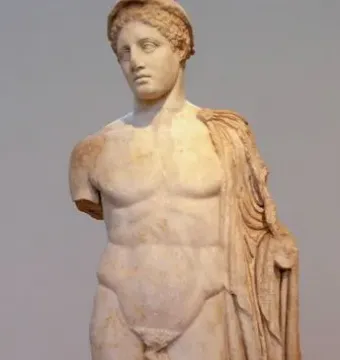
© Copy after Naukydes ? · CC BY-SA 2.5
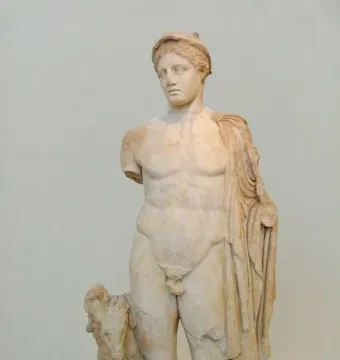
August 2007 © Dorieo · CC BY-SA 4.0
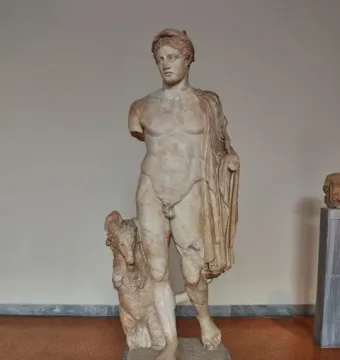
July 2018 © George E. Koronaios · CC BY-SA 4.0
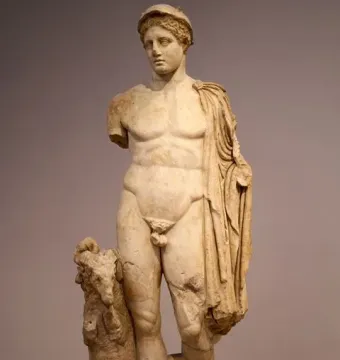
January 2023 © George E. Koronaios · CC BY-SA 4.0
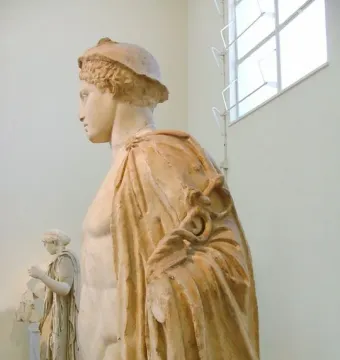
August 2007 © Dorieo · CC BY-SA 4.0
Identification | |
| Type | marble sculpture |
| Title | Hermes Criophorus |
Historical context | |
| Date | 2nd century AD |
| Original Greek prototype date | 5th century BC |
Creator | |
| Attribution of original work | Attributed to Naukydes of Argos |
| Artistic school | School of Polycleitus |
Materials | |
| Material | Pentelic marble |
Physical characteristics | |
| Height | 1.80 m |
| Size relative to life | slightly over life-size |
| Condition | mostly preserved, with some evident damage |
Appearance | |
| Headgear | petasos |
| Clothing | chlamys fastened on the left shoulder, hanging down and covering the left arm |
| Head orientation | turned to the right |
| Depicted figure | Hermes |
| Pose | frontally nude, body slightly turned to the left, in contrapposto, weight on the right leg with the left leg relaxed |
Iconography and meaning | |
| Iconographic role | Hermes as god of pastures and shepherds |
| Distinctive iconography | unlike other ram-bearing sculptures, Hermes drags the animal upward instead of carrying it on his shoulders |
| Missing attribute | caduceus, not preserved |
| Action shown | Hermes drags the ram upward |
| Ram position | crouching on its hind legs at Hermes' right side |
| Attribute held in right hand | a ram by the horns |
Discovery and provenance | |
| Discovery place | Troezen, southern Greece |
| Discovery date | 1890 |
| Discovery context | found during excavations carried out by the French School under Ernest Legrand |
Location and ownership | |
| Current museum | National Archaeological Museum of Athens |
| Current collection | collection of the National Archaeological Museum of Athens |
| Inventory number | 243 |
History and restoration | |
| Missing parts | right arm absent below the shoulder; left hand missing; anterior parts of the arms missing |
| Restorations | feet and parts of the thighs restored with plaster; head reattached to the body |