
Statue of a Ptolemaic King-A 28
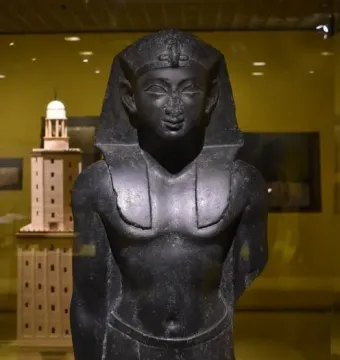
Statue of a ptolemaic king-A 28 is an ancient Egyptian fragmentary statue in black basalt, representing an anonymous young pharaoh of the Ptolemaic dynasty. The figure follows traditional royal Egyptian sculpture conventions, standing still with rigid arms against the hips and the left leg advanced. Several parts are missing, including the legs, the lower skirt, the right hand, part of the left arm, and the nose; the uraeus on the ruler’s forehead is also damaged. Despite the loss, the face remains gentle and the torso athletic but softened in form, suggesting the king’s youth. The sculpture is preserved in the Department of Egyptian Antiquities at the Louvre Museum.
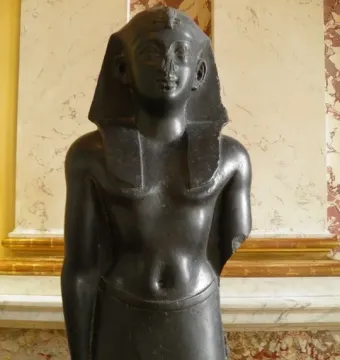
June 2012 © Carole Raddato · CC BY-SA 2.0
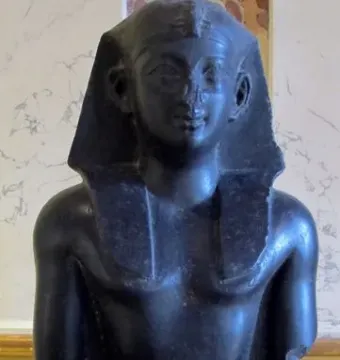
November 2013 © Sailko · CC BY-SA 3.0
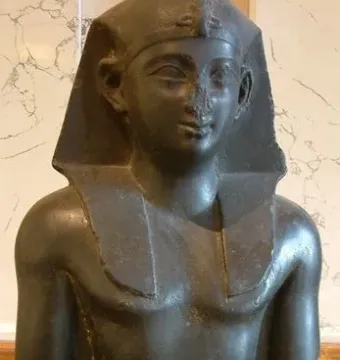
© Aoineko · CC BY-SA 1.0
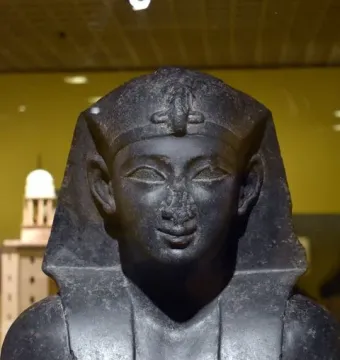
October 2024 · Public domain
October 2024 · Public domain
Identification | |
| Title | Statue of a Ptolemaic king-A 28 |
| Object type | Ancient Egyptian statue fragment (torso) |
Historical context | |
| Dynasty | Ptolemaic dynasty |
| Period | Hellenistic period |
| Date | Stylistic considerations suggest a date after the 3rd century BC, with some features also described as more typical of the 1st century BC |
Creator | |
| Attribution | Anonymous |
Discovery and provenance | |
| Current location | Department of Egyptian Antiquities, Louvre Museum, France |
Physical characteristics | |
| Facial features | Soft face with a small mouth that appears to be smiling or pouting, large asymmetrical ears, large eyes, and well-defined eyebrows |
| Body treatment | Athletic but softer than muscular torso |
| Headgear | Smooth nemes headdress with a royal uraeus |
| Garment | Short kilt |
| Pose | Standing upright and motionless, with the arms held rigidly close to the sides and the left leg advanced |
| Condition | Fragmentary; the lower legs below the kilt, the right hand, half of the left arm, and the nose are missing, and the uraeus on the forehead is worn |
Iconography and meaning | |
| Depicted figure | A Ptolemaic king / pharaoh, shown as a young ruler |
| Interpretation of age | The softened physique suggests the king was young |
| Stylistic tradition | Modeled on traditional ancient Egyptian royal sculpture conventions established in earlier periods |
| Alternative identification | Possibly Ptolemy V, though some stylistic features are also said to fit the reign of Ptolemy VIII |
| Identification note | The youthfulness of the figure supports a possible identification with Ptolemy V, while the small mouth and large eyes are considered more typical of the second half of the 2nd century BC and the reign of Ptolemy VIII (169–116 BC, alternating) |
Other | |
| Comparative examples | The sculpture is compared with later Ptolemaic examples, including colossi of Ptolemy II and Ptolemy XV Caesar, and with images from the Temple of Sobek and Haroeris |