
Holocaust Memorial
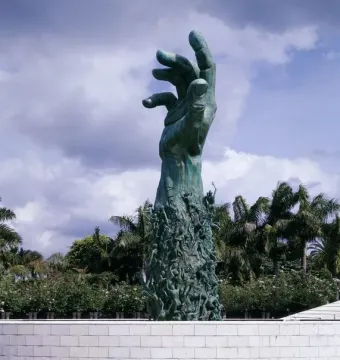
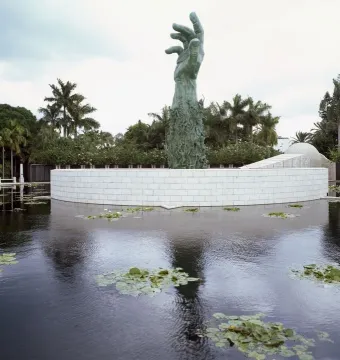
The Holocaust Memorial of the Greater Miami Jewish Federation is a Holocaust memorial located at 1933-1945 Meridian Avenue in Miami Beach, Florida. It was conceived by a committee of Holocaust survivors in 1984 and formally established in 1985 as the Holocaust Memorial Committee, a non-profit organization. Designed by Kenneth Treister, the memorial stands on a site selected by the City of Miami Beach Commission at Meridian Avenue and Dade Boulevard. The memorial was opened on February 4, 1990, with Nobel laureate Elie Wiesel speaking at the dedication ceremonies. Miami attorney and Holocaust survivor Andrew C. Hall serves as chairman.
© Carol M. Highsmith · Public domain
© Carol M. Highsmith · Public domain
© Daniel Di Palma · CC BY-SA 4.0
© Giu.gent93 · CC BY-SA 4.0
© Ricardo Olbera Liriano · CC BY-SA 4.0
© Daniel Di Palma · CC BY-SA 4.0
© Daniel Di Palma · CC BY-SA 4.0
© Daniel Di Palma · CC BY-SA 4.0
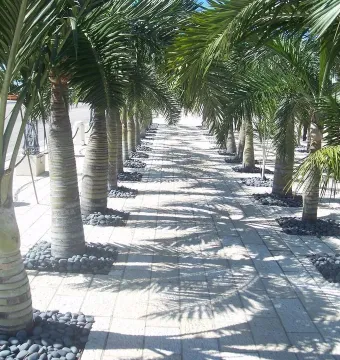
April 2011 © Ebyabe · CC BY-SA 3.0
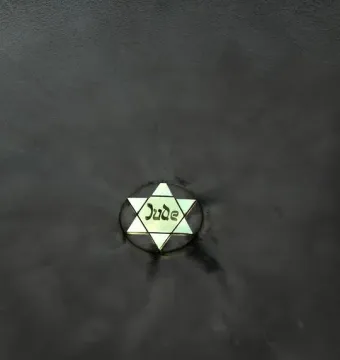
© Daniel Di Palma · CC BY-SA 4.0
Identification | |
| Title | Holocaust Memorial of the Greater Miami Jewish Federation |
| Sculpture title | The Sculpture of Love and Anguish |
| Alternative names | Holocaust memorial of Miami Beach; Holocaust Memorial on Miami Beach |
| Type | Holocaust memorial / monument / memorial |
Historical context | |
| Subject | Victims of the Holocaust (the Shoah); the destruction of millions of Jews during the era of National Socialism in Europe |
| Purpose | To commemorate the Holocaust; memorial to the victims of the Holocaust committed by the Nazis during World War II |
| Reason for creation | Created because this part of Florida is home to the largest community in the United States of Jewish Holocaust survivors |
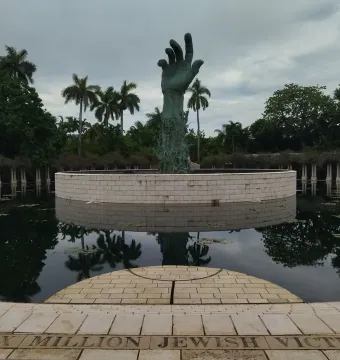
| Address symbolism | The address 1933–1945 is symbolic, corresponding to the years in which Nazism remained in power in Germany |
Creator | |
| Designer | Kenneth Treister |
| Conceived by | A committee of Holocaust survivors |
| Chairman | Andrew C. Hall, Miami attorney and Holocaust survivor |
Discovery and provenance | |
| Proposed installation area | Between Meridian Avenue and Dade Boulevard |
| Site selected by | The City of Miami Beach Commission / the municipality of Miami Beach |
| Commissioned year | 1984 |
| Commissioned by | A committee of Holocaust survivors |
| Organization formed | Holocaust Memorial Committee, a non-profit organization |
| Idea originated | 1984 |
| Formal establishment | 1985 |
Location and ownership | |
| Location | 1933–1945 Meridian Avenue, Miami Beach, Florida, United States; Meridian Avenue and Dade Boulevard, Miami Beach, Florida |
| Address | 1933–1945 Meridian Avenue, Miami Beach, Florida |
| City | Miami Beach |
| State | Florida |
| Country | United States |
History and restoration | |
| Original residents | William and Florrie Loeb and their son Robert |
| Existing trees | Trees in the back of the memorial planted by the original owners in the 1920s and 1930s |
| Origin of original residents | They emigrated from Rotterdam, Netherlands after the bombing and occupation by the Nazis |
| Site history | The site was previously the home of Holocaust survivors William and Florrie Loeb and their son Robert; Florrie sold it to the city of Miami Beach in the early 1970s after the property had been purchased in the 1940s; it had been planned for use as a parking lot |
| Guest speaker at inauguration | Elie Wiesel, Nobel Prize winner; Nobel laureate; Holocaust survivor and Nobel Peace Prize laureate |
| Opened / inaugurated | 4 February 1990 (Sunday) |
| Expansion | An extension of the memorial was opened in March 2026 |
Materials | |
| Primary material | Bronze; Jerusalem stone |
| Additional materials | Pink Jerusalem stone (Meleke); black granite; wood; white bougainvillea |
Technique | |
| Construction | Entirely built in Jerusalem stone |
Appearance | |
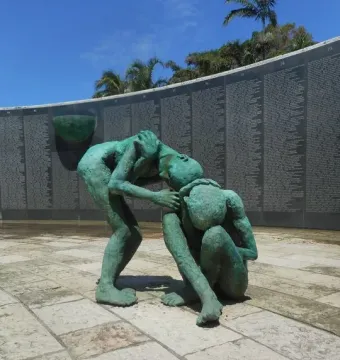
| Associated entrance sculpture | A statue of a grieving mother with two children pressed against her stands at the entrance |
| Opening from tunnel | The tunnel opens onto the water basin with the bronze sculpture and another black granite wall |
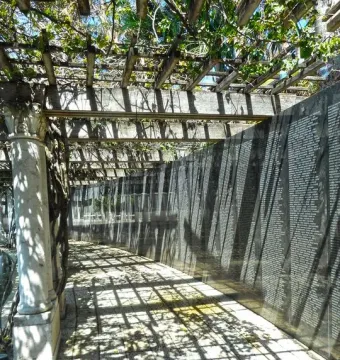
| Tunnel wall inscriptions | The names of Nazi concentration camps are written on the tunnel walls |
| Tunnel | The Dome of Contemplation leads into a narrowing tunnel called The Lonely Path |
| Contemplation space | The colonnade leads into a room called the Dome of Contemplation |
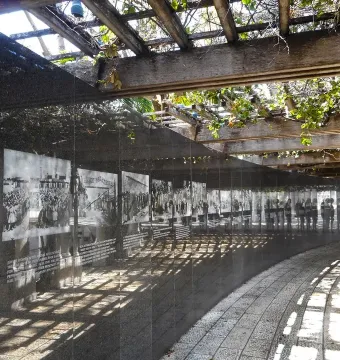
| Roof structure | A passage covered by a wooden framework planted with white bougainvillea |
| Associated colonnade | A semicircular colonnade arbor with columns made of pink Jerusalem stone (Meleke) and a black granite wall |
| Setting within memorial | Stands on a round platform in a water basin |
| Additional marking | Marked with a prisoner number |
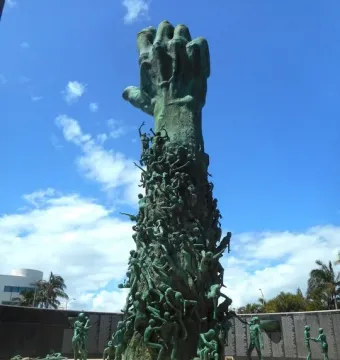
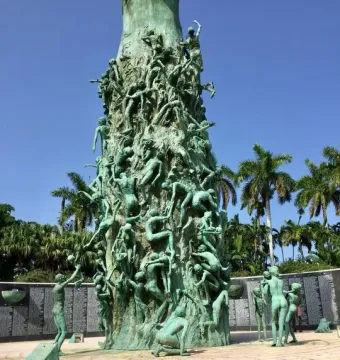
| Forearm composition | Modeled from about 100 people, some standing together in family groups |
| Hand style | Realistically modeled open hand |
| Form depicted | An arm with an open hand |
| Height | 13 meters |
| Description | A 13-meter-high bronze sculpture representing an arm with a realistically modeled open hand |
Iconography and meaning | |
| Wall content | Documentary images and informational texts about the development of the Holocaust, supplemented with original quotations from the Nazi period in Germany |
| Photographic content | Scenes from concentration camps and from liberation by Allied forces |
| Chronological tablets | Three engraved panels listing events in tabular form from Adolf Hitler’s seizure of power in 1933 to his death in 1945 |
| Final wall inscription | The names of Holocaust victims |
| Meaning of address | The street number 1933–1945 corresponds to the years in which Nazism remained in power in Germany |
| Purpose of memorial elements | Memorial to the victims of the Holocaust; commemoration of the Holocaust |
| Depicted person | Elie Wiesel shown as a child in a concentration camp in one of the images |
Significance | |
| Caption author | Historian Helen N. Fagin wrote the introduction and the image captions |
| Designated site by | City of Miami Beach Commission |