
Lobster Telephone
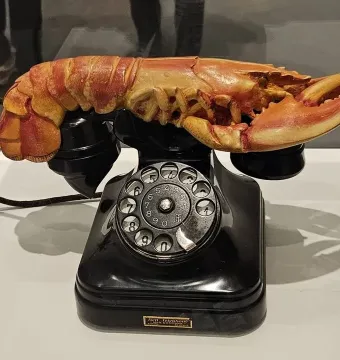
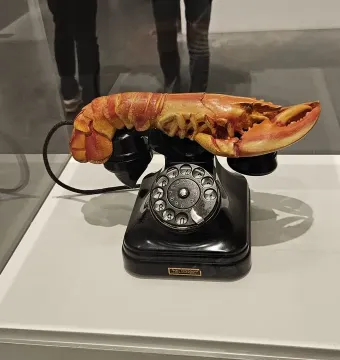
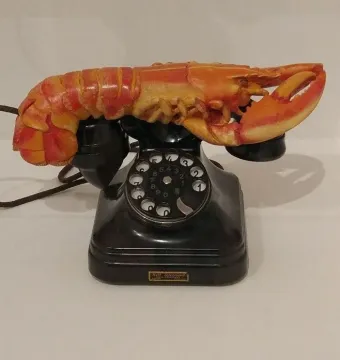
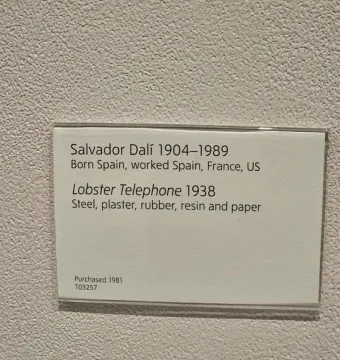
Lobster Telephone is a surrealist object created by Salvador Dalí in 1936 for the English poet and collector Edward James. Also known in English as Aphrodisiac Telephone, it combines a common working telephone with a lobster made of plaster, measuring approximately 15 × 30 × 17 cm. The piece is a classic surrealist object, bringing together unrelated items to create an effect that is both playful and threatening. Dalí linked lobsters and telephones to sexual symbolism and believed such objects could reveal hidden desires of the unconscious. The lobster’s tail is placed directly over the mouthpiece, reinforcing the work’s erotic associations.
December 2025 © GualdimG · CC BY-SA 4.0
December 2025 © GualdimG · CC BY-SA 4.0
August 2018 © Nacaru · CC BY 4.0
December 2025 © GualdimG · CC BY-SA 4.0
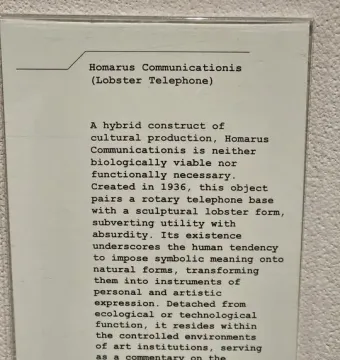
December 2025 © GualdimG · CC BY-SA 4.0
Identification | |
| Title | Lobster Telephone |
| Alternative names | Aphrodisiac Telephone; Teléfono Afrodisíaco; The Aphrodisiac Telephone; The Lobster Telephone |
| Type | Surrealist object; artwork; composite sculpture / surrealist object; sculpture / object; surrealist sculpture / object |
| Art movement | Surrealism; Surrealist |
| Original title | Telefone-lagosta; Teléfono Langosta |
Creator | |
| Artist | Salvador Dalí |
Historical context | |
| Created for | Edward James |
| Series | Paranoia and War |
| Related commission | In 1935, Dalí was commissioned by the magazine American Weekly to execute a series of drawings based on his impressions of New York; in 1935, Dalí was hired to create a commission for American Weekly consisting of a series of drawings of his impressions of New York |
| Relationship to artist | Patron of Dalí during much of his artistic career |
| Commissioned by | Edward James |
| Commissioned for | Edward James (1907–1984), an English poet and one of the main collectors of surrealist art; the poet and surrealist art collector Edward James; Edward James |
| Date created | 1936 |
Discovery and provenance | |
| Number of copies made | Five copies were made; executed in five copies |
| Copy locations | 'Universe of Dalí' exhibition, London; Museum of Communication, Frankfurt am Main; Belongs to the Edward James Foundation; National Gallery of Australia; Liverpool, Tate Gallery; Dalí Universe exhibition in London; Museum of Communication in Frankfurt am Main; owned by the Edward James Foundation; at the National Gallery of Australia; exhibited in Liverpool at Tate Gallery |
| Number of versions | Dalí created several versions of the object; eleven in total |
| Version count by color | Four red and seven white |
| White variants | Six white versions exist |
| White variant locations | Salvador Dalí Museum in St. Petersburg, Florida; Belém Cultural Center in Portugal; collection of Joe Berardo; Johannesburg Art Gallery, South Africa |
| White variant ownership | One white version at the Belene Cultural Center belongs to collector Joe Berardo |
| Inspiration for | the "Lobster Dress" created for Elsa Schiaparelli |
| First exhibited / presented | First London International Surrealist Exhibition, 1936; First London Surrealist Art Exhibition, 1936; International Surrealist Exhibition of 1938 |
Physical characteristics | |
| Dimensions | Approximately 15 × 30 × 17 cm (6 × 12 × 6.6 inches); 17 × 15 × 30 cm; 15 x 30 x 17 cm |
| Functionality | The telephone is fully functional |
Materials | |
| Components | An ordinary working telephone and a lobster |
| Materials | Plaster; a telephone (working, common type); plaster (for the lobster); telephone components are implied by the functional rotary phone; telephone |
| Medium / components | A common working telephone and a lobster made of plaster |
| Main components | A rotary-dial telephone with a plaster lobster placed on top of it, serving as the handset or receiver |
Appearance | |
| Form | A telephone combined with a lobster |
| Concept | An object from nature joined with a human invention; combines an object from living nature with a human invention |
| Placement of lobster on sculpture | The lobster's tail, where its sexual parts are located, is placed directly over the mouthpiece; the crustacean's tail, where its sexual parts are located, is placed directly over the mouthpiece |
| Description | A conjunction of items not normally associated with each other, resulting in something both playful and menacing; a regular telephone with a plaster handset shaped as a lobster imitation |
Technique | |
| Technique / formal idea | Made from 'partial objects' that strive to connect with each other to form a 'desired machine'; made from "partial objects" that seek to unite with one another to form a "desirable machine" |
| Specific intended combination | Created with the specific aim of combining the lobster's 'back part' with the end of the telephone handset; created to combine the lobster's "rear part" with the end of the telephone handset |
Iconography and meaning | |
| Related artwork references | The telephone appears in certain paintings of the late 1930s, such as Mountain Lake (Tate); the telephone appears in some late-1930s paintings, including Mountain Lake (Tate); the lobster appears in drawings and designs, usually associated with erotic pleasure and pain; the lobster appears in drawings and sketches, usually associated with erotic pleasure and pain |
| Related drawing caption | "NEW YORK DREAM - MAN FINDS LOBSTER IN PLACE OF PHONE"; "Dream of New York - Man Finds Lobster in Place of Telephone"; "Dream of New York - A man finds a lobster in the place of a telephone" |
| Related event | For the 1939 New York World's Fair, Dalí created a multimedia experience entitled Dream of Venus; it consisted in part of dressing live nude models in costumes made of fresh seafood; a lobster was used by Dalí to cover the female sexual organs of his models; the Dream of Venus event was photographed by Horst P. Horst and George Platt Lynes; the Dream of Venus, a multimedia experience in which nude models wore clothing made of fresh seafood, and the genitals of female models were covered by a lobster |
| Related publication and illustration | In the 1938 Dictionnaire Abrégé du Surréalisme, Dalí contributed an entry under 'TÉLÉPHONE APHRODISIAQUE'; the entry is accompanied by a small drawing of a telephone with its receiver replaced by a lobster surrounded by flies; Dalí contributed to the 1938 Surrealist Dictionary with an entry called 'Téléphone Aphrodisiaque' accompanied by a small drawing of a telephone with a lobster surrounded by flies as the receiver; a similar drawing is printed in The Secret Life of Salvador Dalí; a drawing of a Lobster Telephone appears in Dalí's autobiography, 'The Secret Life of Salvador Dalí' |
| Interpretation | A parody and joke expressing Dalí's protest against the worship of technology and audio-communication media that separate people from one another; a parody and joke expressing Dalí's protest against worship of technology and audio communication tools that separate people from one another |
| Dalí quote / anecdote | Dalí wrote provocatively that when he ordered a grilled lobster in a restaurant, he never was presented with a boiled telephone; "I do not understand why, when I ask for a grilled lobster in a restaurant, I am never served a cooked telephone; ... telephones, which are habitually so frightfully warm and disagreeably sticky to the touch, are not also put in silver buckets with crushed ice around them"; Dalí also listed imagined variants such as telephone frappé, mint coloured telephone, aphrodisiac telephone, lobster-telephone, telephone sheathed in sable, Edgar Allan Poe telephones with a dead rat concealed within, Boecklin telephones installed inside a cypress tree, telephones on the leash, and telephones screwed to the back of a living turtle |
| Dalí quotation | "The telephone is a means of transmitting news"; "in the future lobsters will replace telephones" |
| Associated themes | Eroticism, dream imagery, food, sex, pleasure, pain, desire, and the unconscious |
| Sexual symbolism | Lobsters and telephones had strong sexual connotations for Dalí |
| Interpretation by Dalí | Dalí believed such objects could reveal the secret desires of the unconscious |
History and restoration | |
| Associated performance at exhibition | During the exhibition's promotional event, Dalí gave a lecture on the influence of the subconscious while wearing a diving suit; during a promotional action for the exhibition, Dalí gave a lecture on the influence of the subconscious while wearing a diving suit |
Significance | |
| Significance | One of the most representative works of the surrealist movement of the 20th century; classic example of surrealism |
Other | |
| Mentioned in | Dalí's 1942 book A Vida Secreta de Salvador Dalí; In his 1942 book The Secret Life of Salvador Dalí, Dalí wrote teasingly that when he asked for a grilled lobster in a restaurant, he was never presented with a boiled telephone; In the 1942 book The Secret Life of Salvador Dalí, Dalí wrote teasingly that when he asked for a grilled lobster in a restaurant, he was never presented with a boiled telephone |