
The Picasso
The Picasso is Pablo Picasso’s untitled monumental sculpture in Daley Plaza in Chicago, Illinois. Installed in 1967, the COR-TEN steel work became the first monumental abstract public artwork in Downtown Chicago and a well-known city landmark. Picasso later said it represented the head of his Afghan Hound Kabul. Publicly accessible, it is known for its jungle gym-like character, and visitors can often be seen climbing on and sliding down its base. The sculpture was commissioned in 1963 for the Chicago Civic Center plaza, with support from several charitable foundations. Picasso completed a maquette in 1965, approved a final model in 1966, and refused payment for the work, making it a gift to the city.
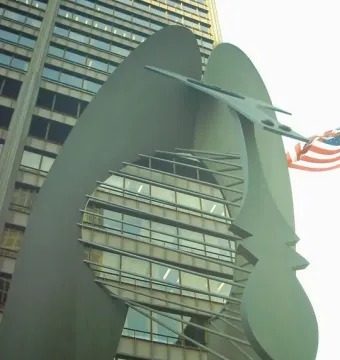
October 2004 © jetzenpolis · CC BY 2.0
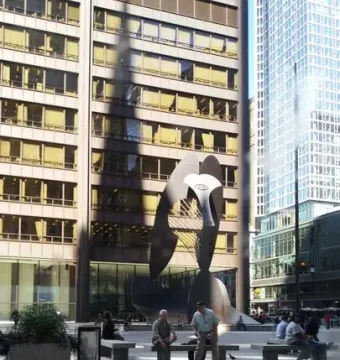
© Gabrieleamalillymera · CC BY-SA 4.0
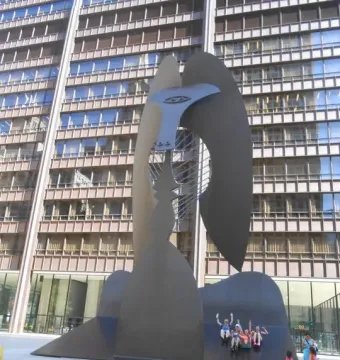
July 2015 © Marlin Keesler · CC BY 2.0
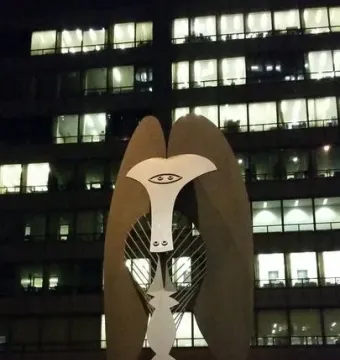
August 2014 © Michel Curi · Public domain
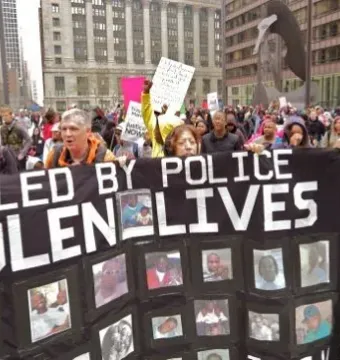
March 2012 © Debra Sweet · CC BY 2.0
Identification | |
| Title | Chicago Picasso |
| Alternative name | El Picasso |
| Type | untitled monumental sculpture |
| Alternative name | The Picasso |
Creator | |
| Facilitated by | Architect William Hartmann of Skidmore, Owings & Merrill (SOM) |
| Final model approved | 1966 |
| Maquette completed | 1965 |
| Artist | Pablo Picasso |
Historical context | |
| Request for the sculpture | Richard Bennett wrote Picasso a poem asking him to make the sculpture |
| Picasso's response | He accepted, saying he never accepted commissions, but in this case he was involved in projects for two great gangster cities, the other being Marseille, France |
| Artist's response to payment | Picasso refused the $100,000 payment and wanted the work to be a gift to the city of Chicago |
| Construction cost | $351,959.17 |
| Construction cost equivalent | About $2.7 million in 2018 or $3.2 million in 2022 |
| Funders | Woods Charitable Fund, the Chauncey and Marion Deering McCormick Foundation, and the Field Foundation of Illinois |
| Final site approval date | May 25, 1967 |
| Commission year | 1963 |
| Commissioned by | Richard Bennett, an architect working on the Richard J. Daley Center project |
Discovery and provenance | |
| Fabrication sequence | Fabricated in Gary, Indiana, then dismantled and relocated to Chicago |
| Wooden approval model | A 3.5-meter-tall wooden model was built for Picasso's approval and later sent to the Gary Career Center |
| Steel source | USS Gary Works 160/210-inch plate mill |
| Fabrication location | Gary, Indiana, United States |
| Fabricated by | American Bridge Company, a division of the United States Steel Corporation |
Physical characteristics | |
| Height | 15 meters |
| Weight | 147 tons |
Materials | |
| Material | COR-TEN steel |
Appearance | |
| Style | Cubist |
| Notable characteristics | Inviting, jungle gym-like qualities |
| Viewpoint-dependent appearance | Picasso liked how the figure changed when viewed from different angles |
Iconography and meaning | |
| Alternative explanation | An abstract replica of an Afghan hound |
| Artistic relationship | There is a continuous dialogue between Picasso's sculpture and his painting |
| Broader artistic context | Part of Picasso's lifelong inspiration from Africa |
| Representation according to Picasso | The head of his Afghan Hound Kabul |
| Alternative explanation | A male baboon seen from the front |
| Possible inspiration | Sylvette David (later Lydia Corbett), whom Picasso met and portrayed in 1954; she was 19, living in Vallauris, France, and noted for her high ponytail and long neck |
| Possible inspiration | Jacqueline Picasso; historian Patricia Stratton made a convincing case that she was the model for the sculpture |
Location and ownership | |
| Location | Daley Plaza, Chicago, Illinois, United States |
| Civic area | Chicago Loop |
| Nearby landmark | Immediately near Chicago City Hall and directly across from the Richard J. Daley Center |
| Public access | Publicly accessible |
| Public use | A well-known meeting place and a structure visitors often climb on, hang from like monkey bars, and slide down |
| Associated events | Music performances, farmers' markets, a Christkindlmarkt, and other seasonal events are held around it on Daley Plaza |
| Related building | Richard J. Daley Center, formerly called the Chicago Civic Center until 1976, is clad in COR-TEN steel |
History and restoration | |
| Publicity stunt | Algis Budrys erected a giant pickle at the proposed site for Pickle Packers International |
| Court ruling | The judge ruled that the city's actions dedicated the sculpture to the public domain |
| Legal significance | These publicity efforts were cited in a 1970 U.S. District Court case |
| Publicity efforts | The City of Chicago staged press events before completion and displayed the maquette without a copyright notice |
| Initial reception | Controversial |
| Replacement proposal | John Hoellen, a Chicago City Council alderman, proposed replacing it with a statue of Ernie Banks |
| Previous public sculpture tradition | Chicago's public sculptures were mainly of historical figures before this work |
| Installation year | 1967 |
| Dedication date | August 15, 1967 |
Significance | |
| Status | First monumental abstract public artwork in downtown Chicago |
| Status | A well-known landmark |
| Interpretive note | Its 1967 installation, according to Ruth Lopez in The Art Newspaper, helped shift civic and urban planning aesthetics by broadening the idea of public art beyond the commemorative |
| Influence on other artists | Alexander Calder, Marc Chagall, Joan Miró, Claes Oldenburg, and Henry Moore were inspired by the sculpture |
Other | |
| Film appearances | The Blues Brothers (1980), The Fugitive (1993), Ferris Bueller's Day Off (1986), and Interferences (1988) |
| Notable 1968 event | A press conference on August 23, 1968, where Jerry Rubin, Phil Ochs, and others nominated Pigasus for President of the United States; it took place just before the opening of the 1968 Democratic National Convention |