
Bassae Frieze
The Bassae Frieze is a high relief marble sculpture made of 23 panels, measuring 31 m long and 0.63 m high. It was created to decorate the interior of the cella of the Temple of Apollo Epikourios at Bassae and depicts scenes of Greeks fighting centaurs and Amazons. Likely carved around 400 BC, it belongs to the High Classical period. The frieze was discovered in 1811 and excavated the following year, though the original sequence of its blocks remains controversial. Most of the sculpture is now in the British Museum, where it is displayed in Gallery 16, with eight fragments in the National Museum, Athens.
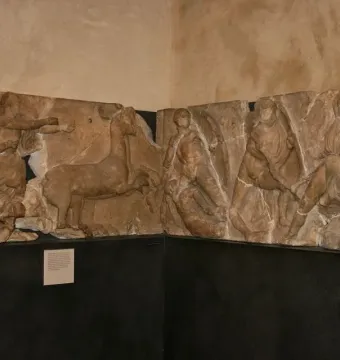
June 2010 © Mike Peel · CC BY-SA 4.0
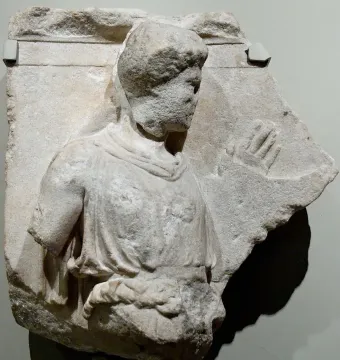
© Unknown artistUnknown artist · Public domain
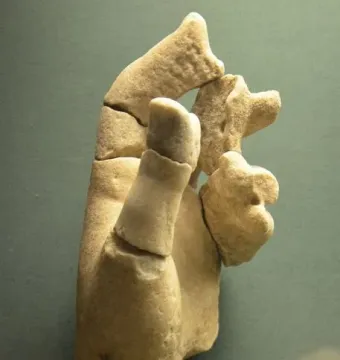
May 2014 © Carole Raddato · CC BY-SA 2.0
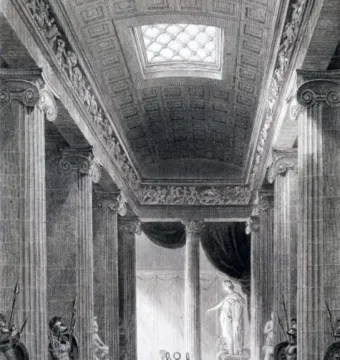
© C. Cockerell · Public domain
May 2014 © Carole Raddato · CC BY-SA 2.0
Identification | |
| Title | Bassae Frieze |
| Original title | Frise du temple de Bassæ |
| Related artist and recreation | John Henning created a one-twentieth-scale model of the Bassae Frieze over twelve years and used it, with his son, to install recreations of the Bassae Frieze and Parthenon Frieze on other buildings |
| Type | Ionic frieze |
Physical characteristics | |
| Form | High-relief marble frieze |
| Material | Marble |
| Number of slabs | 23 |
| Technique | Carved slabs with surviving sections of relief and some attached bronze elements such as weapons and a club |
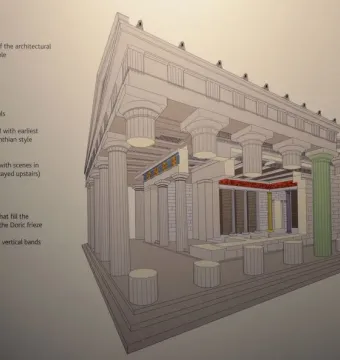
| Original placement | Inside the cella of the Temple of Apollo at Bassae, about seven metres above the floor near the ceiling |
| Length | 31 m |
| Height | 0.63 m |
Historical context | |
| Temple dedication | Dedicated by the Phigalians to Apollo Epikourios (Apollo Epicurius), according to Pausanias, in thanks for deliverance from the plague of 429 BC |
| Temple site history | The site had been in continuous use since the Archaic period; the surviving temple is the last of four on the site, designated Apollo IV |
| Date | Around 400 BC |
| Period | High Classical period |
Creator | |
| Authorship | Unknown; attribution to Paionios has been rejected |
| Proposed attribution | Cooper identifies the artists as a group of three anonymous masters |
Discovery and provenance | |
| Publication | Formally published in 1892 in Arthur Smith's catalogue of the British Museum's holdings |
| Auction purchasers | James Linkh, Thomas Legh, Karl Haller von Hallerstein, George Christian Gropius, John Foster, and Charles Robert Cockerell |
| Removal | The 23 slabs were removed in 1812 and transported to Zante |
| Acquisition by British Museum | Purchased at auction in 1815 |
| Findspot documentation | Early archaeologists did not record the block findspots |
| Findspot | The paved floor of the cella, buried under collapsed temple debris; exact findspots were not recorded |
| Excavated by | An expedition of the Society of Travellers led by Karl Haller von Hallerstein and Otto von Stackelberg |
| Excavation date | 1812 |
| Discovered by | Karl Haller von Hallerstein and Charles Cockerell |
| Discovery date | 1811 |
Appearance | |
| Composition by side | The Centauromachy occupies seven slabs on the east side and four on the north side; the Amazonomachy episodes run from the northwest corner around the west and south sides to the east side |
| Stylistic features | Continuous narrative across all sides rather than separate scenes by side; the north and south sides are compositionally adapted to the architecture, with centrifugal movement on the north side and axial symmetry on the south side |
| Related sculptural programme | Part of the temple's larger sculptural programme, including the metopes of an external Doric frieze and an over-life-size statue |
| Reconstruction | The sequence is based on internal evidence from the surviving slabs, but the ordering remains controversial |
| Reconstruction basis | Cooper and Madigan's reconstruction |
| Episode distribution | 11 slabs show Greeks fighting centaurs and 12 slabs show Greeks fighting Amazons |
| Subjects depicted | Greeks fighting centaurs and Amazons |
| Frieze arrangement | A continuous narrative frieze around the interior of the cella/naos, with a single clear break at the northwest corner |
| Narrative episodes | Amazonomachy of Penthesilea, Amazonomachy of Heracles, and Centauromachy |
Iconography and meaning | |
| Trojan Amazonomachy | Amazons under Penthesilea attack Troy; Achilles kills Penthesilea on BM 537, and BM 539 shows a truce and the clearing of the battlefield |
| Heraklean Amazonomachy | Heracles and the Greeks fight the Amazons in his attempt to seize Hippolyte's belt; BM 535 shows the final capture of the last Amazon |
| Centauromachy | A battle between Lapiths and Centaurs |
| Centauromachy interpretation | The imagery includes elements more typical of the wedding-feast brawl of Peirithoos, possibly to unify the subject with the other frieze scenes and adapt it to the sanctuary's deities |
| Apollo and Artemis | Apollo and Artemis intervene directly in BM 523 |
Location and ownership | |
| Copies | Copies decorate the walls of the Ashmolean Museum and London's Travellers Club |
| Other fragments | Eight fragments believed to belong to the frieze are in the National Museum, Athens |
| Current location | British Museum |
| Current display | On permanent display in a specially constructed room in Gallery 16 |
History and restoration | |
| Early site work | The excavation team cleaned the site to uncover the sculptures |
| Documentation | Haller recorded the 1812 dig in his field notebook; two copies survive and preserve the only surviving details of the intact site and finds |
| Lost documentation | Drawings made in 1811 were lost at sea |
| Display reconstruction | The British Museum arrangement follows Peter Corbett's proposal and is shown at an easily viewable height in a room built to the same size as the temple's main chamber |
| Arrangement disputes | The sequence and even the wall placement of some blocks remain disputed; proposals by W.B. Dinsmoor and Haller are among the alternatives |
Significance | |
| Architectural significance | A strikingly unusual example of its period, departing from Doric and Ionic norms; possibly one of the earliest uses of the Corinthian order and the first temple to have a continuous interior frieze around the naos |