
Peace Monument
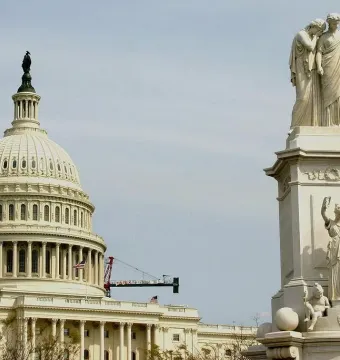
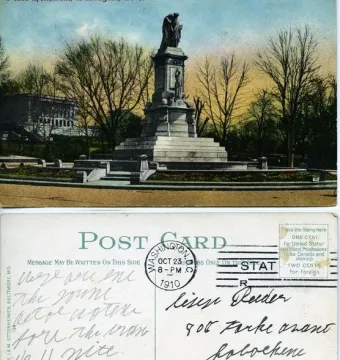
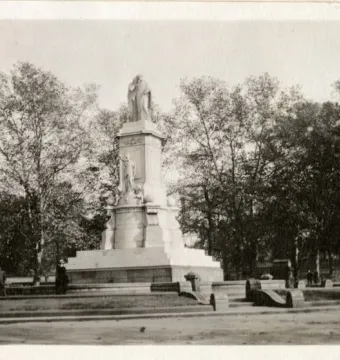
Peace Monument is a 13.4-meter-high white marble memorial standing at the U.S. Capitol in the Peace Circle in Washington, D.C. It was erected in 1877/1878 to commemorate members of the Navy who died in the Civil War. The sculpture features allegorical classical figures, including Mourning, History, Victory, Peace, and symbols of war, peace, science, literature, art, and industry. The monument also includes a fountain and a dedication inscription honoring officers, sailors, and Marines who fell in defense of the Union and their country’s freedom, 1861–1865. Designed by Admiral David Dixon Porter and executed by sculptor Franklin Simmons, it is now part of a three-part monument group with the James A. Garfield Monument and the Ulysses S. Grant Memorial.
November 2011 © Jamieadams99 · CC BY-SA 3.0
© David · CC BY 2.0
June 2012 © rich701 · CC BY 2.0
July 2010 © Smithsonian Institution · No restrictions
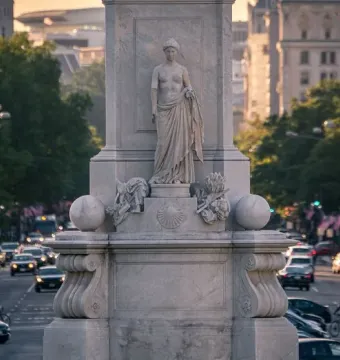
September 2019 © John Brighenti · CC BY 2.0
Identification | |
| Title | Peace Monument |
| Alternative names | Friedensdenkmal; Monumento alla Pace; Naval Monument; Civil War Sailors Monument; Monument to Peace; Navy-Peace Monument; Monument to the sailors of the Civil War |
Location and ownership | |
| Part of ensemble | Part of a three-monument ensemble with the James A. Garfield Monument and the Ulysses S. Grant Memorial |
| Inscription | 'In memory of the officers, seamen, and marines of the United States Navy who fell in defense of the Union and the freedom of their country, 1861–1865' |
| Orientation | Faces west toward the National Mall; the east side faces the United States Capitol |
| Setting | At the intersection of First Street NW and Pennsylvania Avenue NW, in Union Square |
| Location | Peace Circle on the grounds of the United States Capitol, Washington, D.C., United States |
Historical context | |
| Commemorates | Union Navy officers, seamen, and marines who died in the American Civil War |
| Purpose | Created after the Civil War to honor naval deaths in defense of the Union |
| Initial intended location | Annapolis, Maryland |
| Reason for change of location | Porter's relationship with Secretary of the Navy Gideon Welles made Annapolis unacceptable; Congress placed it near the U.S. Capitol instead |
| Significance | Contributing property to the National Mall Historic District, Pennsylvania Avenue National Historic Site, the Civil War Monuments in Washington, D.C. group, and the L'Enfant Plan; also listed in the District of Columbia Inventory of Historic Sites |
Creator | |
| Architectural parts maker | Bonanni brothers of Carrara |
| Pedestal designer | Edward Clark, Architect of the Capitol |
| Porter's role | Commanded fleets of gunboats and troop transports during the war |
| Commissioned by | Admiral David Dixon Porter |
| Conceptual designer | Admiral David Dixon Porter |
| Sculptor's residence at commission time | Rome, Italy (since 1868) |
| Sculptor's reputation | Known for portrait busts |
| Sculptor's birthplace | Maine, United States |
| Sculptor | Franklin Simmons |
Discovery and provenance | |
| Fundraising | Private fundraising began in 1865; Porter raised $9,000 from naval personnel and private citizens |
| Commission date | 1871 |
| Congressional approval | In 1872 Congress approved the monument and allocated $20,000 for the base |
| Congressional authorization date | July 31, 1876 |
| Shipping of components | Marble pieces began arriving in Washington in 1876 and were shipped in 1877, including by the boat Supply |
| Installation date | Most pieces were installed in 1877; the final figure, Peace, was added in January 1878 |
History and restoration | |
| Later public use | Flowers and flags were left there after the death of Capitol Police officer Brian Sicknick |
| Vandalism and protest history | Used as a gathering point during protests and rallies, including protests against the Vietnam War, the Three Mile Island accident, and the murder of George Floyd; rioters gathered there before the January 6, 2021 Capitol attack |
| Condition at transfer | By 1973 it needed major repair and cleaning; pieces were missing and the marble was covered with lichen and grime |
| Restoration history | Cleaned and restored several times, including repairs in 1990 and cleaning in 1991, 1999, and 2010 |
| Ownership | Transferred to the Architect of the Capitol in 1973 |
| Reason for unfinished state | Probably lack of funding, though interference by Gideon Welles was also suggested |
| Dedication | No formal dedication ceremony was held |
| Unfinished elements | Planned decorative lampposts and water features were never completed, leaving the monument unfinished |
Physical characteristics | |
| Height | 44 feet (13.4 meters) |
| Type | Monument; memorial |
Materials | |
| Main material | Carrara marble; white marble |
| Base material | Blue granite from Maine |
| Sculptural technique | Carved from Carrara marble in Rome |
Appearance | |
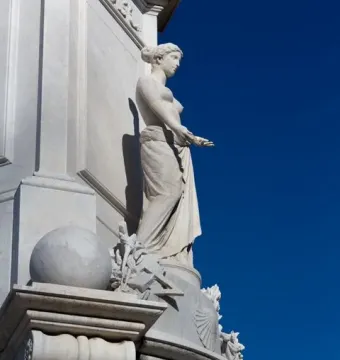
| Capitol-facing figure | Goddess Peace holding an olive branch |
| Fountain | Water ran through pipes on each side into a quatrefoil-shaped basin; the sub-base includes bronze dolphins and the rim had decorative lamp posts |
| Corner elements | Four marble spheres visually supported by massive brackets |
| Shaft decoration | Garlands, ribbons, and scallop shells |
| Middle figure | Victory, a classical female figure holding up a laurel wreath and carrying an oak branch |
| Lower figures | Child Mars, god of war, and child Neptune, god of the sea |
| Mourning | Leans on History's shoulder with her face covered by her hand and weeps |
| Top figures | Two classical female figures representing Mourning and History (also described as the personification of the United States and History) |
| Style | Idealized neoclassical sculpture |
| History | Holds a pen or stylus and a tablet inscribed 'They died that their country might live.' |
Iconography and meaning | |
| Oak branch meaning | Strength or severity |
| Symbols below Peace | Symbols of peace and industry |
| Opposite-side symbols | Symbols of science, literature, and art, including a compass, book, gear, square, and dividers; they signify that peace made the progress of civilization possible |
| Missing element | A dove, once shown with a sheaf of wheat, cornucopia, sickle, and sword, is now missing and not documented in any known photograph |