
Vercingetorix Monument
The Vercingetorix Monument is a statuary monument dedicated to the Gaulish chieftain Vercingetorix, who was defeated by Julius Caesar in the Gallic Wars. Designed by Aimé Millet and commissioned by Emperor Napoleon III, it was installed in 1865 on Mont Auxois near Alise-Sainte-Reine in the Côte-d'Or department of Burgundy, eastern France. The site was believed to be ancient Alesia. The memorial’s architect was Eugène Viollet-le-Duc, who also added the nationalistic inscription on the base, translating Caesar’s words about Gaul united. The monument is designated as a monument historique.
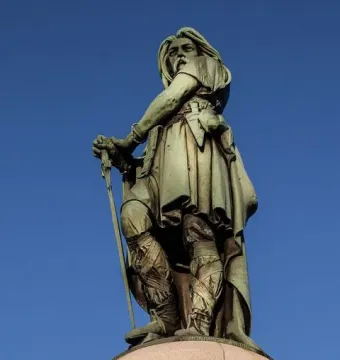
July 2016 © Claire Jachymiak · CC BY-SA 4.0
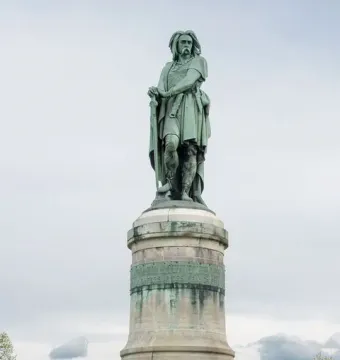
April 2014 © Myrabella · CC BY-SA 4.0
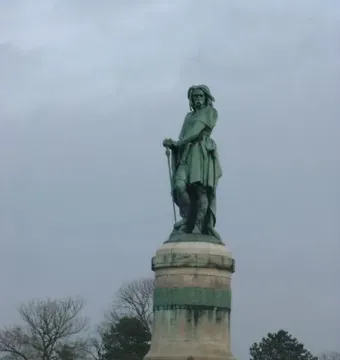
© Ascia · CC BY-SA 3.0
June 2013 © Tdahweb · CC BY-SA 3.0
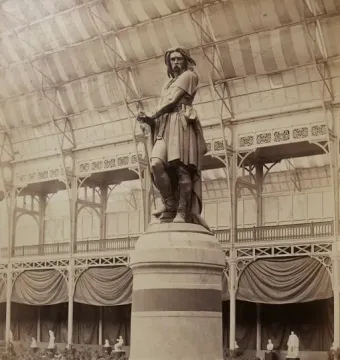
1865 © Charles Marville · Public domain
Identification | |
| Title | Vercingetorix Monument |
| Subject | Vercingetorix, the Gaulish chieftain defeated by Julius Caesar in the Gallic Wars |
| Original title | Monument à Vercingétorix |
| Type | Statuary monument |
Creator | |
| Architect / memorial designer | Eugène Viollet-le-Duc |
| Sculptor | Aimé Millet |
Historical context | |
| Commissioned by | Emperor Napoleon III |
| Date | 1865 |
| Context | Created in the context of Napoleonic interest in Gallic history and later strengthened as a national heroic symbol after the defeat of 1871 |
Discovery and provenance | |
| Installed on | 27 August 1865 |
| Exhibited at | Palais de l'Industrie during the 1865 Salon |
| Place made | Paris |
Location and ownership | |
| Site | Top of Mont Auxois, on the site of the Gallic oppidum of Alesia |
| Site significance | The supposed site of Alesia, famous for the siege and defeat of Vercingetorix |
| Position | Western end of Mont Auxois, overlooking the archaeological battlefield site of Alésia |
| Designation | Historic monument |
| Current location | Mont Auxois, near Alise-Sainte-Reine, Côte-d'Or, Burgundy-Franche-Comté, France |
Physical characteristics | |
| Pedestal height | 7 m |
| Height | 6.60 m |
| Weight | About five tonnes |
| Form | Hollow statue made of hammered and repoussé copper sheets fixed to a beam framework |
Materials | |
| Pedestal material | Saulieu granite and Pouillenay stone |
| Statue material | Copper |
Appearance | |
| Style | Romantic style |
| Depiction | An archetype of the Gauls as imagined by 19th-century French people |
| Facial features | Drooping moustache, long shaggy hair, mournful expression |
| Accessories | Pearl necklace; bands around the breeches; sword and cuirass |
| Anachronisms | The pearl necklace is pure fantasy; the bands around the breeches belong to the Early Middle Ages; the sword and cuirass are copied from Bronze Age models more than 500 years earlier than Vercingetorix's time |
| Intended viewing distance | Designed to be seen from far away |
Iconography and meaning | |
| Lower inscription | Napoleon III, emperor of the French, to the memory of Vercingetorix |
| Inscription note | The wording introduces the 19th-century vocabulary of the nation, which is not present in the original phrase |
| Inscription source | Inspired by a speech attributed to Vercingetorix in Julius Caesar's De Bello Gallico, VII, 29 |
| Inscription translation | Gaul united, forming a single nation, animated by a common spirit, can defy the universe. |
| Inscription on pedestal | La Gaule unie / Formant une seule nation / Animée d'un même esprit, / Peut défier l'Univers. |
History and restoration | |
| Classification date | 17 January 2014 |
Significance | |
| Reception | Criticized by Charles Lecomte de Nouy and Théophile Thoré; defended by Théophile Gautier |
| Historical significance | After the defeat of 1871, Vercingetorix became an icon of the national hero and the monument gained symbolic force in anti-German revanche sentiment |
Other | |
| Associated comparison | Built like the Statue of Liberty in New York |
| Related monuments | Another monument was made by François Mouly in Gien in 1887, and an equestrian statue by Frédéric-Auguste Bartholdi was made in Clermont-Ferrand in 1903 |
| Political context | The monument reflected Napoleon III's political aspirations and his interest in the history of the Gauls; a rumor that it was financed from his personal funds is false |