
Muisca Raft
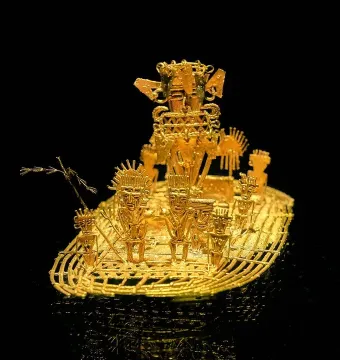
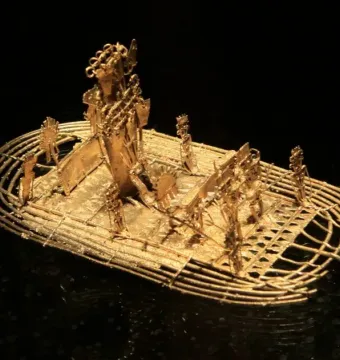
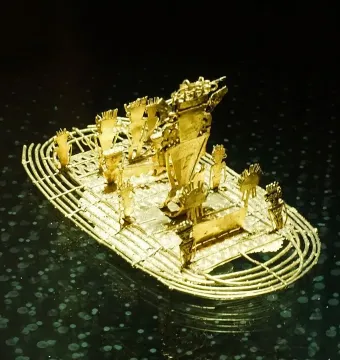
The Muisca raft, also known as the Balsa Muisca or the Golden Raft of El Dorado, is a pre-Columbian votive piece made by the Muisca of Colombia. Created between 1295 and 1410 AD using lost-wax casting in an alloy of gold, silver, and copper, it was found as part of an offering placed in a cave in Pasca. Some scholars believe it depicts the gold offering ceremony associated with the legend of El Dorado at Lake Guatavita, though others see it as a more general reference to Muisca ritual practice. Discovered in 1969, it has become a national emblem of Colombia and is exhibited at the Gold Museum in Bogotá.
August 2017 © Pedro Szekely · CC BY-SA 2.0
December 2008 © S23678 · CC BY-SA 3.0
May 2020 © Sebastián Arena · CC BY-SA 4.0
March 2018 © Mariordo (Mario Roberto Durán Ortiz) · CC BY-SA 4.0
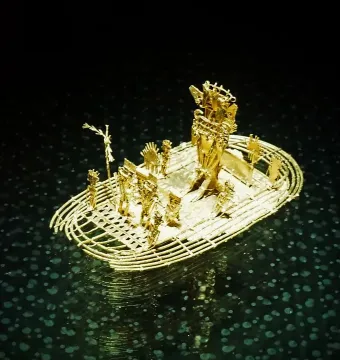
March 2018 © Mariordo (Mario Roberto Durán Ortiz) · CC BY-SA 4.0
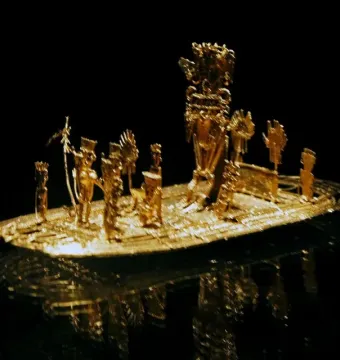
April 2012 © Mariordo (Mario Roberto Durán Ortiz) · CC BY-SA 3.0
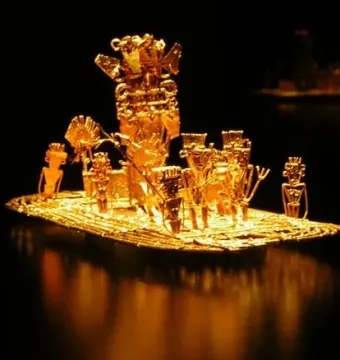
January 2006 © Andrew Bertram · CC BY-SA 1.0
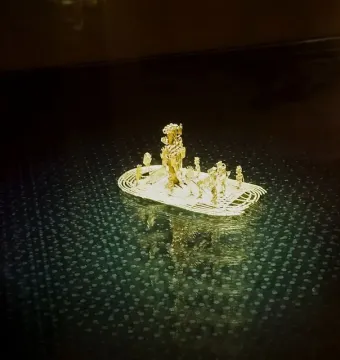
March 2018 © Mariordo (Mario Roberto Durán Ortiz) · CC BY-SA 4.0
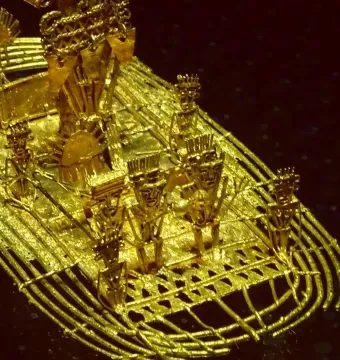
October 2016 © Tisquesusa · CC BY 4.0
June 2015 © Universalis · CC BY-SA 4.0
Identification | |
| Title | Muisca raft |
| Associated people | An Andean people of Colombia; the Muisca people |
| Associated region | Eastern Ranges of the Colombian Andes; region that currently corresponds to central Colombia; the Eastern Andes, near modern-day Bogotá, Tunja, and Lake Guatavita |
| Alternative names | Balsa Muisca; Golden Raft of El Dorado; Pasca raft; Muisca raft or golden raft; Gold raft of Eldorado; Gold raft of Pasca; Chibcha |
| Type | Pre-Columbian votive piece; Pre-Columbian votive goldwork piece; votive offering sculpture / artifact; Pre-Columbian votive artwork; votive offering; Small votive offering; Gold artifact |
| Culture | Muisca; Muisca (also known as Chibcha) |
Historical context | |
| Historical context | Created within the context of the emerging Muisca chiefdom of Pasca; The Pasca chiefdom was emerging due to its participation in trade networks and its proximity to non-Muisca groups and powerful musical chiefdoms |
| Historical period | Between 600 and 1600 CE; During the emergence of the Pasca chiefdom |
| Date of creation | Between 1295 and 1410 AD; Made between approximately 1200 and 1400 AD; between 1295 and 1410 |
| Historical significance | Considered to be the origin of the legend of El Dorado; Since its discovery in 1969, it has become a national emblem for Colombia |
Creator | |
| Possible commissioner | Most likely a votive offering commissioned by the chief of Pasca; Probably commissioned by the ruler of the Pasca chiefdom (or uzaque) described by the Spanish colonial chronicler Pedro Simon |
Discovery and provenance | |
| Related find context | Found together with another object representing a ruler seated on his litter |
| Never left country | The piece has never left Colombia since then |
| Protection and acquisition | Parish priest Jaime Hincapié, who protected the piece from being sold or melted down until it was acquired by the Museo del Oro; Father Santamaría arranged for the object to be acquired by the Bank of the Republic |
| Current location | Gold Museum in Bogotá; Gold Museum of Bogotá; Gold Museum, where it remains |
| Current ownership/location | Acquired by the Museo del Oro |
| Placement context | Part of an offering placed in a cave in the municipality of Pasca |
| Container found in | A ceramic vessel |
| Found by | Farmers; Found in 1969 by a peasant from Pasca named Cruz María Dimaté |
| Discovery date | 1969; Early 1969 |
| Discovery location | Altiplano Cundiboyacense, in the area of the former chiefdom of Pasca of the Muisca, Colombia; A cave in the vereda Lázaro Fonte, municipality of Pasca, Cundinamarca, Colombia |
| Place of manufacture | Altiplano Cundiboyacense, in the area of the former chiefdom of Pasca of the Muisca, Colombia |
| Associated finds | Several pieces of gold and ceramics were found in a cave |
Physical characteristics | |
| Central figure adornments | Three pendants, two ear pendants, and three other trapezoidal adornments around the body |
| Figures' attributes | The figures carry various fruits and stylized headdresses |
| Central figure posture | Naked, seated, arms folded over the chest in a W pattern, leaning backward |
| Central figure seat | Seated on a duho (small chair with a high backrest); Seated on a throne |
| Large front figures | Each wears a headdress with eleven feathers, carries a maraca (rattle), wears an animal-head-shaped mask, and carries a trident next to the waist |
| Central figure jewelry | Large rectangular nose pendant with bird heads and trapezoidal decorations; also a headdress and possibly a crown |
| Central figure surroundings | Surrounded by banners and feather-like projections |
| Grouping of surrounding figures | Two larger standing figures at the front and center; two medium-sized seated figures around them; six smaller standing figures around the perimeter |
| Medium-sized figures | Each wears a coiled headdress possibly representing fabric and carries a poporo |
| Smallest figures | Each wears a headdress and carries a small stick |
| Decorations on central figure | Headdresses, nose ornaments, and ear spools |
| Height of central figure | 10.2 cm |
| Figures depicted | eleven human figures |
| Support structure | Triangle-patterned central support structure with wire coils around the perimeter |
| Width | Not specified in the fragment |
| Base shape | Log boat form |
| Form | an oval reed raft |
| Figure style | No figures-in-the-round; each figure is cast as a flat plaque |
| Dimensions of base | 19.5 x 10.1 cm |
| Length | 18 cm; Not specified in the fragment |
| Shape | Oval-shaped reed raft |
| Height | Not specified in the fragment |
| Figures on the raft | Several figures standing on the raft |
| Central figure | Apparently represents the cacique; a large seated figure representing the chief or cacique; a large central chief; One person stands above the others |
| Surrounding figures | The cacique is surrounded by soldiers carrying standards; Ten smaller figures representing attendants and oarsmen, some wearing masks |
| Other figures | ten smaller figures interpreted as attendants and rowers |
| Number of human figures | Eleven |
Materials | |
| Materials | Alloy of gold with silver and copper; Gold with a small amount of copper; Gold alloy (80% gold), silver, and copper; alloy of gold, silver, and copper; Gold |
| Alloy used | Tumbaga, a gold alloy containing as much as 70% copper; tumbaga (an alloy of gold and copper with added silver) |
Technique | |
| Technique | Lost-wax casting; Made by the Muisca using the lost-wax casting method |
| Goldworking technique | Lost-wax casting |
| Manufacturing method | Created in a single pour of gold; no visible joints anywhere on the raft; cast from a model using lost-wax or similar casting in a single pour; no joins were found |
| Production process | Likely required hundreds of hours of work by a single craftsperson |
| Dating method | Radiocarbon dating of charcoal remains left on the raft from the casting mold; Radiocarbon dating of charcoal remnants on the casting mould yielded 1295–1410 AD for the raft's construction |
| Scientific analysis | X-ray fluorescence identified the chemical signature of the gold used in the raft; Microscopic analysis: no connections/joints were detected; the object and each decorative detail were made from one single casting of gold |
Appearance | |
| Comparison | The piece is crude in appearance compared with Muisca jewelry |
| Surface texture | rough surface compared with the polished gold of other pre-Columbian peoples |
| Surface finish | Unpolished and crude in comparison to Muisca jewelry |
| Surface characteristics | Rough surfaces, in contrast to the polished gold in surrounding regions |
Iconography and meaning | |
| Interpretation status | This traditional interpretation is uncertain |
| Function | Propitiatory offering |
| Poporo | A gourd-shaped flask that contained lime chewed with coca leaves |
| Central figure orientation | None of the surrounding figures face the central figure, interpreted as a sign of reverence to the cacique |
| Cacique status symbol | The nose pendant and duho are associated with the chief; nose pendants signaled new cacique status according to one Spanish chronicler |
| Muisca social context | All Muisca families decorated their doors and windows with gold objects |
| Muisca gold usage | Gold was mainly used for religious offering purposes rather than as a principal prestige object |
| Distinctive use of tunjos | Used for symbolic purposes, not worn as clothing or jewelry |
| Muisca ritual context | The Muisca venerated lakes |
| Museum association | Notably interpreted at the Museo del Oro as the Guatavita ceremony |
| Related hypothesis | Several similar ceremonies were organized in Muisca territory, which makes the traditional interpretation uncertain |
| Possible subject | The El Dorado legend’s ceremony or the ruler of the Muisca, known as the Golden Man |
| Alternative scholarly interpretation | Some scholars consider the Guatavita interpretation to be euro-centric; other ceremonies on lakes were documented, and the object was not found in association with the pre-Columbian Guatavita chiefdom |
| Alternative interpretation | Other anthropologists and historians consider that it does not refer specifically to the Guatavita ceremony, because similar ceremonies were documented across Muisca territory |
| Traditional interpretation | Depiction of the initiation ceremony at Lake Guatavita; Representing the famous Guatavita ceremony associated with the myth of El Dorado |
| Interpretation | According to some scholars, it probably refers to the gold offering ceremony described in the legend of El Dorado; Represents the act by which the heir to the chieftaincy covered his body with gold dust and, accompanied by the people, threw gold and emeralds as an offering to the gods; Probably relates to the gold-offering ceremony described in the legend of El Dorado; the new king covered his body with gold dust and was taken to the middle of the sacred lake to offer gifts to the goddess Guatavita |
| Depicted scene | A scene on a raft, perhaps a ceremony, including a chief and his servants; Possibly represents the ceremony on Lake Guatavita |
| Depicted event | Investiture ceremony of Muisca chiefs held at the Guatavita lagoon |
| Subject | Ceremony of the legend of El Dorado |
| Associated event | Ceremony of offering gold |
| Associated location | Lake Guatavita, Colombia |
| Associated ritual location | Lake Guatavita |
| Associated legend | El Dorado |
| Probable purpose | created for a ceremony connected with the 'legend of El Dorado' |
| Intended function | Symbolic offering, not decorative |
Significance | |
| Depiction on currency | Shown on the reverse of a series of 2 Colombian peso banknotes issued by Banco de la República in 1972 |
| Depiction in modern culture | depicted on a Colombian postage stamp set from 2004, a coin from 1971, and a banknote from 1977 |
| Depiction on stamps | Featured on a stamp series issued by Adpostal on 29 April 2004 |
| Depictions | Depicted on postage stamps; Shown on the reverse of a series of 2 Colombian peso banknotes issued by Banco de la República in 1972; Featured on a stamp series issued by Adpostal on 29 April 2004; Included in the coats of arms of the municipalities of Sesquilé and Pasca, both in Cundinamarca; depicted on a Colombian postage stamp set from 2004, a coin from 1971, and a banknote from 1977 |
| Meaning in Pasca coat of arms | Refers to the place where the sculpture was found |
| Discovery significance | Since its discovery in 1969, it has become a national emblem for Colombia |
| Meaning in Sesquilé coat of arms | Represents the relationship of Muisca culture with the Guatavita lagoon, which is within its jurisdiction |
Other | |
| Related earlier similar object | The Balsa de Siecha, found in 1856 in the Siecha lagoons |
| Association of other raft | Associated with the ceremony referred to in the legend of El Dorado |
| Discovery context of other raft | First discovered in 1856 by Joaquín and Bernardino Tovar after partially draining a nearby lagoon in Siecha |
| Museum of other raft | Ethnologisches Museum, Germany |
| Owner of other raft | In the hands of diplomat Salomón Koppel before being sold to a museum in Germany |
| Related object fate | The ship carrying it caught fire upon arrival at the port of Bremen, Germany, and the Balsa de Siecha disappeared |
| Related object legal export | It was legally taken out of Colombia because no heritage-protection legislation existed there at the time |
| Related object sold to | Royal Museum in Berlin |
| Related object collector | Salomón Koppel |
| Public disclosure of related object | First publicly shown in 1883 in Liborio Zerda's book El Dorado |
| Report to priest | Dimaté described the finds to Father Jaime Hincapié Santamaría, a parish priest |
| Identification aid | Santamaría showed Dimaté a drawing of the Siecha raft in a book by Liborio Zerda, and Dimaté confirmed the similarity |
| Discovery of subject raft | Found in 1969 by a peasant from Pasca named Cruz María Dimaté |
| Subject raft provenance | Pasca |
| Other known raft | Siecha raft, now lost |
| Preservation status of the other example | not preserved |
| Other known example location | from the Lake Guatavita area (not preserved) |
| One known example location | from the city of Bogotá |
| Known examples | Two known Muisca golden rafts; two Muisca gold rafts are known |
| Source of legend accounts | The legend of El Dorado emerged from six accounts: three by Fernandez de Oviedo, Pedro Cieza de Leon, and Juan de Castellanos, and three by Gonzalo Pizarro, Jimenez de Quesada, and Sebastian de Benalcazar |
| Associated civilization | One of the highly developed civilizations of South America |
| Reconstruction | Researchers from Universidad de los Andes (UNIANDES), Bogotá, recreated the Siecha raft in gold and identified a plausible casting process |