
Beautiful Virgin Mary from Krużlowa
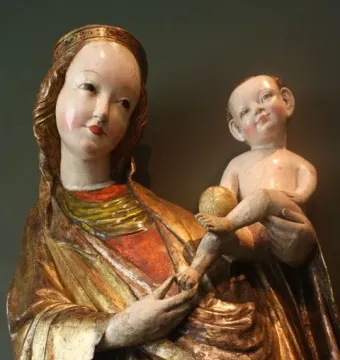
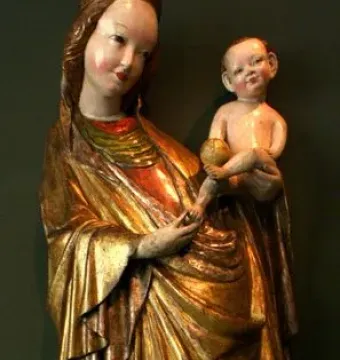
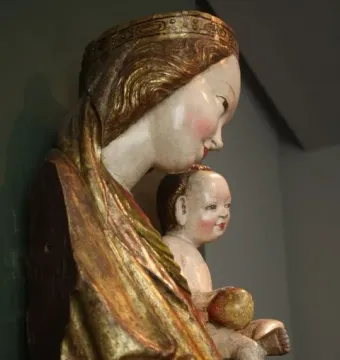
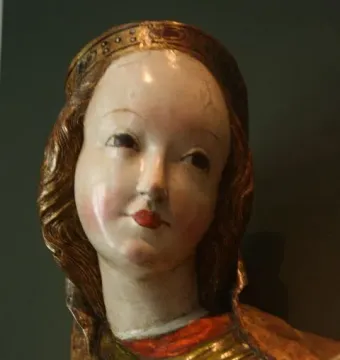
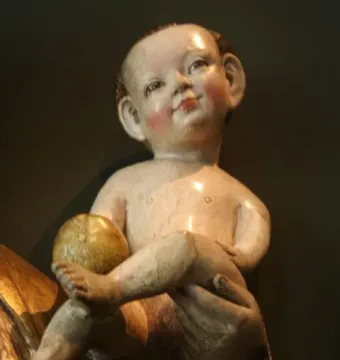
Beautiful Virgin Mary from Krużlowa is a Gothic limewood sculpture from the early 15th century and a fine example of the Beautiful Madonnas of late Gothic art. The unknown woodcarver created the 119 cm high figure for viewing from three sides; the back is deeply hollowed to protect the wood from cracking. It shows Mary standing in contrapposto with richly folded clothing, holding the naked Child, who has an apple. Discovered in 1889 in the parish church in Krużlowa Wyżna, it was acquired by the National Museum in Kraków in 1899. Since October 2007, it has been part of the collections of the Archbishop Erazm Ciołek Bishop's Palace in Kraków.
© image · CC BY-SA 3.0

© image · CC BY-SA 3.0

© Ludwig Schneider · CC BY-SA 3.0
© Ludwig Schneider · CC BY-SA 3.0
© Ludwig Schneider · CC BY-SA 3.0
Identification | |
| Title | Beautiful Virgin Mary from Krużlowa |
| Alternative name | Madonna z Krużlowej |
| Type | Gothic sculpture |
| Iconographic type | Beautiful Madonna |
Historical context | |
| Date of creation | c. 1410, usually dated to the early 15th century |
| Style | Soft style of late Gothic art, within International Gothic |
Creator | |
| Artist | Unknown |
Physical characteristics | |
| Height | 119 cm |
| Depth | 18 cm |
| Proportions | Height-to-depth ratio 1:7 |
Materials | |
| Material | Lime wood |
| Surface finish | Polychromed; later covered with at least three layers of oil paint |
Technique | |
| Construction | Wood carving, hollowed out from the back; front solid, back unfinished |
| Intended viewing | Designed to be viewed from the front and both sides |
Appearance | |
| Spatial effect | The staggered drapery creates an illusion of depth and three-dimensionality |
| Composition | Mary and the Child’s faces are at nearly the same height and share similar facial features |
| Clothing | Mary wears richly draped garments with a deep neckline and festoon-like sleeve folds |
| Pose | Mary stands in pronounced contrapposto |
| Depicted subject | Virgin Mary with the Child Jesus |
| Child Jesus | Naked, holding an apple |
Discovery and provenance | |
| Original location | Church of the Nativity of the Blessed Virgin Mary in Krużlowa Wyżna, Lesser Poland, Poland |
| Possible earlier provenance | Possibly intended for a major church in Kraków; exact original provenance is unknown |
| Relocation hypothesis | Probably moved to Krużlowa in the 17th century, possibly replacing by Baroque sculptures |
| First documentary records | 1607 and 1766 |
| Discoverers | Władysław Łuszczkiewicz and Stanisław Wyspiański |
| Discovery | Found in 1889 in the parish church in Krużlowa Wyżna |
Location and ownership | |
| Church locations | Originally in the high altar, later moved to the vestibule/entrance and finally kept in the attic |
| Current location | National Museum in Kraków, in the Bishop Erazm Ciołek Palace collection since October 2007 |
History and restoration | |
| Condition when found | Poor condition, with bark beetle damage and multiple layers of oil paint |
| Museum acquisition | Purchased by the National Museum in Kraków in 1899 |
| Display history | First exhibited in the Sukiennice in Kraków; since 1924 displayed in the Town Hall Tower |
| World War II | Confiscated by German authorities in 1940 and placed in Hans Frank’s office at Wawel; restored by a German named Kneisel in 1942–1943 |
| Postwar recovery | Recovery after the war is uncertain and disputed; versions place it in a depot at Wawel Castle in 1945 or in the residence of a senior Nazi dignitary near Munich |
Significance | |
| Historical assessment | A major example of the Beautiful Madonnas and one of the most important works of late Gothic sculpture in Poland |