
Ombra della sera
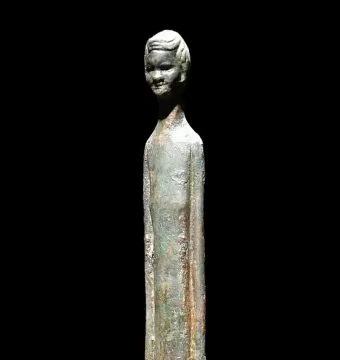
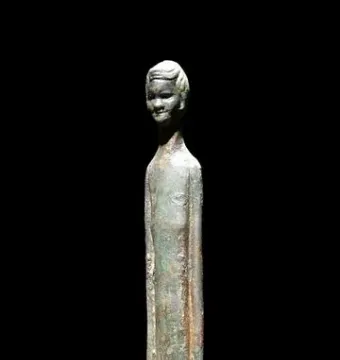
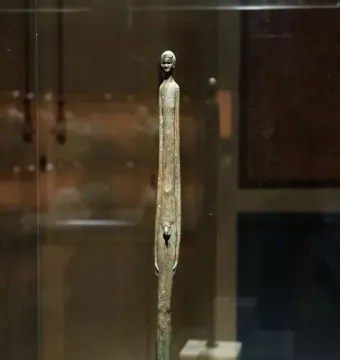
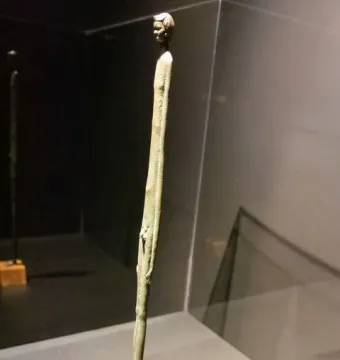
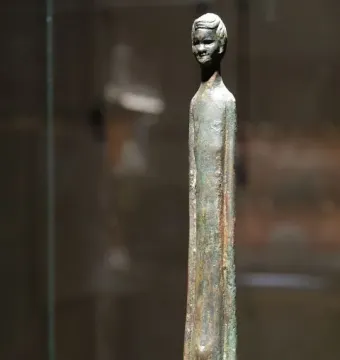
Ombra della sera is a 3rd-century BCE Etruscan bronze votive figure from Volterra, now in the Museo etrusco Guarnacci. Found in a tomb in ancient Velathri, it stands 57.5 cm tall and is striking for the unnatural elongation of its body, contrasted with a normally proportioned head. Its name, meaning “evening shadow,” is associated with Gabriele D’Annunzio, who saw in its silhouette the image of a long shadow at dusk. The sculpture was first described in 1737 by Anton Francesco Gori, later entered the collection of Mario Guarnacci, and has been scientifically analyzed to confirm its Etruscan bronze composition.
September 2019 © Jnn95 · CC BY-SA 4.0
September 2019 © Jnn95 · CC BY-SA 4.0
September 2019 © Jnn95 · CC BY-SA 4.0
November 2021 © Dorieo · CC BY-SA 4.0
September 2019 © Jnn95 · CC BY-SA 4.0
Identification | |
| Title | Ombra della sera |
| Type | Etruscan bronze votive statuette |
| Inventory number | 226 |
Historical context | |
| Date | Probably 3rd century BCE; more specifically, current accepted dating is the third quarter of the 3rd century BCE |
| Culture | Etruscan art |
Discovery and provenance | |
| Origin | Velathri (modern Volterra) or its surroundings |
| Found in | A tomb in Volterra, Tuscany |
| Discovery date | Before 1737 |
| Provenance history | Recorded in 1737 in the collection of the Buonarroti family in Florence; owned by Filippo Buonarroti in 1737; probably transferred to Mario Guarnacci's collection between 1744 and 1761; donated by Mario Guarnacci to Volterra in 1761, forming part of the core of the Museo Etrusco Guarnacci |
Creator | |
| Name attributed to | Gabriele D'Annunzio (an attribution now regarded as discredited in scholarship) |
| First publication | Museum Etruscum |
| First described by | Anton Francesco Gori |
Physical characteristics | |
| Height | 57.5 cm |
| Proportions | Unnaturally elongated body with normal-sized head; the figure is slender, vertically distorted, and almost exactly two Roman feet tall |
| Depicted figure | A nude male figure, probably a boy |
| Pose | Upright with arms close to the body and legs together |
| Facial features | Round face with a slight smile |
| Anatomical details | Head, hands, feet, and genitals are carefully worked out |
| Visual effect | Creates a fragile, hovering or floating impression |
Materials | |
| Material | Bronze |
| Alloy composition | Copper, tin, and lead; measured average composition 71% copper, 14% tin, 15% lead |
Technique | |
| Analysis method | Non-invasive laser-induced breakdown spectroscopy (LIPS) |
| Scientific analysis result | Bronze composition typical of the Etruscan era; analysis also suggested the figure had remained underground for many years |
Appearance | |
| Stylistic classification | One of the so-called bronzetti allungati (elongated bronze figures) |
| Stylistic features | Deliberately elongated body not following the Greek canon of proportions; body form is markedly elongated and anatomically reduced to essentials, while the head and limbs are rendered with more attention to reality |
| Comparison with other art | Often compared with the sculptures of Alberto Giacometti |
Iconography and meaning | |
| Function | Votive offering / votive image |
| Name meaning | "Evening shadow"; the name refers to the long shadow a person casts in the evening before sunset |
| Name origin | The current name is recent; it was earlier called "lemure" in the 18th and 19th centuries |
Location and ownership | |
| Current location | Museo Etrusco Guarnacci, Volterra |
| Associated museum | Guarnacci Museum |
History and restoration | |
| First documented use of current name | 1954, in a travel guide to Volterra by Paolo Ferrini |
| Earlier documented name | "lemure" |
| Scholarly status | Its authenticity has often been doubted, but scientific analysis confirmed a bronze composition consistent with the Etruscan period |
Significance | |
| Notability | One of the best-known sculptures of Etruscan art and the best-known example of its class; also one of the tallest examples |
| Art-historical significance | A substantial part of the class is attributed to Volterra workshops; the type is associated with Etruscan votive practice and the use of weight as a measure of value |
| Comparative chronology | The style of elongated bronzes may begin as early as the late Archaic period in the late 6th century BCE; the statuette is placed in the period when the comparison coinage was in circulation |
| Metrological basis | Measured weight 1322 g; comparable to about ten times the average weight of the Volterran "delfino" coin series, which had an average unit weight of 132.26 g |
| Interpretation of size and weight | Its two-foot height and metal weight were likely meaningful in the votive context, since votive value could be expressed by dimensions and by converted monetary value |
| Influence | Frequently cited as an inspiration for Alberto Giacometti; later institutional sculptures in Tuscany were also inspired by this model |
Other | |
| Related comparative example | A monumental Ombra in Pisa; a bronze figurine from the stipe of Torraccia di Chiusi near San Gimignano is a later comparative example |
| Scholarly context | Before Ornella Terrosi Zanco's 1961 study, these bronzes were treated as curiosities rather than as a distinct artistic current; later scholars such as Giovanni Colonna and Adriano Maggiani further classified the group |
| Cataloguing status | No complete catalogue of the class exists; find spots and discovery information are unknown for many examples, especially those that surfaced in uncontrolled excavations in the 18th and 19th centuries |