
Cross of the Angels
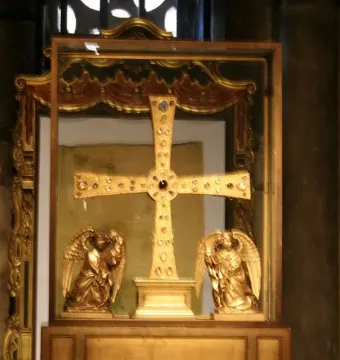
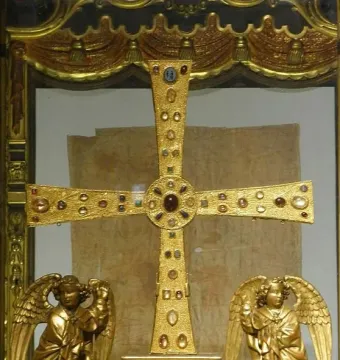
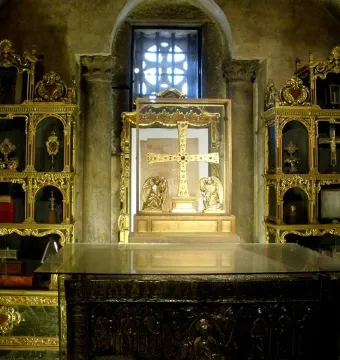
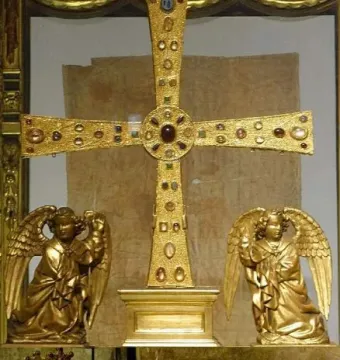
The Cross of the Angels is a pre-Romanesque Asturian reliquary donated by Alfonso II of Asturias in 808 to the Church of San Salvador in Oviedo, Asturias, Spain. It is the symbol of the city of Oviedo and the first example of jewelry made in the Kingdom of Asturias that has survived to the present day. The cross’s current appearance comes from a careful reconstruction after the damage it suffered in August 1977 during the robbery of the Camara Santa. Its squared form, with two cedar-wood pieces and a round disc at the center, is typical of Greek crosses.
© Sitomon · Public domain
September 2011 © Zarateman · CC BY-SA 3.0 es
September 2011 © Zarateman · CC BY-SA 3.0 es
January 2016 © Zarateman · CC0
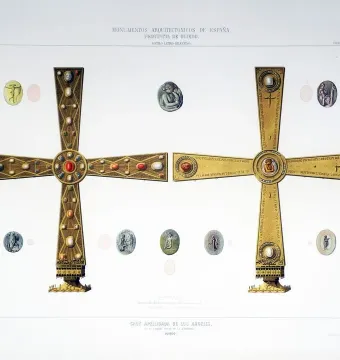
January 2022 © Teófilo Rufflé Según dibujo de Ciriaco Miguel Vigil · Public domain
Identification | |
| Name | Cross of the Angels |
| Object category | movable piece |
| Type | reliquary cross |
| Alternative names | Cruz de los Ángeles; La Croce degli Angeli; La Croix des Anges; Cruz dos Anjos; Das Kreuz der Engel |
Historical context | |
| Historical period | Asturian monarchy |
| Date of creation | early 9th century; inscription gives 808 |
Creator | |
| Donor | Alfonso II of Asturias, called the Chaste |
| Donation recipient | the Cathedral of San Salvador of Oviedo |
Discovery and provenance | |
| Legendary origin | According to legend, two angels disguised as pilgrims made the cross for Alfonso II |
| Possible occasion of donation | possibly the consecration of the new temple dedicated to San Salvador in Oviedo |
| Legend source | Bishop Lucas de Tuy |
| Associated location | Holy Chamber of Oviedo Cathedral |
| Current location | Cámara Santa of the Cathedral of San Salvador of Oviedo, Asturias, Spain |
| Original location | Church of San Salvador, Oviedo |
| Donation date | 808 |
| Inscription | A reverse inscription states that Alfonso II donated the cross to the Cathedral of San Salvador of Oviedo in 808 |
Physical characteristics | |
| Shape | Greek cross with flared arms |
| Arm proportions | the four arms are almost identical in length |
| Central feature | a round disc at the center |
| Construction | made of two joined pieces of wood |
Materials | |
| Wood | cedar wood; wild cherry wood |
| Metal | gold |
| Gemstones | precious and semi-precious stones, including garnets, agates, and pearls |
| Other materials | Roman intaglios; Roman agate cameo |
Technique | |
| Reliquary structure | each arm contains a small reliquary box with a sliding lid |
| Surface finish | covered with a thin gold sheet fixed with small gold nails |
| Decoration | filigree with inlaid stones; forty-eight cabochon stones; inscriptions in gold letters |
Appearance | |
| Reverse side | covered with a plain gold sheet with gold-letter inscriptions and gem ornaments at the arm ends |
| Central reverse ornament | originally had a Roman agate cameo surrounded by pearls and stones; replaced after 1977 by a German cameo |
| Heraldic depiction | many heraldic versions show alpha and omega hanging from the arms, though this is historically uncertain |
| Front side | decorated with cabochon stones, reused Roman intaglios, and filigree |
Iconography and meaning | |
| Relic contained | Vera Cruz (True Cross) |
| Symbolism | the inscription includes 'By this sign the pious is protected; by this sign the enemy is conquered' |
Location and ownership | |
| Current display status | on display |
| Heraldic use | symbol of Oviedo and other Asturian municipalities, including Langreo, San Martín del Rey Aurelio, Boal, and Quirós |
| Symbol of | the city of Oviedo |
History and restoration | |
| Theft in 1977 | stolen from the Cámara Santa and later recovered; the thief was caught before the objects were sold |
| Return location | Cámara Santa of Oviedo |
| Return date | 14 September 1985 |
| Restoration after 1977 theft | restored by the Commission for the Restoration of the Historical Jewels of the Holy Chamber of the Cathedral of Oviedo |
| Damage in 1934 | seriously damaged when the Cámara Santa was bombed during the Asturian Revolution |
| Assessment of 1942 restoration | several historians considered it a violation of archaeological, artistic, and historical principles because original and added parts were not clearly distinguished |
| Restoration after 1934 damage | restored by 1942 |
| Associated damaged objects in 1934 | Holy Ark; Agate Casket |
| Original function | altar ornament and processional cross; originally hung above the main altar |
Significance | |
| Claim to fame | oldest surviving work of goldsmithing in Asturias |
| Significance | first surviving example of jewelry made in the Kingdom of Asturias |
| Heraldic use date | from the 13th century onward |