
Lion-man Sculpture
The Lion-man is a prehistoric figurine discovered in 1939 in Hohlenstein-Stadel, a German cave in the Swabian Jura. Carved from mammoth ivory with a flint stone knife, it combines a human-like body with the head of a cave lion. Carbon dating places the layer where it was found between 35,000 and 41,000 years old, making it one of the oldest known artistic representations and the oldest confirmed statue ever discovered. The figure is associated with the Aurignacian culture of the Upper Paleolithic and features seven parallel carved gouges on the left arm. After several reconstructions, it is now displayed in Museum Ulm in Ulm.
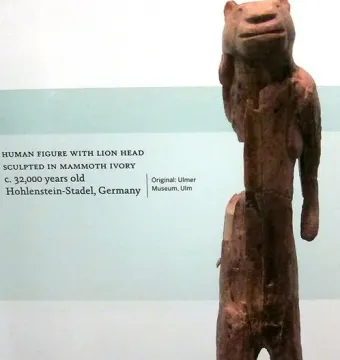
July 2013 © schizoform · CC BY 2.0
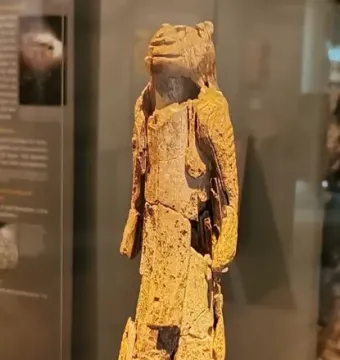
© User:Mateus2019 · Public domain
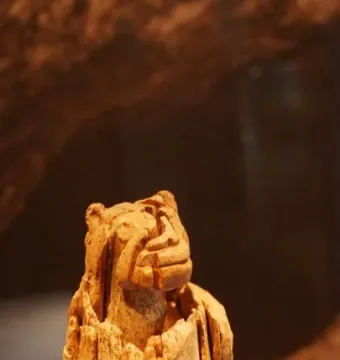
March 2021 © Moleskine · CC BY-SA 4.0
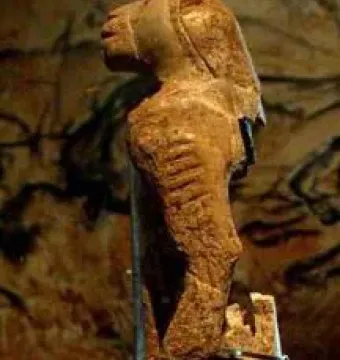
2011 © JDuckeck · Public domain
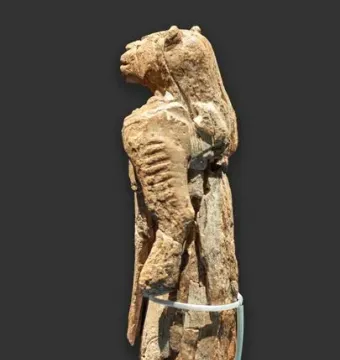
November 2013 © Thilo Parg · CC BY-SA 4.0
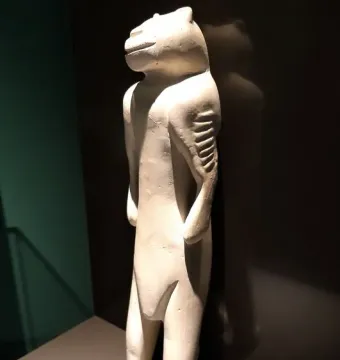
August 2020 © Catatine · CC BY-SA 4.0
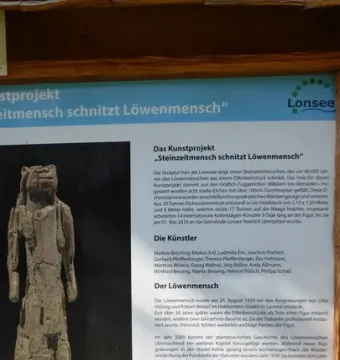
October 2019 © Vux · CC BY-SA 4.0
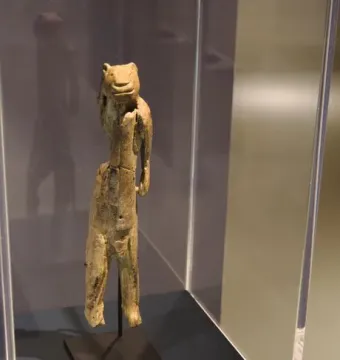
May 2016 © MathieuMD · CC BY-SA 4.0
March 2021 © Moleskine · CC BY-SA 4.0
© Mateus2019 · CC BY-SA 4.0
Identification | |
| Title | Lion man of the Hohlenstein Stadel |
| Depiction | Human-like body with the head of a cave lion (Panthera spelaea); a human body wearing a lion's head; a creature with a human body and a lion's head; a human being with a lion's head; a human figure with the head and limbs of a cave lion; a hybrid being combining a human and a large cat, probably a cave lion; a statue of a creature with a human body and a lion's head; a figurine with animal and human features; later restoration emphasized feline characteristics |
| Alternative names | Lion-man of Hohlenstein-Stadel; Löwenmensch; "lion-person" or "lion-human"; Человеколев; El hombre león; Ludina-lev (Людина-лев, Людинолев); "Lion man"; "lion woman" (Löwenfrau) |
| Form | Anthropomorphic figurine; round sculpture (free-standing sculpture) |
| Object type | Prehistoric sculpture; sculpture; statue / sculpture; sculpture; figurine; prehistoric ivory sculpture; prehistoric figurine / sculpture; fragmented figurine with animal and human features; the oldest zoomorphic sculpture |
Historical context | |
| Dating period | Aurignacian (Upper Paleolithic); Upper Paleolithic; Aurignacian period |
| Associated archaeological culture | Aurignacian culture; Aurignacian, an Upper Paleolithic culture |
| Art style / type | Zoomorphic art |
| Dating method | Carbon dating of the layer in which it was found; carbon dating of the layer where it was found; radiocarbon analysis; Carbon-14 |
| Significance | One of the oldest-known examples of an artistic representation; oldest confirmed statue ever discovered; one of the oldest known sculptures in the world and the oldest zoomorphic sculpture; one of the oldest known sculptures in the world; one of the oldest known sculptures up to that time; oldest known zoomorphic sculpture; oldest known example of figurative art; one of the oldest known small-scale works of art of humanity; one of the oldest known sculptural round figures |
| Cultural association | Aurignacian culture of the Upper Paleolithic |
| Interpretation history | Initially called "lion man"; prehistorian Joachim Hahn proposed interpreting it as a female being because the head was thought to be a lioness, leading to the name "lion woman" (Löwenfrau); the identification remains unclear and it is still mostly called "lion man" |
| Possible meaning and function | Scientists believe the figure may represent a deity; may have been an object of religious worship; possibly a deity; possibly an object of religious worship; possible mythological significance: these finds raise the possibility that the "lion man" played a prominent role in the mythology of Upper Paleolithic humans |
| Date / age | 40,000–38,000 BCE; between 35,000 and 41,000 years old; between 35,000 and 40,000 years old; 32,000 years old; 32,000 years; 40 thousand years old; 41,000 and 35,000 years ago |
Creator | |
| Discovery and excavation | Discovered by Otto Völzing / Otto Volzing (1910–2001), with Robert Wetzel as excavation leader; excavation started in 1937; discovered by a geologist (name not given in the fragment); the excavation ended prematurely due to the beginning of World War II on 1 September 1939; fieldwork was left incomplete because World War II began one week later, and analysis of the finds was not undertaken; work was interrupted by World War II; study began almost thirty years after the end of World War II |
Discovery and provenance | |
| Associated finds | Ivory pendants and perforated teeth of red deer, fox, and wolf; few stone tools and little to no other traces of everyday life |
| First storage / donation | Nearby Museum Ulm; donated to Ulm Museum |
| Heritage site association | Caves and Ice Age Art in the Swabian Jura UNESCO World Heritage Site |
| Find context | Found in an isolated chamber, away from settlement activity; found broken into pieces |
| Discovery date | 1939; 25 August 1939 |
| Discovery location | Hohlenstein-Stadel; Hohlenstein-Stadel in the Lone Valley (Lonetal); Hohlenstein-Stadel cave, Lonetal valley, Baden-Württemberg, Germany; Hohlenstein-Stadel cave, a German cave; Stadel cave, one of the three karst caves of the Hohlenstein near Asselfingen, Swabian Jura, Germany; Germany |
Materials | |
| Material | Mammoth ivory; ivory; mammoth ivory fragments |
Technique | |
| Carving tool | Flint stone knife |
| Carved features | Seven parallel, transverse carved gouges on the left arm; seven horizontal, parallel incisions; seven horizontal, parallel grooves, possibly indicating a tattoo or decorative scarification; more than a dozen fine transverse incisions on the left ear; the left sole also seems to be decorated with lines; a triangular plate in front of the crotch is described as being carved all around and clearly separated from the pubic area |
Physical characteristics | |
| Dimensions | 29.6 cm high, 5.6 cm wide, 5.9 cm thick; 29–31 cm high; 31.1 cm high; 6 cm diameter; 296 millimetres high before second restoration; 311 millimetres high after second restoration |
| Body features | Elongated neck |
| Condition and completeness | Broken into pieces; about two-thirds complete after the 1987 assessment; severely damaged back; some ivory lamellae missing from the legs; preserved parts included the ears, eye-holes, two-thirds of the mouth and nose, and the back of the head; the first reconstruction still lacked the head; individual fragments of the right arm were not yet fitted and much of the right shoulder was still missing |
Appearance | |
| Visible reconstruction details | Head, back, and right side of the body further completed in the second restoration; height increased after restoration; the figurine was disassembled into its individual parts and newly discovered fragments were added along with the old ones; the method of reassembly used X-ray computed tomography, digital modeling, and virtual reassembly |
| Notable reconstruction changes | After several reconstructions that incorporated newly found fragments; clear features of a predatory cat's face became visible; restored from one thousand fragments; about 200 fragments assembled by Joachim Hahn in 1969; all matching parts were newly assembled; one part fitted to the left foot; another identified as part of the previously missing snout with the deeply incised mouth; newly added parts in restoration; about 80 parts still stored in the museum were added under the direction of Nicole Ebinger-Rist; the previously isolated right arm could be fitted using newly available parts of the right shoulder; artificial additions used during the first restoration were discarded |
| Depicted subject | A hybrid figure with a human body and a lion's or big cat's head; a human body with a lion's head; a human-like body with the head of a cave lion; a human figure with the head and limbs of a cave lion; a creature with a human body and a lion's head; a human being with a lion's head; a hybrid being combining a human and a large cat, probably a cave lion; possibly a male human, but it could also be a human female |
Iconography and meaning | |
| Sex interpretation | Initially disputed; Joachim Hahn thought it was male, Elisabeth Schmid believed it was female, later research favored a male interpretation; based on the genital-area feature, the excavators concluded that the figure must have been male |
| Symbolism and ritual context | A triangular plate in front of the crotch separated from the pubic area; possible tattoo or decorative scarification; findings suggest the chamber may have been reserved for ritual activities |
Location and ownership | |
| Current location | Museum Ulm, Ulm; Ulm Museum; Ulm, Germany; on display at the Ulm Museum in Ulm, Germany |
History and restoration | |
| Reconstruction and restoration history | Recognized as a hybrid human-big-cat figure in 1969; additional reconstruction in 1982; restoration in 1987–1988 at the workshops of the Landesmuseum Württemberg, under the direction of paleontologist Elisabeth Schmid and restored by Ute Wolf in cooperation with Elisabeth Schmid; restoration from 1997–1998; complete reconstruction after 2000; second restoration started in 2012 and was completed in late 2013 at the workshops of the State Office for the Preservation of Historical Monuments in Esslingen under Nicole Ebinger-Rist; the reconstruction presented from 1988 onward |
| Fragment discovery and reassembly | Initial fragment count: more than 260 ivory fragments; further small fragments were found in 1974 and 1975 by walkers in the cave and during the clearing of Robert Wetzel's office at the University of Tübingen; additional ivory finds in the 1970s; 2008 excavation used systematic sieving and found many minute fragments; 2010 to 2012 further fragments were found from the debris of the 1939 excavation; 2008 new adjustments were first simulated virtually so fragments could be added without disassembling the original recreation; 2013 the figure was virtually fitted and reassembled, with approximately 80 stored parts added under Nicole Ebinger-Rist; the figure was rediscovered in 2009 by excavations under Claus-Joachim Kind; first reconstruction based on more than 200 fragments; later re-dating used nearby bones and placed the age between about 41,000 and 35,000 years ago |
| Restoration materials | A reversible mixture of beeswax, artificial wax, and chalk |
| Late discovery note | Its late rediscovery explains why the figurine was almost unknown and had not yet appeared in textbooks or popular publications |
Other | |
| Comparative and related finds | Similarities have been noted with cave-art depictions from French caves of the Magdalenian period, such as the "Great Sorcerer" from Les Trois-Frères cave, which also show hybrid beings; a similar smaller statue representing a lion man was found in Hohle Fels cave, together with other animal sculptures; in Vogelherdhöhle cave, a detached lion head was found that appears to have had a human body |