
Harbaville Triptych
The Harbaville Triptych is a Byzantine ivory triptych dated to the mid-10th century and now kept in the Louvre in Paris. Measuring 28 × 24 cm, it was probably made in Constantinople during the Macedonian dynasty. Its central panel shows a Deesis, while the wings depict saints; the reverse of the central section is decorated with rich ornamental and vegetal motifs, along with smaller animal forms. Traces of polychromy can still be seen on some figures. It is considered one of the most valuable and best-preserved ivory works of the so-called "Romanos group," associated with the imperial court and early Byzantine ivory carving. The triptych takes its modern name from the collector Louis-François Harbaville, its last private owner before the Louvre acquired it in 1891.
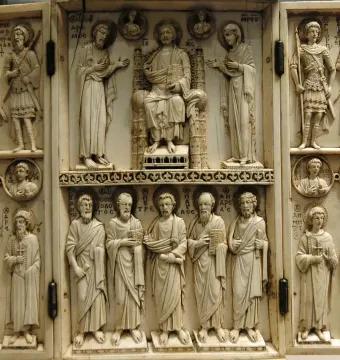
· Public domain
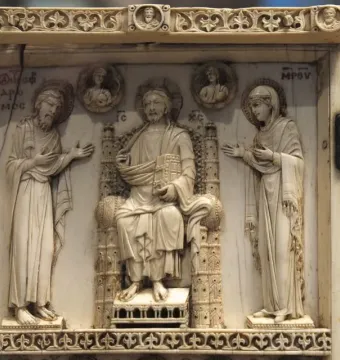
November 2016 © GFreihalter · CC BY-SA 3.0
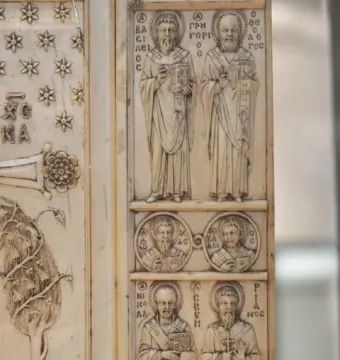
November 2016 © GFreihalter · CC BY-SA 3.0
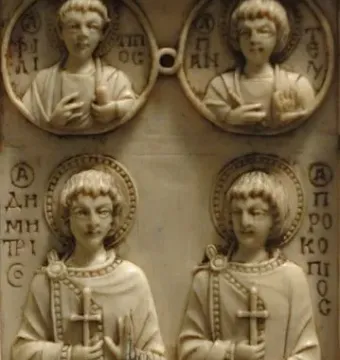
© Unknown artistUnknown artist · Public domain
© Unknown artistUnknown artist · Public domain
Identification | |
| Title | Harbaville Triptych |
| Type | Byzantine ivory triptych |
| Original name | Tryptyk Harbaville |
Historical context | |
| Production context | Probably closely connected with the imperial court |
| Art historical group | Romanos group |
| Group dating | Early works of the Romanos group are sometimes dated to the end of the second quarter of the 10th century |
| Date | Mid-10th century; some researchers date it to the mid-11th century |
| Place of origin | Probably Constantinople |
Creator | |
| Attribution | Attributed to the workshop of the so-called Romanos Group |
Discovery and provenance | |
| Named after | Louis-François Harbaville (1791–1866), its last owner |
| First owner | Louis-François Harbaville (1791–1866) |
| Provenance before Harbaville | Harbaville inherited it from the Beugny de Pommeras family of Arras |
| Acquisition by Louvre | Purchased by the Louvre in 1891 from Harbaville's grandsons and heirs |
| Early history | Undocumented |
Physical characteristics | |
| Condition | Well preserved; some figures preserve traces of polychromy |
| Style | Elegant, delicate, highly polished, typical of a court school |
| Quality | Considered the finest and best-preserved ivory of the Romanos group |
| Dimensions | 28 × 24 cm |
| Construction | All sides are fully carved |
| Structure | A central panel with two hinged side wings, folded closed |
Materials | |
| Material | Ivory |
Technique | |
| Technique | Carved and engraved |
Iconography and meaning | |
| Right wing lower register | Demetrius of Thessalonica and Saint Procopius, with Philip the Apostle and Saint Pantaleon in medallions |
| Meaning of reverse vegetation | Symbol of paradise |
| Inscriptions | All depicted persons have name inscriptions |
| Reverse side figures | Church Fathers and bishops, each identified by inscription |
| Reverse decoration | A Latin cross with rosettes, 24 stars, two cypresses, vine leaves, ivy, and paradise vegetation, including shrubs, stylized plants, birds, hares, and lions |
| Reverse of central panel | A Triumphal Cross in Paradise with two Trees of Life and the inscription 'Iesou Christos nika' ('Jesus Christ conquers') |
| Main subject | Deesis with other saints |
| Right wing upper register | Saint George and Eustathius of Rome |
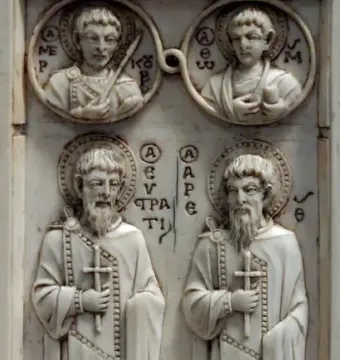
| Left wing lower register | Saint Eustratius and Aretas, with Mercury of Caesarea and Thomas the Apostle in medallions |
| Left wing upper register | Theodore of Amasea and Theodore Stratelates |
| Central panel lower register | Apostles James, John, Peter, Paul, and Andrew standing on pedestals and holding books or scrolls |
| Central panel upper register | Christ enthroned with Mary and John the Baptist, with archangels in medallions above the throne |
| Front composition | A Deesis in the upper register and apostles in the lower register, with saints on the side wings |
Location and ownership | |
| Current location | Louvre, Paris |
| Current collection | Louvre holdings |
| Museum department | Department of Medieval, Renaissance and Modern Objects of Art |
Significance | |
| Significance | An important work for the history of Byzantine art under the Macedonian dynasty, because far more ivories survive than panel paintings from the period |
| Comparative status | One of the most valuable works of the Romanos group |
Other | |
| Associated comparative object | A later ivory plaque in the Cabinet des Médailles, Bibliothèque nationale de France, Paris, showing Christ crowning Emperor Romanos and Empress Eudokia |
| Related works | Similar monuments are in Rome, the Vatican, and Moscow |
| Related plaque identification uncertainty | The emperor may have been Romanos II, crowned in 959, or Romanos IV Diogenes, crowned in 1068 |
| Related Moscow work date | Probably 944 |
| Historical naming uncertainty | The name 'Romanos group' does not unequivocally identify which emperor named Roman is meant |