
Monteverde Angel
Monteverde Angel, also called the Angel of the Resurrection, is an angel statue that decorates the Oneto family tomb, one of the best-known monumental graves in Staglieno Cemetery in Genoa. It is one of the most famous works by the Italian sculptor Giulio Monteverde, who created it in 1882 at the height of his artistic maturity. Commissioned by Francesco Oneto, a wealthy merchant and president of the Banca Generale, the monument was intended to preserve the memory of his family. The sculpture is notable for its strong sensual emotionality and for breaking with conventional funerary angel imagery: although it holds the horn of the Last Judgment, its pose and distant gaze give it an unsettling, detached presence.
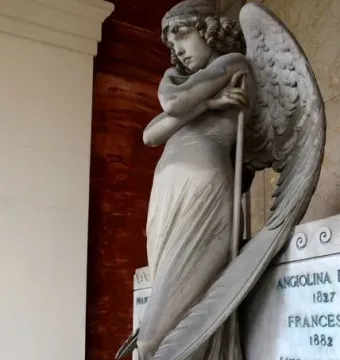
July 2015 © Vassil · CC0
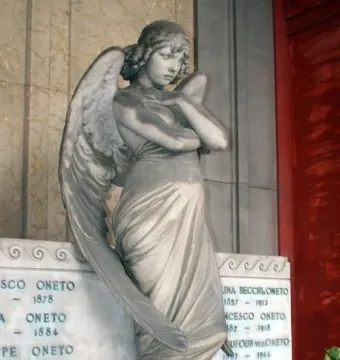
October 2007 © Krissstephens1 · CC BY-SA 4.0
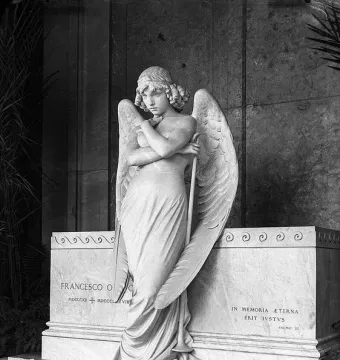
© Alfred Noack · Public domain
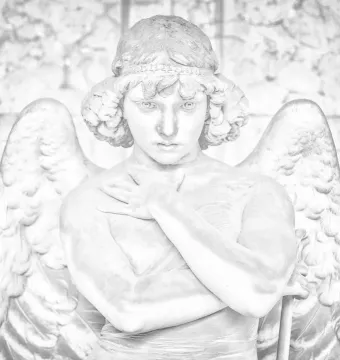
September 2017 © IlNat · CC BY-SA 4.0
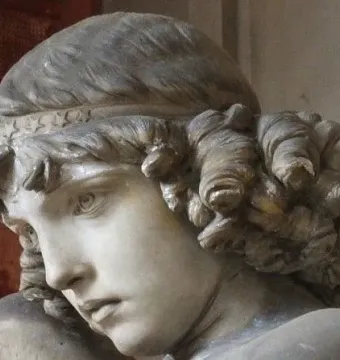
© user:twice25 · CC BY 2.5
Identification | |
| Title | Monteverde Angel |
| Subject | An angel |
| Alternative titles | Angel of Monteverde; Angel of the Resurrection; L'Angelo di Monteverde; L'Anjo Monteverde; Anjo da Ressurreição; L'Ange de Monteverde |
| Type | Sculpture |
Historical context | |
| Style | Neoclassical |
| Date created | 1882 |
Creator | |
| Artist | Giulio Monteverde |
| Artist nationality | Italian |
| Artist lifespan | 1837–1917 |
Discovery and provenance | |
| Commission purpose | To honor the memory of deceased members of his family |
| Created with | the adjoining funerary monument of the Oneto family |
| Part of | The monumental tomb of the Oneto family |
| Commissioned by | Francesco Oneto, a wealthy merchant and president of Banca Generale |
Location and ownership | |
| Replica location | Monteverde's private funerary chapel, Verano Cemetery, Rome |
| Original location | Oneto family monumental tomb, Staglieno Cemetery, Genoa, Italy; Nicchione XIII of the upper western portico |
| Additional copy location | Cloister of the church of Sant'Agostino, Prato |
Materials | |
| Material | Marble |
Physical characteristics | |
| Depiction | A pensive angel with long, richly detailed wings and strong androgynous features |
Appearance | |
| Pose and expression | The angel has a non-consoling posture and inscrutable gaze, appearing distant and detached from the event it silently witnesses |
Iconography and meaning | |
| Interpretation of attribute | Shown as if ready to sound the trumpet at the Last Judgment |
| Thematic dualism | Eros-Thanatos dualism |
| Iconographic interpretation | A mysterious, ambiguous, inscrutable witness who departs from the classic Christian iconography of a guiding angel |
| Attribute held | A trumpet of the Last Judgment in the right hand |
History and restoration | |
| Replica made by artist | A principal replica was made by Monteverde himself in 1891 |
| Replica chapel construction | Construction of the chapel began in 1885 as a temple open on three sides |
| Replica vandalism | In 2015, the Rome replica was vandalized; the fingers of the right hand and the trumpet shaft were broken |
| Additional copy status | An anonymous copy now isolated from its original burial context and displayed as an autonomous work of art |
Significance | |
| Reception | One of Giulio Monteverde's best-known and most famous works |
| Critical assessment | Considered one of the most beautiful and sensual sculptures in its genre and a high point of genre sculpture |
| Stylistic significance | Breaks with the sculptural conventions then in vogue |
| Influence | Inspired numerous sculptors and developed into a real style |
| Historical significance | Seen as a symbol of the transition from a positivist view of death to Symbolist and Decadent currents |
| Publication reception | Featured on the cover of several editions of Camposanto Di Genova and described there as a true masterpiece |
| Publication commentary | Praised for the perfect modeling of the arms, neck, and head, and for the deep, soft, or gentle expression of grief or sorrow in the features |
| Distribution | Many copies and imitations exist, including by Monteverde himself; they spread from the early 20th century in cemeteries and necropolises in Europe, America, and elsewhere |
Other | |
| Related works by artist | Monumento Pratolongo (1868) at Staglieno; Tomba Celle (1893); other important neoclassical works |