
Benito Juarez
Benito Juarez portrays the renowned Mexican leader often called the “Mexican George Washington” and remembered as the father and builder of modern Mexico. Born into a poor Zapotec family and orphaned at an early age, he learned to read and write from Catholic priests, studied law, and became governor of Oaxaca by age forty-one. He later rose to national prominence as a liberal reformer, opposing dictatorship, civil conflict, and foreign intervention. Juarez served as president, worked to build a modern civil society and a capitalist economy, and defended Mexico’s national sovereignty. He remained in office until his death in 1872, leaving a lasting reputation as a progressive reformer.
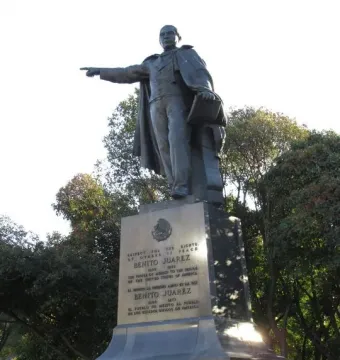
November 2013 © G0T0 · CC0
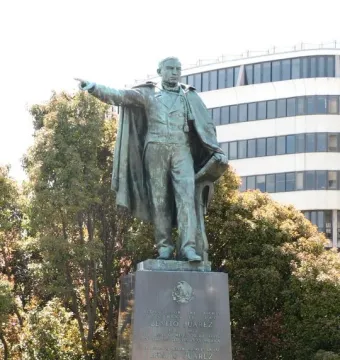
1891 © Slowking4 · Public domain
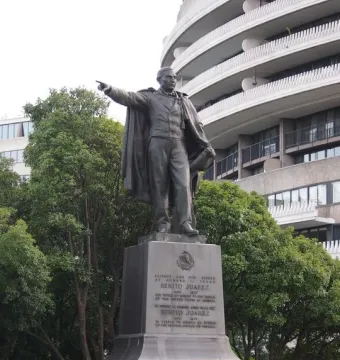
June 2014 © Slowking · Public domain
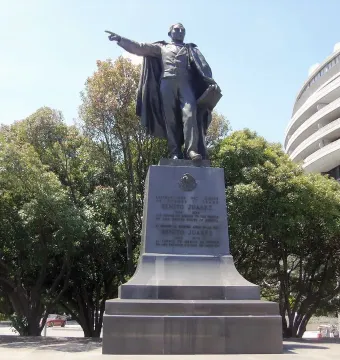
June 2013 © Farragutful · CC BY-SA 3.0
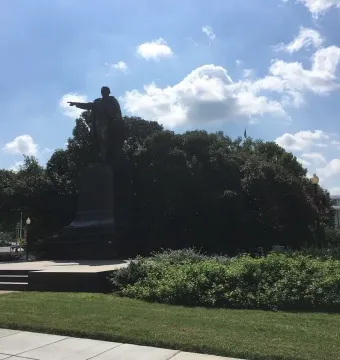
© NPS Photo · Public domain
Identification | |
| Title | Benito Juarez |
| Series | Statues of Liberators |
| Number in series | One of five statues in the series |
| Type | Monument / statue |
Creator | |
| Sculptor | Unnamed sculptor |
| Pedestal designers | Luis Sosa Villasenor and Luis Ortiz Macedo |
| Casting supervision | R. Moreno |
Materials | |
| Statue material | Bronze |
| Pedestal material | Granite |
Physical characteristics | |
| Dimensions | Statue: 19 feet by 9 feet, with a diameter of 3 feet 6 inches; base: 11 feet by 11 feet 9 inches, with a circumference of 11 feet |
| Weight | 3,600 pounds |
Appearance | |
| Object held | Book titled Reforma, resting on a low lectern |
| Attire | Short double-breasted jacket with a long cape draped from the shoulders |
| Pose | Standing with his right arm raised and pointing into the distance |
Iconography and meaning | |
| Depicted subject | Benito Juarez |
Historical context | |
| Government location in 1858 | Veracruz |
| Legacy | Remembered as a progressive reformer who defended democracy and national sovereignty |
| Death | Served as president until his death in 1872 from a heart attack |
| Reelection | Re-elected president in 1871 |
| Imperial rival | Maximilian I, French-backed claimant to the Mexican imperial throne, was killed in 1867 |
| Foreign intervention | Napoleon III invaded Mexico in 1861; occupying forces were sent from several European countries |
| Presidency | Elected president in 1861, ruled from Veracruz during the French intervention, took Mexico City in 1867, abolished the monarchy, and was elected president again |
| Alliance | Befriended Abraham Lincoln during the American Civil War; Lincoln advised him on establishing democracy in Mexico |
| Political aims | To create a modern civil society, grant rights to the Indigenous population, and build a capitalist economy based on the American model |
| Conflict | Resisted the Roman Catholic Church as well as military and conservative opponents |
| Assumption of presidential powers | Assumed presidential powers in 1858 after a right-wing coup and the flight of President Ignacio Comonfort |
| Plan of Ayutla | Participated in drafting the Plan of Ayutla in 1854, calling for a boycott of Santa Anna and a convention to create a new constitution |
| Exile | Fled to New Orleans after Antonio López de Santa Anna seized power in 1853 |
| Political office | Governor of Oaxaca by age 41 |
| Political affiliation | Liberal |
| Education | Learned to read and write from Catholic priests; studied law and became a lawyer |
| Early life | Orphaned before age three |
| Ethnic background | Zapotec Indian from a poor rural family |
| Subject description | Mexican statesman and reformer known as the "Mexican George Washington" and regarded as the father and builder of modern Mexico |
| Subject lifespan | 1806–1872 |
| Post-restoration office | Minister of Justice |
Location and ownership | |
| Proposal date | 26 October 1967 |
| Proposal purpose | A gesture of friendship after the unveiling of a statue of Abraham Lincoln in Ciudad Juárez in 1966 by U.S. President Lyndon Johnson |
| Proposal context | During a ceremonial luncheon on an official visit to Washington |
| Proposed by | President Gustavo Díaz Ordaz |
| Gift | A gift from the Mexican people to the American nation |
| Owner | National Park Service |
| Country | United States |
| Current location | Juarez Circle at Virginia Avenue and New Hampshire Avenue, near Farragut West station, Foggy Bottom, northwest Washington, D.C., near the headquarters of the Organization of American States and George Washington University, in front of the Watergate Hotel and the John F. Kennedy Center for the Performing Arts |
| Maintenance | Maintained by the National Park Service |
Discovery and provenance | |
| Plasterwork | Luis Ortiz Monesterio |
| Transport damage | One leg broke off and one arm cracked during transport to the United States |
| Authorization date | 17 October 1968 |
| Monument casting | Cast in Mexico City at Fundidores Artísticos under the guidance of R. Moreno |
| Model statue | A realistic statue by Enrique Alciati, cast in 1891 at Nelli Foundry in Rome and originally installed on a hill in Oaxaca |
History and restoration | |
| Repair | Broken leg and cracked arm repaired by American and Mexican welders |
| Unveiling date | 7 January 1969 |
| Hidden urn | An urn containing soil from San Pablo Guelatao, Oaxaca, Juarez's birthplace, was placed inside the base |
| Inscription | Front pedestal inscription: "Respect for the rights of others is peace / BENITO JUAREZ / 1806–1872 / The people of Mexico to the people of the United States of America"; lower back corner inscription: "A. CENCETFI (sic), SCULTORE, ROMA 1891"; back inscription: "En este sitio fue depositada tierra de Guelatao, Oaxaca, lugar de origen del presidente Benito Juarez, 7 de enero de 1969" |
| Survey and condition | Surveyed by Smithsonian Institution's Save Outdoor Sculpture! in 1993; described as well maintained |
| 2005 intervention | National Park Service workers installed tightening straps at the base to help control slippage of the facing stones and deter pedestrian access |
| Repair planning | In 2010, Oehrlein & Associates Architects prepared a survey and repair plan; repairs began in November 2011 and were planned to continue through spring 2012 on site |
| Planned repairs | Repair granite on the pedestal and in the plaza, clean and repair the statue, repair loose lettering, reinstall missing lettering, and waterproof the statue |
Significance | |
| Dedication | The people of Mexico to the people of the United States of America |