
Pioneer Monument
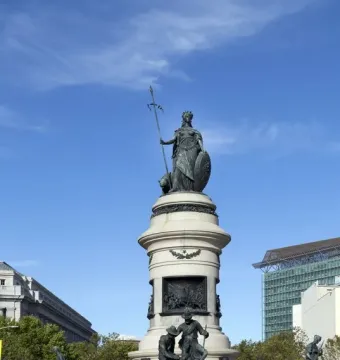
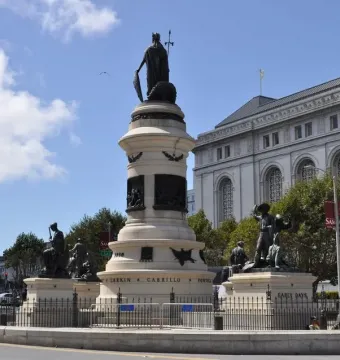
Pioneer Monument is a historic memorial in San Francisco, California, created by sculptor Frank Happersberger with financial support from James Lick. Unveiled on Thanksgiving Day in 1894, the 820-ton bronze and granite monument originally stood at Marshall Square near Hyde, Grove, and Market streets. Designed in a Victorian style, it once complemented the old City Hall. After the 1906 earthquake and fire, it remained in place until 1993, when it was moved to make room for a new library. The monument has long been controversial because of its depiction of Native Americans in submissive poses. In response to protests, the city later installed an explanatory plaque acknowledging the suffering of Indigenous people.
© Carol M. Highsmith · Public domain
August 2009 © Joe Mabel · CC BY-SA 3.0
April 2017 © Beyond My Ken · CC BY-SA 4.0
April 2017 © Beyond My Ken · CC BY-SA 4.0
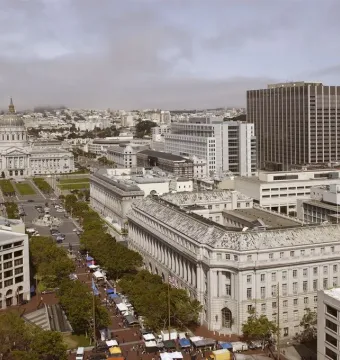
© Carol M. Highsmith · Public domain
Identification | |
| Title | Pioneer Monument |
| Original-language title | Пам'ятник піонерам |
| Alternative name | Monument of Pioneers |
| Type | Historical monument |
Historical context | |
| Century | 19th century |
| Dedicated | 29 November 1894 |
| Installed | 1894 |
| Opening occasion | Thanksgiving Day |
Creator | |
| Financier | James Lick |
| Sculptor | Frank Happersberger |
Discovery and provenance | |
| Bequest | US$100,000 left by James Lick in 1876 for the construction of a monument |
| Donor | James Lick |
| Associated organization | The Society of California Pioneers |
| Selection date | September 1890 |
| Selection process | Chosen by the trustees of the Lick estate from four artist submissions and twenty-eight design entries |
Location and ownership | |
| Commemorated subject | Pioneers |
| Intended donation site | A section of land on Fourth Street near Market |
| Relocation reason | To free space for a new public library |
| Relocated in | 1993 |
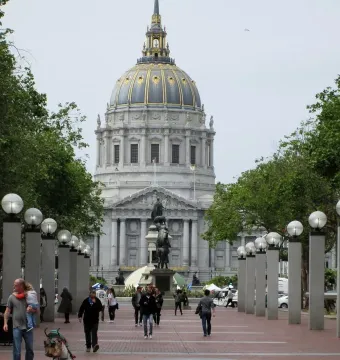
| Relocated to | The middle of Fulton Street, between the old and new libraries and across a park from City Hall |
| Nearby landmark | San Francisco Public Library |
| Current location | Fulton Street between Hyde and Larkin Streets, Civic Center, San Francisco, California, United States |
| Original location | Marshall Square, near the intersection of Hyde and Grove Streets, in front of the Old City Hall, San Francisco, California, United States |
Physical characteristics | |
| Height | 47 feet |
| Height | 14.3 meters |
| Weight | 820 tons |
| Form | Column-shaped pedestal with pedestal-mounted sculptural groups |
| Composition | A central column surrounded by four additional statues on surrounding piers, plus bas-reliefs and portrait medallions |
Materials | |
| Components | Bronze figures and reliefs |
| Materials | Bronze and granite |
Technique | |
| Relief type | Bas-reliefs |
Style | |
| Style | Victorian style |
Appearance | |
| Central composition | Minerva/Athena stands on a column with a California bear, representing California's motto 'Eureka' ('I have found it') |
| Medallion figures | Francis Drake, John Sutter, John Fremont, Father Junipero Serra, and James Lick |
| Cardinal-direction placement | South: Commerce; North: Plenty; West: In '49'; East: Early Days |
| Column dates | 1848 and 1850 |
| Portrait medallions | Five portrait medallions |
| Additional sculpture on the third pedestal | Three prospectors |
| Female sculpture representing trade | A woman on her own base in a boat with an oar |
| Female sculpture representing agriculture | A woman on her own base holding a cornucopia |
| Gold Rush group | In '49' |
| Additional allegorical figures | Commerce and Plenty |
| Accompanying figure | California bear |
| Central figure placement | On top of the central column |
| Central figure attributes | Spear and shield |
| Other sculptural group | Early Days |
| Central figure | Athena, personification of California |
Iconography and meaning | |
| Local Indigenous people | The Native people of the Bay Area were Ohlone |
| Father Junipero Serra role | Brought Christianity to California in 1769 |
| James Marshall significance | Known for discovering gold in 1848, though some accounts say he rediscovered it |
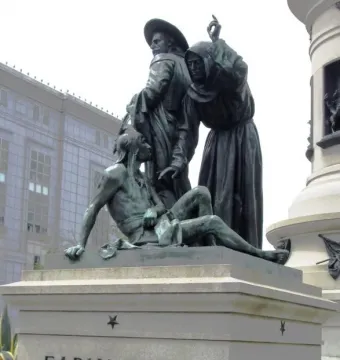
| Early Days criticism | Criticized for depicting Native Americans as subservient and for factual inaccuracy |
| Early Days meaning | Depicts a Franciscan missionary, a Native American, and a vaquero from the ranches of Mexico |
| In '49' meaning | Represents the California Gold Rush |
| Plenty meaning | Represents the potential of starting a new life in California |
| Commerce meaning | Represents the significance of shipping and trade in California and San Francisco |
| Artist's goal | To represent California's motto, 'Eureka' meaning 'I have found it' |
| Theme | Allegorical and historical figures representing California's history, economy, and settlement |
History and restoration | |
| Plaque added | A brass plaque was installed in 1996 at the base of 'The First Days' / 'The Early Days' |
| Relocation method | Twenty heavy-duty steel carrying beams were used to transport the monument |
| Post-removal storage | Moved to a storage facility |
| Removal reason | Native American organizations and some politicians considered it humiliating, racist, and demeaning to Native Americans |
| Removal circumstances | Removed in the early morning before sunrise |
| Removal decision | The San Francisco Appeals Board unanimously voted to dismantle it on 12 September 2018, and the city council later ordered its removal |
| Removed component date | 14 September 2018 |
| Removed component | Early Days |
| Plaque content | It acknowledged colonial occupation and the deaths of 150,000 Native Americans during the mission period of 1769 to 1834 |
| Cornerstone laid | 10 September 1894 |
| Church and Spanish response | Representatives of the Roman Catholic Church and the Spanish consul general said the spread of serious diseases was an unintended consequence of colonization |
| Preservationist position | Some preservationists wanted it to remain in place to mark the site of Old City Hall |
| Removal demands | Since 1991, Native American organizations demanded removal of the monument as racially oriented, offensive, dehumanizing, and factually inaccurate |
| Relocation context | A 1991 plan to move the monument for a new public library led to protests and a lawsuit |
| Survived event | The 1906 earthquake and fire |
| City Hall construction period | 1870 to 1897 |
| Architectural relationship | It complemented the pediment of City Hall |
| Dedication organizers | Lick Trustees, Society of California Pioneers, and Native Sons of the Golden West |
| Construction ground broken | May 1894 at San Francisco City Hall |
Significance | |
| Planning context | Pioneer monuments were being built in increasing numbers in the late 19th century |
| Stylistic borrowing | Borrowed conventions from Confederate monuments erected at the same time |