
Externsteine Relief
The Externsteine relief is a monumental rock relief carved into the sandstone formation of the Externsteine in the Teutoburg Forest near Detmold, in present-day North Rhine-Westphalia. Dating to the high medieval period, likely the 12th century, it is considered the oldest relief of its type known north of the Alps. The carving measures 4.8 m high by 3.7 m wide and is divided into three registers. The central scene shows the Descent from the Cross, with Christ, Nicodemus, Joseph of Arimathea, Mary, and John the Apostle. The upper and lower registers contain additional symbolic figures, including the ascended Christ, Sun and Moon, and kneeling figures caught by a dragon.
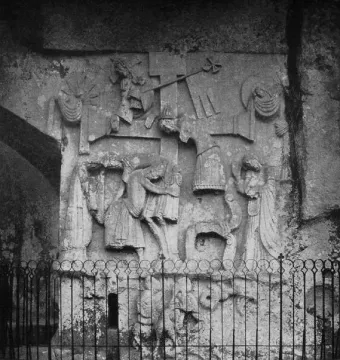
© Oswald Reissert · Public domain
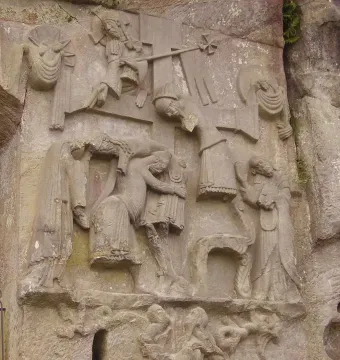
July 2009 © Zairon · CC BY-SA 3.0
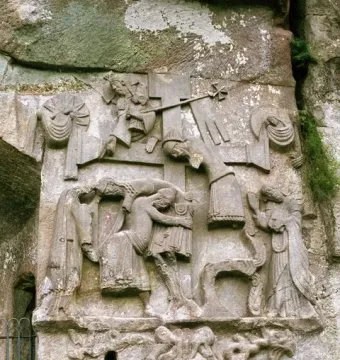
July 2017 © m66roepers · CC BY 2.0
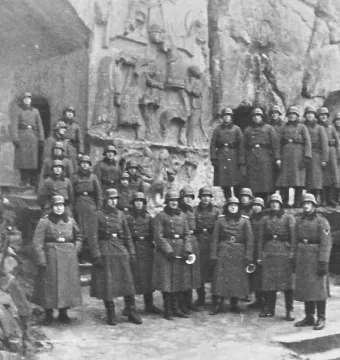
© Josef Gierse, my uncle · CC BY 3.0
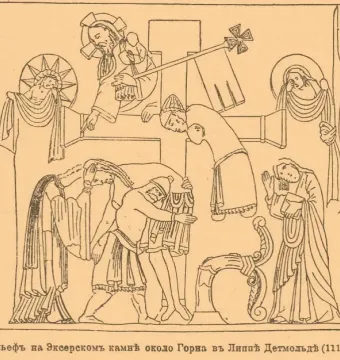
© Брокгауз и Ефрон · Public domain
Identification | |
| Title | Externsteine relief |
| Type | Monumental rock relief |
Historical context | |
| Date | Probably 1160/70; the dating has long been disputed, with earlier proposals ranging from the early 9th century to the 12th century |
| Period | High medieval |
| Historical significance | Considered the oldest large stone sculpture carved from solid rock north of the Alps |
Creator | |
| Artist | Unknown |
Discovery and provenance | |
| Carved into | The side of the Externsteine sandstone formation, at the Turmfels (tower rock) |
Location and ownership | |
| Historical location | The Duchy of Saxony in the Middle Ages |
| Location | Externsteine, near Detmold, Teutoburg Forest, North Rhine-Westphalia, Germany |
Physical characteristics | |
| Dimensions | 4.8 m high, 3.7 m wide |
| Composition | Divided into three registers |
Materials | |
| Material | Sandstone |
Appearance | |
| Upper register | The upper body of Christ, shown with a cross nimbus and victory banner, accompanied by a small figure in his arms and anthropomorphic Sun and Moon figures holding drapes |
| Central register | The Descent from the Cross: the cross stands in the center, with Nicodemus and Joseph of Arimathea assisting, Mary supporting Jesus' head, and John holding a book |
| Lower register | A naked bearded man and a clothed figure are kneeling and entangled by a two-legged winged dragon |
Iconography and meaning | |
| Main subject | The Deposition from the Cross (Descent from the Cross) |
| Religious theme | Christian Passion imagery, especially the Deposition from the Cross and the Ascension |
| Interpretation of central supporting form | The form under Nicodemus is variously interpreted as a bent Irminsul, a plant-like form, a chair, or a date palm; the Irminsul reading is mostly rejected |
| Interpretation of upper register | The upper figure is usually identified as the risen victorious Christ, though some scholars interpret it as God the Father; the small figure in his arms is variously explained, including as a self-presentation of Christ in the Mass |
| Interpretation of lower register | The two figures are variously identified as Adam and Eve, as representatives of fallen humanity, or as a Saxon warrior and a priest |
| Overall symbolism | The relief has been read as expressing the medieval world order of heaven, earth, and hell |
History and restoration | |
| Condition | Damaged; Mary's head and Nicodemus' lower legs are missing, and the lower part is less distinct than the upper part |
Significance | |
| Significance | The oldest relief of this type known north of the Alps |