
Saint Luke
Saint Luke Painting the Image of Mary is a Gothic sculptural composition and the only surviving part of the original altar retable dedicated to Saint Luke. It formed the central section of the retable, which originally stood in the chapel of the painters’ guild in the parish church of St Mary Magdalene in Wrocław. The work is now displayed in the Medieval Art Gallery of the National Museum in Warsaw. It is probably by Jakub Beinhart. The sculpture is notable for its varied relief treatment, from shallow relief to fully three-dimensional figures, and for its deliberate lack of polychromy. Scholars connect it with late Gothic monochrome sculpture from southern German lands, as well as with the art of Veit Stoss and early Netherlandish painting.
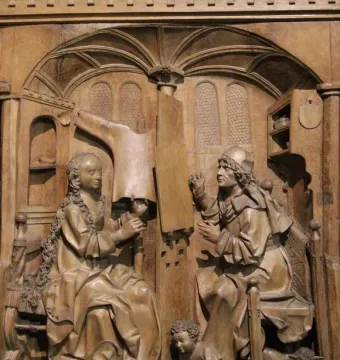
© Jacob Beinhart · CC BY-SA 4.0
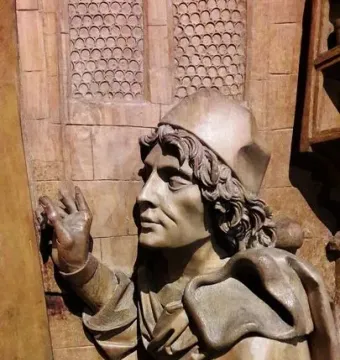
© Jacob Beinhart · CC0
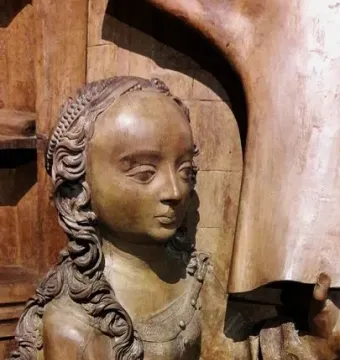
© Jacob Beinhart · CC0
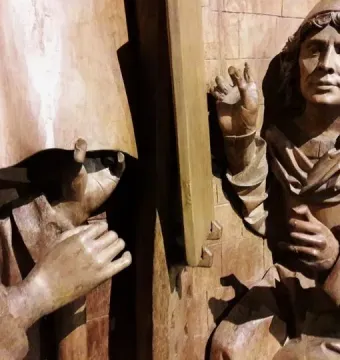
© Jacob Beinhart · CC0
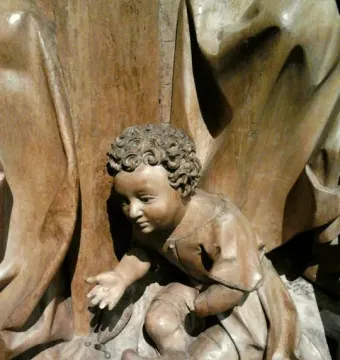
© Jacob Beinhart · CC0
Identification | |
| Title | Saint Luke Painting the Virgin |
| Polish title | Święty Łukasz malujący wizerunek Marii |
| English title | Saint Luke |
| Type | International Gothic limewood relief sculpture |
| Style | Late Gothic monochrome sculpture |
Historical context | |
| Associated period | Second half of the 15th century |
| Reason for rejecting polychromy | Intentional rejection of polychromy with ideological and artistic justification |
| Contemporary criticism of polychrome sculpture | Late Gothic polychrome and gilded sculpture was criticized by part of the clergy for its splendor |
| Later work of Wit Stwosz | In his later phase, the Kraków-Nuremberg woodcarver also preferred sculpture without polychromy |
| Position in retable | Central part |
| Surviving part | Only surviving element of the original altarpiece retable dedicated to Saint Luke |
| Original function | Central panel of an altarpiece for the chapel of the painters' guild in St Mary Magdalene Church, Wrocław |
Creator | |
| Possible stylistic background | Beinhart was familiar with contemporary sculpture in Swabia, which is sometimes considered the presumed place of origin of the sculptor |
| Attribution | Probably carved by Jakob Beinhart |
Discovery and provenance | |
| Original location | Chapel of the painters' guild in the parish cathedral of Saint Mary Magdalene in Wrocław |
Location and ownership | |
| Current location | National Museum, Warsaw, Medieval Art Gallery |
Materials | |
| Material | lime wood |
Technique | |
| Sculptural technique | Combination of full-round sculpture, convex relief, and concave relief |
| Relief depth | Flat relief for the wall with windows, deep relief for the interior furnishings, and fully three-dimensional sculpture for the figures of Mary, Jesus, Saint Luke, and the ox |
| Workshop implications | Rejection of polychromy expanded the technical range of woodcarving, emphasizing detail, texture, chiaroscuro modeling, and varied relief depth |
Physical characteristics | |
| Polychromy | No surviving fragments of polychromy; researchers consider the sculpture monochrome |
| Surface treatment | Bare wood covered only with a protective, visually unifying stain |
| Conservation studies | Chemical and microscopic studies and conservation work in 1996–2003 confirmed the monochrome character |
Appearance | |
| Framing | Enclosed by a border formed by a segmental arch supported by two massive pillars |
| Windows | Two pairs of leaded-glass windows with semicircular tops in the background wall |
| Style and treatment | Realistic physiognomy and clothing, with careful use of perspective, detail, and varied relief depth |
| Setting | Inside a richly furnished Gothic chamber with a vault supported by a central pillar |
| Furniture | Ornate chairs, furniture behind Mary and Saint Luke, and vessels on a shelf behind the painter |
| Wall detail | A meat-preparation board hangs on the side wall |
Iconography and meaning | |
| Subject | Saint Luke painting Mary, with the Infant Jesus and an ox also depicted |
| Saint Luke's action | Shown painting Mary on a wooden panel |
| Subject type | Combination of religious and genre themes |
| Attribute of Saint Luke | A small ox resting under Saint Luke's chair |
| Christ Child depiction | The Infant Jesus is shown playing between Saint Luke and Mary |
| Mary's depiction | Mary looks at the painter and is simultaneously weaving a costume hanging on a stick attached to a wooden pole |
| Saint Luke's gaze | Looking toward the seated Mother of God opposite him |
Significance | |
| Monochrome tendency | Represents a monochrome artistic tendency that emerged in the southern parts of the Holy Roman Empire, mainly Franconia and Swabia, in the second half of the 15th century |
| Influence of Wit Stwosz | Inspired by Wit Stwosz; his woodcut Holy Family has a composition very close to the sculpture |
| Influence from Early Netherlandish painting | Researchers detect influence from 15th-century Early Netherlandish painting on the composition |
| Early Netherlandish thematic parallels | The theme of Saint Luke painting Mary was depicted by Rogier van der Weyden and Hans Memling |
| Leading representative of monochrome sculpture | Tilman Riemenschneider |