
Taddei Tondo
Taddei Tondo is a round marble relief measuring 109 x 109 cm, created by Michelangelo Buonarroti between 1504 and 1506 for Taddeo Taddei, a patron and friend of Raphael from a noble Florentine family. It is an early work by the great High Renaissance sculptor. The relief is now held in the collection of the Royal Academy of Arts in London. The source text also notes that the name "Madonna Taddei" belongs to another Renaissance work: Raphael’s painting, made in Florence for the same patron in 1506 and now in the Kunsthistorisches Museum in Vienna.
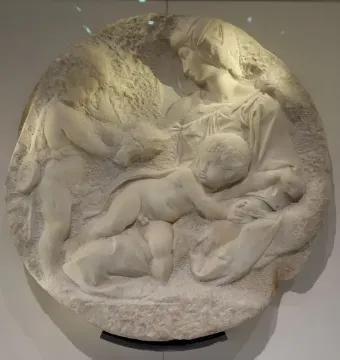
© Daderot · Public domain
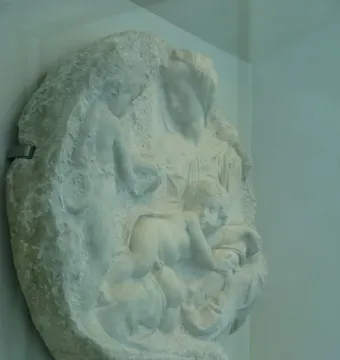
August 2009 © Yair Haklai · CC BY-SA 3.0
2011 © shakko · CC BY-SA 3.0
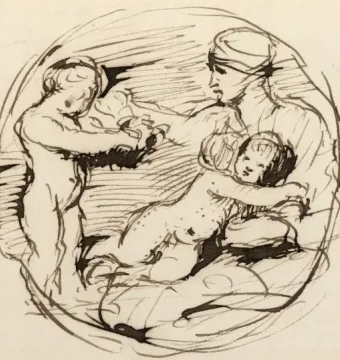
© David Wilkie · Public domain
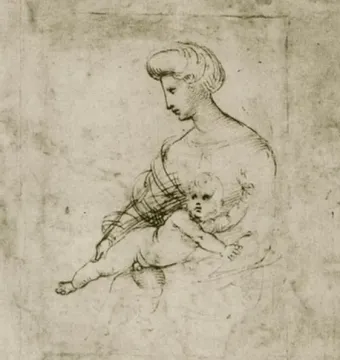
© Raphael · Public domain
Identification | |
| Title | Taddei Tondo |
| Original language title | Tondo Taddei; Madonna Taddei |
| Type | unfinished marble tondo relief |
| Form | circular composition |
| Subject | the Madonna and Child with the infant Saint John the Baptist |
| Alternative titles | Taddei Madonna; The Virgin and Child with the Infant Saint John; Tondo Taddei; Madonna Taddei; Madonna of Taddei |
Creator | |
| Artist | Michelangelo Buonarroti |
| Artistic period | High Renaissance / Italian Renaissance |
Historical context | |
| Date of creation | circa 1504–1506 |
| Place of creation | Florence, before Michelangelo's move to Rome in 1505 |
| Commissioned for | Taddeo Taddei, a member of the Florentine Taddei family |
| Status in artist's oeuvre | an early work |
| Historical source | According to Giorgio Vasari, Michelangelo began but did not finish two marble tondi while working on the bronze statue of David; the other was begun for Bartolomeo Pitti |
Physical characteristics | |
| Missing area | a missing segment in the lower right corner |
| Mounting holes | five holes on the outer edge, intended for fixings; the dating of the holes is disputed |
| Dimensions | 109 × 109 cm |
| Surface finish | the Child Jesus and the upper part of the Virgin are polished; the rest is rough and incompletely finished |
| Condition | unfinished; incomplete |
| Diameter | 40 inches |
Materials | |
| Material | marble |
| Support mark | a ligature of the letters L and A on the lower right of the reverse |
| Damage | a chisel blow on the reverse caused a hairline crack in the Virgin's face |
Appearance | |
| Composition and modeling | the rough background and unfinished state make the figures seem to emerge from the marble; Christ's feet and left hand still appear trapped in the stone |
| Figure arrangement | Saint John the Baptist is placed on the left to balance the composition |
Iconography and meaning | |
| Symbolism | the bird held by Saint John the Baptist symbolizes the Passion of Christ |
Location and ownership | |
| Uniqueness | the only marble sculpture by Michelangelo in Great Britain |
| Current collection | Royal Academy of Arts |
| Current location | Royal Academy of Arts, London |
| Country of current location | Great Britain |
Discovery and provenance | |
| Original location | the Palazzo Taddei in Florence |
| Documented location in 1568 | still in the Palazzo Taddei |
| Later location | taken to Rome at an unknown date |
| Acquisition | sold by Jean-Baptiste Wicar to Sir George Beaumont in 1822 |
| Beaumont residence | initially displayed in Sir George Beaumont's house in Grosvenor Square, London |
| Bequest | bequeathed to the Royal Academy in 1830 |
| First Academy installation | Somerset House |
| Move with Academy | moved with the Academy to the east wing of the new National Gallery building in 1836 |
| Later Academy home | Burlington House from 1868 |
| Exhibition history | exhibited at the Victoria and Albert Museum in 1960 |
History and restoration | |
| Current display | since 1991, displayed free to the public in a specially built area on the top floor of the Royal Academy's Sackler Wing of Galleries behind protective glass |
| Protective display purpose | to help prevent damage from air pollution and vandalism |
| Conservation | cleaned with dichloromethane swabs and clay poultices to remove 19th-century plaster casts, oil-based release agents, packing materials, traces of beeswax, pine resin adhesives, and other surface accretions |
| Permanent display decision | a fine crack through the upper half of the marble contributed to the 1989 decision to provide a permanent home for the tondo |
| Post-conservation finish | left unwaxed, with no other coating applied because the work is unfinished and was not originally polished |
Interpretation and significance | |
| Assessment | described as a perfect demonstration of Michelangelo's sculptural technique and as having powerful emotional and narrative force |
| Vasari's assessment | considered outstanding, marvellous, excellent, and admirable |
| Completion status according to Michelangelo scholarship | it is unknown whether Michelangelo intentionally left the relief in a suggestive unfinished state or was prevented from finishing it by other commitments |
| Working method | Michelangelo is described as working layer by layer from his preparatory drawings rather than carving isolated areas |
| Related work | the Pitti Tondo in the Museo Nazionale del Bargello, Florence is the other surviving circular relief sculpture by Michelangelo |
| Related work mentioned by Vasari | a second unfinished marble tondo begun for Bartolomeo Pitti |
Other | |
| Mark interpretation | the L A mark is probably the initials of Lapo d'Antonio di Lapo, though it may be the mark of another carver or dealer |
| Associated person | Lapo d'Antonio di Lapo, an assistant of Michelangelo who was active at the Opera del Duomo and in Florence cathedral work in 1506–1507 |