
Nike Untying Her Sandal
Nike untying her sandal is a Classical Greek relief from the 5th century BCE. It originally formed part of the parapet balustrade around the Temple of Athena Nike on the Acropolis and is now in the Acropolis Museum in Athens. The relief was one of several panels showing a scene of sacrifice in thanks for victory, with Athena, trophies, and goddesses decorating a tropaion and leading animals for offering. Nike is shown loosening her sandal so she can enter the temple barefoot, according to custom. The work is associated with the so-called wet drapery style, and its authorship and exact date remain uncertain.
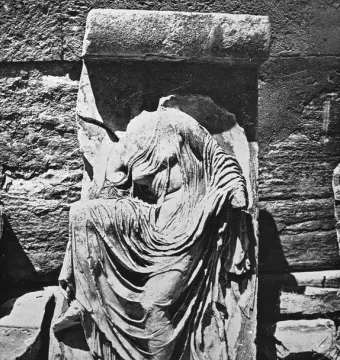
© Brooklyn Museum · No restrictions
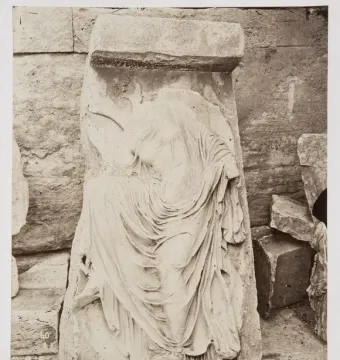
© Unknown authorUnknown author · Public domain
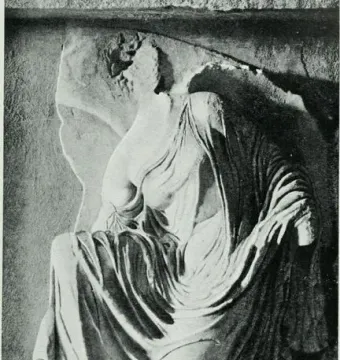
1907 © Internet Archive Book Images · No restrictions
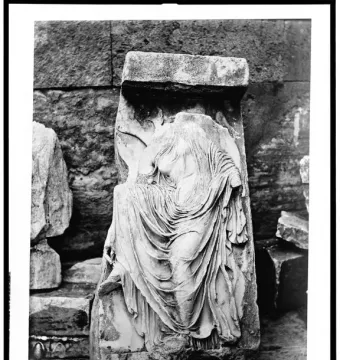
1850 © Miscellaneous Items in High Demand, PPOC, Library of Congress · Public domain
· CC BY 4.0
Identification | |
| Title | Nike untying her sandal |
| Original title | Nike rozwiązująca sandał |
| Alternative titles | Nike Fixing her Sandal; Nike Taking off her Sandal; Nike Sandalbinder |
| Type | Ancient marble relief (bas-relief) |
Historical context | |
| Date | Late 5th century BCE, probably c. 420–400 BCE; some researchers date the parapet work to around 416 BCE and the Nike relief to around 409–406 BCE |
| Period | High Classical period of ancient Greek art |
| Associated structure | Parapet balustrade of the Temple of Athena Nike on the Acropolis of Athens |
| Function of parapet | Built to protect people from accidentally falling off the rock and for the safety of people climbing the tower |
| Subject matter of parapet reliefs | Victorious celebration of Athens' battles against its enemies |
Creator | |
| Attribution note | Several sculptors were distinguished as having made the works; the work on the parapet has been described as among the most stylistically advanced |
| Workshop | Agoracritus' workshop |
| Attribution | Possibly Callimachus; also commonly attributed to "Master E" |
Discovery and provenance | |
| Original location | South side of the parapet of the Temple of Athena Nike, Acropolis of Athens |
| Findspot | Near the Temple of Athena Nike on the Acropolis |
| Excavation date | 1835 |
| Excavation director | Ludwig Ross |
| Original form | Right part of a larger relief slab from the parapet |
Location and ownership | |
| Current location | Acropolis Museum, Athens, Greece |
| Inventory number | 973 |
Physical characteristics | |
| Number of slabs in parapet | Several dozen slabs |
| Support | Relief slab from a parapet balustrade; almost the entire upper edge of the balustrade remains |
| Missing parts | Head, neck, left hand, surface of the left foot, and upper part of the right wing are missing |
| Object dimensions | 106 cm high; 52 cm wide |
| Extent of survival | Most of the relief is preserved, but it has significant damage |
Materials | |
| Material | Pentelic marble |
Technique | |
| Technique | Relief carving; occasional ridges carved over a fully modeled nude |
| Drapery style | Wet drapery style with catenary folds and many finely spaced ridges |
Appearance | |
| Clothing | A himation and a very thin chiton with sleeves fastened at each shoulder; the fastening on the right shoulder has come undone, causing the chiton to slip from Nike's right breast |
| Body proportions | If Nike's right leg were straightened, it would be longer than the left |
| Drapery effect | The drapery clings to the body as if wet, is almost transparent, and clearly distinguishes the cloth from the body underneath |
| Wings | Her wings frame her figure from behind |
| Left arm and hand | Left arm is slightly bent and the hand holds the folds of her himation so both ends fall on the left side |
| Right hand | Adjusting her sandal; the hand appears to hold a strap rather than touch the sandal |
| Pose | Leaning forward with her right foot on a rock, right leg bent, balancing on a slightly bent left leg, with the upper torso turned forward; the lower body is in profile or close to profile and the upper body is almost frontal |
| Depicted figure | Nike, the ancient Greek goddess of victory |
Iconography and meaning | |
| Depicted action | Nike is untying or fixing the sandal of her right foot |
| Interpretation of action | She is removing her sandal to enter the temple barefoot, according to custom |
| Broader scene | A sacrifice offered in thanks for a victory, probably Alcibiades' victory over Sparta |
| Related figures in the relief ensemble | Seated Athena with trophies; goddesses decorating a trophy (tropaion) and leading animals for sacrifice; winged Nikes leading bulls or adorning victory trophies |
| Stylistic associations | The sculpture shows similarities with the iconography of Aphrodite |
| Historical interpretation | These similarities have been taken to suggest the existence of a cult of Aphrodite Pandemos in the area |
History and restoration | |
| Historical fate of temple and parapet | Demolished by the Ottomans in 1687 to strengthen the rampart and fortify the western side of the Acropolis against Venetian attacks under Francesco Morosini |
Significance | |
| Artistic importance | Considered the most noteworthy of all Nikai sculptures found in temples |
| Comparative significance | No other known example has the same graceful attitude combined with the delicacy of the drapery |
| Compositional significance | Its originality is considered one of the features that distinguish it from other sculptures |