
Rachis Altar
The Rachis Altar is one of the most important sculptures of the so-called Ratchis Renaissance. Dated between 737 and 744, when the Lombard Ratchis was duke of Friuli, it is now preserved in the Christian Museum of Cividale del Friuli, Italy. The altar measures 1.44 x 0.90 x 0.88 m and is made of four Aurisina marble panels. Its carved faces show a Latin inscription, the Visitation, Christ in Majesty within a vesica piscis supported by four angels, and the Adoration of the Magi. The surface still preserves traces of altered pigments, and the work was once highlighted with polychromy, glass paste, and gold leaf.
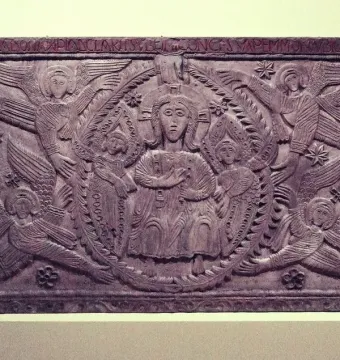
© James Steakley · CC BY-SA 3.0
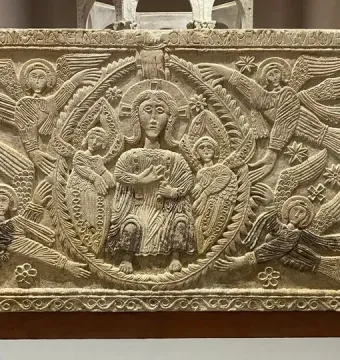
2024 © Christian Diocesan Museum and Treasure of the Cathedral of Cividale del Friuli · CC0
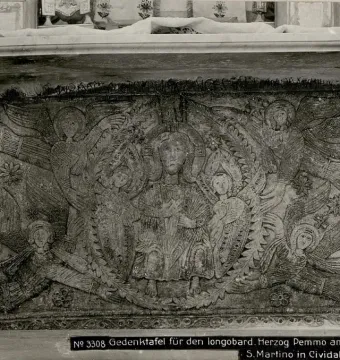
© K.u.k. Kriegspressequartier, Lichtbildstelle - Wien · Public domain
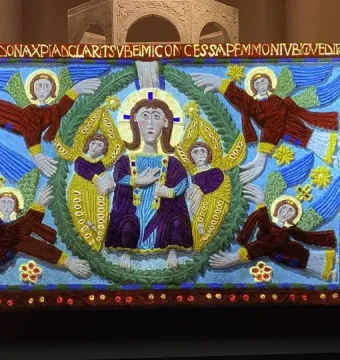
2024 © Christian Diocesan Museum and Treasure of the Cathedral of Cividale del Friuli · CC0
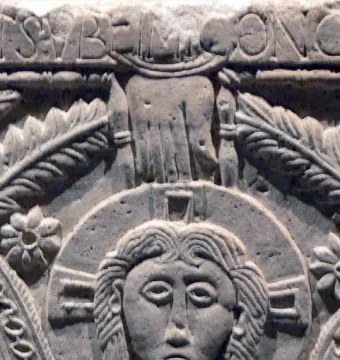
April 2011 © Wolfgang Sauber · CC BY-SA 3.0
Identification | |
| Title | Rachis Altar |
| Alternative name | Altare del duca Rachis |
| Type | Altar |
Historical context | |
| Art historical period | Liutprand Renaissance |
| Date | Between 737 and 744 |
| Historical context | Made during the period when Ratchis was Duke of Friuli |
Creator | |
| Associated ruler | Ratchis, Duke of Friuli at the time and later King of the Lombards |
Discovery and provenance | |
| Documented presence | Attested at the Church of San Martino in Cividale since 1568 |
| Provenance | Transferred in 1947 from the Church of San Martino in Cividale to the cathedral of Cividale del Friuli |
| Original location | Church of San Martino in Cividale |
Location and ownership | |
| Current location | Christian Museum of Cividale del Friuli, Cividale del Friuli, Province of Udine, Friuli-Venezia Giulia, Italy |
Physical characteristics | |
| Dimensions | 1.44 × 0.90 × 0.88 m |
Materials | |
| Material | Four slabs of Aurisina marble |
| Original embellishments | Polychromy, glass paste, and gold leaf |
Technique | |
| Technique | Low relief |
Appearance | |
| Coloring | Originally brightly colored, with significant altered pigment remains still visible on the front surface |
| Hierarchical scale | More important figures are larger than less important ones, such as Mary larger than Elizabeth and Christ larger than the angels |
| Surface decoration | Highly decorated surface in the horror vacui tradition |
| Figural distortions | Some figures are distorted, such as the angels' large hands holding the mandorla |
| Facial type | Faces with narrowed, inverted-pear-shaped chins |
| Comparison | Resembles a monumental ivory casket |
| Stylistic character | Strongly two-dimensional, with figures standing out sharply from the background like a relief drawing |
| Style | Highly abstract, anti-naturalistic style with Late Antique roots and Byzantine iconographic models, marked by stylization and a calligraphic quality |
| Relic cavity | A recess for relics on the side probably hidden from public view |
| Front scene | Christ in Majesty on the front face |
| Back decoration | Two Greek crosses decorated with rhombi and squares, a central rose, a five-pointed star in a circle below the fenestrella confessionis, and two rosettes at the lower corners |
| Inscription | Latin dedication inscription on the upper edge, running around the four sides |
| Relief scenes | The Visitation; Christ in Majesty; the Adoration of the Magi |
| Original architectural setting | Originally surmounted by a ciborium with a hanging ornament, perhaps a cross or a golden crown |
| Decorative frame | Braided frame around the slab |
Iconography and meaning | |
| Symbolism | The anti-naturalistic form and former chromatic richness emphasize the sacred and symbolic value of the work |
| Adoration scene | The Virgin sits on a tall wooden throne with the Child Jesus on her lap; the three Magi stand to the left bringing gifts; an angel above, placed horizontally, guides them |
| Visitation scene | The Visitation of the Virgin Mary to Elizabeth |
| Christ in Majesty iconography | Christ rises to heaven inside a tree-like mandorla supported by four angels and flanked by two additional angels |
| Angelic iconography | The flanking angels combine cherubim and seraphim iconography |
| Magi depiction | The Magi wear Asian-style garments, including Phrygian caps and draped robes |
| Virgin's attribute | A cross is engraved on the Virgin's forehead |
Inscription | |
| Inscription language | Latin |
| Inscription type | Dedication inscription |
| Inscription purpose | Remembers Duke Ratchis as patron of the work |
| Inscription text | "[M]AXIMA DONA XPI ADCLARIT SVB(L)EIMI CONCESSA PEMMONI VBIQVE D(E)I REFO / RMARENTUR UT TEMPLA NAM ET INTER RELIQVA / DOMVM BEATI IOHANNIS ORNABIT PENDOLA TEGURO PVLCHRO ALT / ARE DIDABIT MARMORIS COLORE RATCHIS HIDEBOHOHLRIT" |
| Inscription translation | The text says that Ratchis, using generous donations left for the glory of Christ by the sublime Pemmone to restore ruined churches, adorned among other things the church of Saint John, enriching the altar with a hanging cross placed under the ciborium, beautiful in marble color. |
| Translation note | "hidebohohrit" is probably to be understood as meaning "great knight" |