
Barberini Ivory
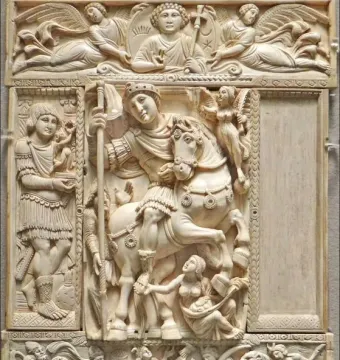
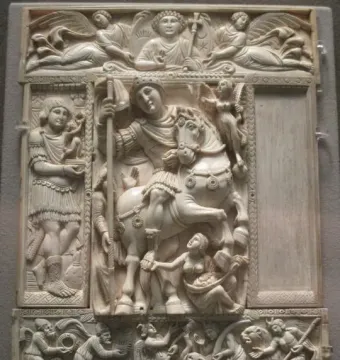
Barberini Ivory, also known as the Barberini Diptych, is a Byzantine work of art dated to the last years of Late Antiquity or the early Middle Ages. It is now in the collection of the Louvre in Paris. The piece is an imperial diptych made of ivory with four carved panels in a classicizing style known as the late Theodosian style. It probably represents a triumphant Byzantine emperor, often identified as Justinian, though other identifications have also been proposed. The front shows the emperor with a conquered barbarian, an allegorical figure, and an angel or Victory crowning him, while Christ appears above with two angels. The back includes a list of Frankish kings linked to Queen Brunhilda of Austrasia.
November 2014 © Jean-Pierre Dalbéra · CC BY 2.0
July 2019 © Thomon · CC BY-SA 4.0
© Unknown authorUnknown author · Public domain
· CC BY 2.5
· CC BY 2.5
Identification | |
| Title | Barberini ivory |
| Alternative names | Barberini Diptych; Peiresc-Barberini ivory |
| Type | Imperial Byzantine ivory diptych leaf; often grouped among imperial diptychs |
| Object category | Profane official object |
Historical context | |
| Date | Usually dated to the first half of the 6th century |
| Period | Late Antiquity |
| Artistic style | Late Theodosian classicizing style |
| Cultural tradition | Byzantine |
| Probable emperor depicted | Usually identified as Justinian I; possibly Anastasius I or Zeno |
Creator | |
| Attribution | Attributed to an imperial workshop in Constantinople |
Discovery and provenance | |
| Museum acquisition | Acquired by the Louvre in 1899 |
| 1625 provenance | Offered by Nicolas-Claude Fabri de Peiresc to Cardinal Francesco Barberini at Aix-en-Provence, then entered Barberini's collection in Rome |
| Later history | Its history is unknown until 1625 |
| Commissioning and offering | Probably commissioned by Brunhilda and offered to the church as a votive image; possibly a gift from Emperor Maurice to Brunhilda |
| Early provenance | Brought to Gaul at an early date |
| Interpretation of reverse inscription | Suggests the prominent position of queens within Frankish royal families |
| Reverse inscription | An engraved list of Frankish kings, all relatives of Brunhilda |
| Historical association | Linked to Queen Brunhilda of Austrasia |
Location and ownership | |
| Current location | Louvre Museum, Paris, Department of Decorative Arts |
| Inventory number | OA 9063 |
Physical characteristics | |
| Surviving state | Only one leaf survives |
| Structure | A diptych leaf made of four rectangular plaques arranged around a larger central plaque |
| Dimensions | 342 × 268 mm overall; central plaque 190 × 125 × 25 mm |
Materials | |
| Material | Carved elephant ivory |
| Inlays | Set with precious stones; seven pearls survive |
| Polychromy | No traces survive |
Technique | |
| Reverse inscriptions | The reverse has later incised lines over older ink inscriptions |
| Relief technique | Very deep relief with parts worked completely à jour (openwork) |
| Reverse surface | Flat and smooth, without a wax recess |
| Construction | The plaques are joined with grooves and strips; no trace of a hinge survives |
Appearance | |
| Condition of missing elements | The right-hand plaque is missing and was probably replaced in the 16th century by a small tablet inscribed "CONSTANT. N. IMP. CONST."; the traditional palm of victory is also lost |
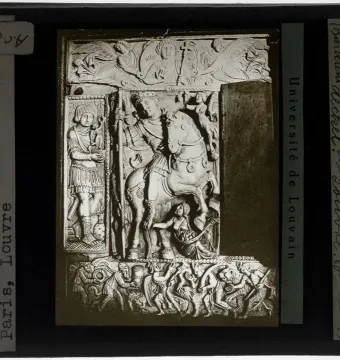
| Front composition | Four plaques with a larger central plaque; the right-hand plaque is a replacement |
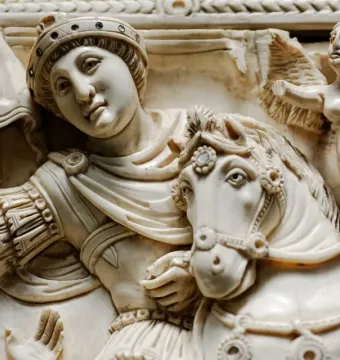
| Main front scene | The emperor, shown as a triumphant victor, is accompanied by a conquered barbarian at left, a crouching allegorical figure, and an angel or Victory crowning him |
| Upper figure | Christ above, flanked by two angels in the style of pagan Victory figures |
| Lower scene | Barbarians from west and east bring tribute, including wild animals |
| Side figure | A high-ranking officer or soldier holds a statuette of Victory; the counterpart on the right is lost |
Iconography and meaning | |
| Overall iconography | Combines pagan Roman triumphal imagery with a Christian upper register showing Christ as Cosmocrator |
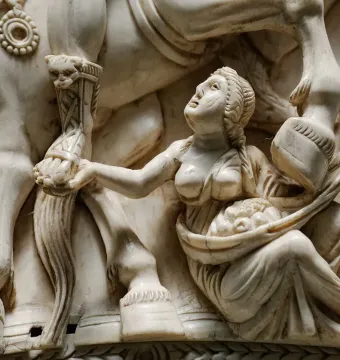
| Lower female figure | A woman below with an allegorical character, corresponding to Tellus/Gaia and possibly also a pacified province; she offers fruits or gifts from a fold of her garment |
| Victory globe detail | The Victoria figure stands on a small globe engraved with an X-shaped mark, sometimes interpreted as a Christogram |
| Tribute | Includes wild animals |
| Lower-right group | Eastern barbarians, depicted at right with ivory tusks, a tiger, and a small elephant |
| Lower-left group | Western barbarians, depicted at left in trousers |
| Christ scene meaning | Christ reigns above, while the emperor represents him on earth below |
| Crowning figure | An angel or Victory with a now-lost palm of victory |
| Main front allegorical figure | A crouching figure probably representing conquered or reconquered territory, holding the emperor's foot in gratitude or submission |
| Main front barbarian | A conquered barbarian in trousers, partly hidden by the emperor's spear, appearing astonished and reverent rather than combative |
Significance | |
| Relation to consular diptychs | Not a consular diptych, but it shares many decorative features with consular diptychs and is not clearly a writing tablet |
| Art historical importance | Considered one of the most important works in its genre and an important historical document |
| Interpretive note | The composition follows the ancient Roman triumphator omnium gentium tradition, with the Christian meaning supplied mainly by the upper panel |
| Dating evidence | Christ’s and the angels’ curled hair is an important clue for dating the work |
Other | |
| Preservation notes | No traces of polychromy are visible despite earlier suggestions; the existing leaf is already too heavy to serve a practical utilitarian function; it is uncertain whether the object belonged to a diptych, and a second leaf, possibly showing an empress, is not securely attested |
| Reverse inscription origin and date | Onomastic analysis suggests the reverse names may come from Auvergne rather than Provence, and the inscriptions are probably from the late 6th or early 7th century, possibly around 613 |
| Reverse inscription content | A list of 350 names arranged in six columns, apparently a prayer for the dead, including the kings of Austrasia and mainly Latin names |
| Collection note | One of the most important pieces in the Barberini collection |