
Major General John A. Logan
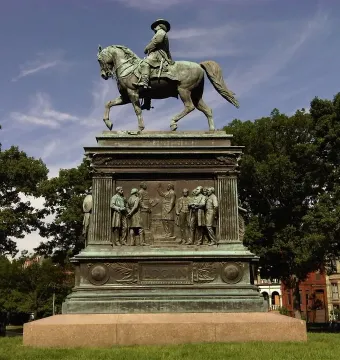
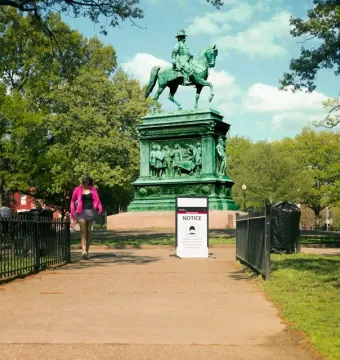
Major General John A. Logan is an equestrian statue in Washington, D.C., honoring politician and Civil War general John A. Logan. Also known as the General John A. Logan Monument and the Logan Circle Monument, it stands at the center of Logan Circle, a public traffic circle and park in the Logan Circle neighborhood. The bronze sculpture was created by Franklin Simmons, with a base designed by Richard Morris Hunt. It rests on a bronze and granite pedestal decorated with two reliefs depicting historically inaccurate moments from Logan’s life. Dedicated in 1901, the monument is one of the eighteen Civil War monuments in Washington, D.C., and it is maintained by the National Park Service.
May 2009 © Payton Chung · CC BY 2.0
April 2021 © Ted Eytan · CC BY-SA 2.0
September 2012 © Ted Eytan · CC BY-SA 2.0
© Carol M. Highsmith · Public domain
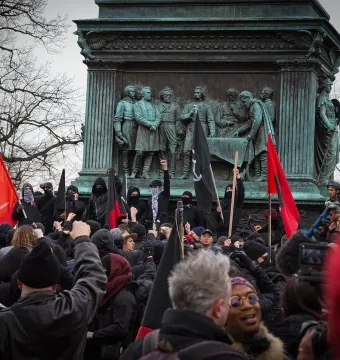
January 2017 © Mobilus In Mobili · CC BY-SA 4.0
Identification | |
| Title | Major General John A. Logan |
| Type | Equestrian bronze statue |
| Monument category | Civil War monument |
| Alternative names | Monument to General John A. Logan; Logan Circle Monument; General John A. Logan Monument; John A. Logan Memorial |
Iconography and meaning | |
| North side figure | Allegorical female figure representing Peace or Victory |
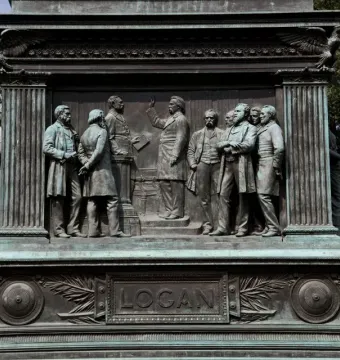
| West relief | Logan and other Civil War officers discussing the war; figures include Francis Preston Blair, Jr., Grenville M. Dodge, William Babcock Hazen, Mortimer Dormer Leggett, Joseph A. Mower, Henry Warner Slocum, and Captain Bill Strong |
| South side figure | Allegorical female figure representing War |
| Historical inaccuracies | The reliefs are historically inaccurate; Logan took the Senate oath in 1879, Arthur became vice president in 1881, two depicted senators were not sworn in until 1882 and 1884, and another depicted senator died in 1877 |
| Interpretation | The monument portrays Logan in relation to his Civil War service and his role as a senator |
| East relief | Logan being sworn in as senator by Vice President Chester A. Arthur; figures include Roscoe Conkling, Shelby Moore Cullom, William M. Evarts, John F. Miller, Oliver P. Morton, Allen G. Thurman, and Daniel W. Voorhees |
| Subject | John A. Logan (1826–1886), Union Army general, politician, and advocate for military veterans |
Location and ownership | |
| Location | Center of Logan Circle, Washington, D.C., United States |
| Ownership and maintenance | Owned and maintained by the National Park Service, U.S. Department of the Interior |
| Original site | Center of Iowa Circle, Washington, D.C. |
| Site context | A traffic circle and public park in the Logan Circle neighborhood; originally in an upscale neighborhood in the city's northwest quadrant |
| Current district | Logan Circle Historic District; Fourteenth Street Historic District |
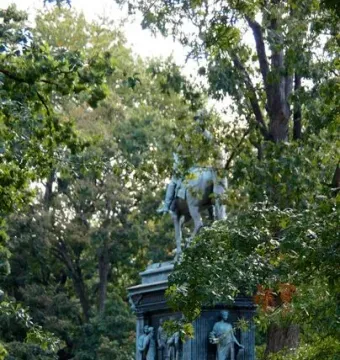
| Site features | Sidewalks lead from the circle to the monument, about 20 oak trees are planted in the circle, and a small ornamental iron fence surrounds the base |
Historical context | |
| Historical context | Erected shortly after Logan's death in 1886 as a memorial to the military hero |
| Commissioning organizations | Society of the Army of Tennessee (SAT), working with the Grand Army of the Republic (GAR) and Mary Logan |
| Commission authorization | March 2, 1889 |
Creator | |
| Artist | Franklin Simmons (1839–1913) |
| Base architect | Richard Morris Hunt |
| Recommended by | Augustus Saint-Gaudens |
Discovery and provenance | |
| Sculptor selection date | December 1892 |
| Model preference | Mrs. Logan preferred the model selected as the most pleasing to her |
| Funding | $65,000 total; about $13,000 from the SAT and the rest from the federal government |
| Foundry | Fonderia Nelli, Rome, Italy |
Physical characteristics | |
| Weight | Not given in the source fragment |
| Base decoration | Two relief panels, a bald eagle at each upper corner, and palm leaves around the name "LOGAN" |
| Base materials | Bronze and granite |
| Base type | Rectangular bronze base on a low granite base |
| Dimensions | The sculpture and base are described as tall, long, and wide; exact measurements are not given in the source fragment |
Materials | |
| Statue material | Bronze |
| Base material | Bronze and granite |
| Casting material | Bronze |
Technique | |
| Inscription | "FOND. NELLI ROMA 1897"; "FRANKLIN SIMMONS" |
Appearance | |
| Horse pose | The horse strides forward with its right foot raised |
| Base details | A bronze base with reliefs, allegorical figures, and patriotic/victory symbolism |
| Statue details | The bronze equestrian statue stands on a bronze base with a granite foundation |
| Pose | He holds the horse's reins in his left hand and a downward-pointing sword in his right |
| Depicted figure | John A. Logan is shown with neck-length hair and a mustache, wearing a Civil War military uniform with a long belted coat, boots, gloves, and a hat |
History and restoration | |
| Contributing property status | Contributing property to the Logan Circle Historic District (listed June 30, 1972) and the Fourteenth Street Historic District (listed November 9, 1994) |
| Historic designations | Listed as one of eighteen Civil War monuments in Washington, D.C. on the National Register of Historic Places on September 20, 1978, and on the District of Columbia Inventory of Historic Sites on March 3, 1979 |
| Site rename | Iowa Circle was renamed Logan Circle in 1930 in honor of Logan, who had briefly lived at 4 Logan Circle in 1885 |
| Mary Logan's defense | She said the reliefs were not meant to be historically accurate and were intended to portray the most prominent men in the Senate during her husband's 16 years there |
| Later criticism | Praise turned to criticism in the weeks after dedication, especially regarding the relief panels |
| Initial reception | Very positive; The New York Times said the statue produced an impression of dignity, beauty, and power |
| Dedication speeches | McKinley called Logan the ideal volunteer soldier of two wars, the eminent senator and commoner, and a heroic son of the nation; Chauncey Depew praised Logan as one of the nation's great heroes |
| Dedication ceremony | A large military parade led by Colonel Francis L. Guenther was followed by the unveiling, presided over by Grenville M. Dodge; George Tucker pulled the cord to part the flags, the Fourth Artillery fired a national salute, and a letter from Illinois Governor Richard Yates Jr. was read by Shelby Moore Cullom; the benediction was given by Reverence J. G. Butler |
| Dedication attendees | President William McKinley, members of his cabinet, Senator Chauncey Depew, Senator Shelby Moore Cullom, General Grenville M. Dodge, Mary Logan, members of the Logan family, GAR and SAT representatives, and Franklin Simmons |
| Dedication date | April 9, 1901 |
| Installation on base | About one week after arrival in Washington, D.C. |
| Arrival in Washington | January 16, 1901 |
| Transport to Washington | Transported to Washington, D.C. on a two-masted schooner because it was too large to move by train |
| Shipment | Shipped to the United States, arriving in Brooklyn in December 1900 |
| Foundry ceremony | A ceremony was held at the foundry upon completion, attended by King Umberto I of Italy and Queen Margherita; Simmons was knighted |
| Sculpture completion | 1900 |
| Base installation | April 18, 1898 |
Significance | |
| Group significance | One of eighteen Civil War monuments in Washington, D.C. and the second equestrian monument commissioned by the SAT in Washington, D.C.; the first was the Major General James B. McPherson statue |
Other | |
| Related organizations | Grand Army of the Republic (GAR); Society of the Army of Tennessee (SAT) |
| Sculptor's other works | Peace Monument; statues in the National Statuary Hall Collection; statues in the United States Senate Vice Presidential Bust Collection |
| Base production | The base was completed in three and a half months instead of the planned year; Simmons requested several extensions beginning in 1896 and paid the foundry extra to work around the clock on the base |
| Site preparation | The Cranford Paving Company prepared the site; a new stone was ordered in September 1897 after dissatisfaction with the first work |