
Armento Rider
Armento Rider is a Greek ancient bronze statuette in the British Museum, inventory number GR 1904.7-3.1. Also known as the mounted warrior or Bronze horse and rider, it was found in Armento and purchased in 1904 from the Forman collection. The bronze is almost intact and covered with a patina. The horse and detachable rider are separately modelled and cast in solid bronze. The rider is shown as a young beardless man wearing a short belted chiton and a helmet enclosing the whole head, decorated with engraved lotus flowers. The bridle is missing. It is a notable example of Corinthian-style Greek bronze art from the 6th century BC.
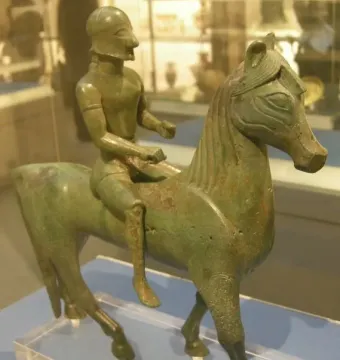
February 2011 © sailko · CC BY-SA 3.0
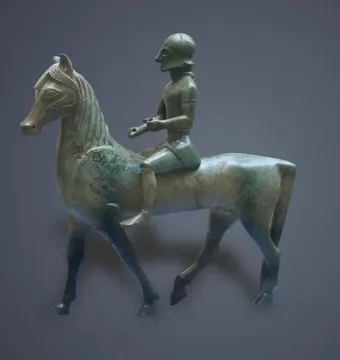
· CC BY-SA 3.0
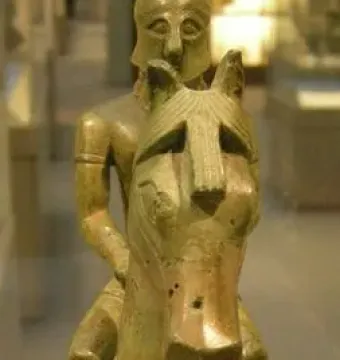
February 2011 © sailko · CC BY-SA 3.0
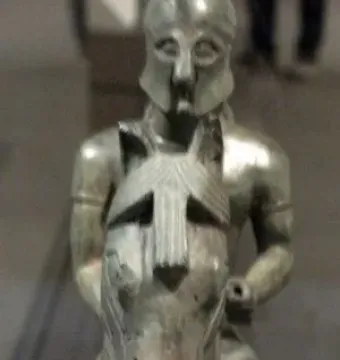
August 2014 © Johnbod · CC BY-SA 4.0
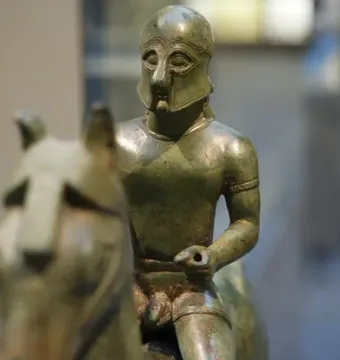
January 2016 © Ashley Van Haeften · CC BY 2.0
Identification | |
| Title | Armento Rider |
| Alternative name | The Riding Warrior; Bronze horse and rider |
| Type | Greek ancient bronze statuette |
Historical context | |
| Date | c. 560–550 BC |
Creator | |
| Artistic style | Greek bronze art of the 6th century BC, Corinthian type |
Discovery and provenance | |
| Findspot | Armento, southern Italy |
| Initial attribution | Originally wrongly attributed to Grumentum |
| Collector | Gábor Fejérváry, a Hungarian collector |
| Purchased by collector | Bought in Naples in 1833 |
| Former collection | Forman Collection |
| Acquisition by museum | Acquired by the British Museum in 1904 |
| Provenance note | Passed through several collections before acquisition by the British Museum |
Physical characteristics | |
| Construction | Horse and detachable rider are made as two separate pieces |
| Condition | Almost undamaged and covered with a patina |
| Dimensions/type | Diminutive statue |
Technique | |
| Casting | Solid cast |
Materials | |
| Material | Bronze |
Appearance | |
| Depicted subject | A rider and a horse |
| Depicted figure | A young beardless Greek warrior |
| Helmet | Corinthian helmet decorated with engraved lotus flowers |
| Clothing | Short belted chiton |
| Horse description | Horse with a long mane and elongated body |
| Missing attributes | Bridle missing; formerly held a spear and reins for the horse |
Location and ownership | |
| Current location | British Museum |
| Inventory number | GR 1904.7-3.1 |
Significance | |
| Art historical significance | Considered one of the oldest works of art from Western Greece or Magna Graecia |
| Historical significance | One of the earliest bronzes produced in the ancient Greek world |
Other | |
| Discovery and attribution status | First discovered with an incorrect attribution; later revised based on recent research |
| Correct origin according to recent research | Armento, an ancient Greek site in Basilicata, southern Italy |