
The Confidence
The Confidence is a sculpture by the French artist Camille Claudel, also known as La Confidence. Created in 1897 in onyx and bronze, it shows four nude women seated together, with one woman confiding in the other three as they lean toward her to listen. The work was first modeled in plaster between 1893 and 1895 and shown at the Salon, where it attracted strong interest. Several versions were later made, including the 1897 onyx and bronze version from the Peytel collection, exhibited at the Rodin Museum in Paris, as well as a version held by the Camille Claudel Museum. The group is regarded as one of Claudel’s masterpieces.
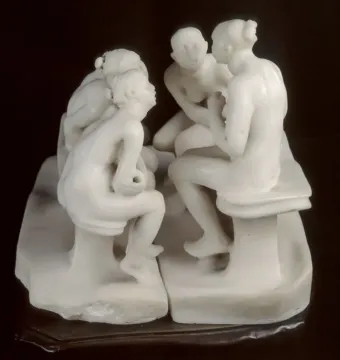
March 2017 © Museo Soumaya · Public domain
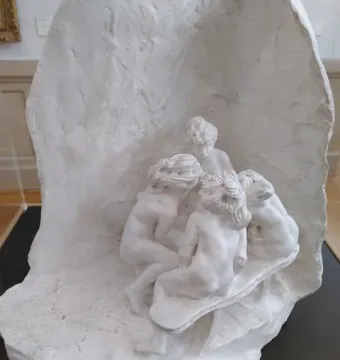
February 2022 © 2le2im-bdc · CC BY-SA 4.0
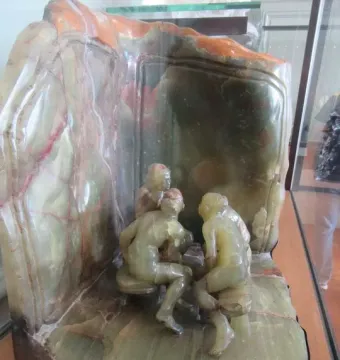
April 2018 © Draganapopovic · Public domain

March 2014 © Thibsweb · Public domain
Identification | |
| Title | The Confidence |
| Original French title | Les Causeuses |
| Alternative titles | Le pettegole; Les Bavardes; La confidenza; La Confidence |
Creator | |
| Artist | Camille Claudel |
| Artist nationality | French |
| Artist occupation | Sculptor |
Historical context | |
| Date conceived | 1893 |
| Date created | 1893–1895 |
| Creation period | 1890s |
| Original version | Plaster |
| Series context | Part of a series of small-scale works Claudel called "sketches from nature" |
| Related earlier works | Vertumne et Pomone; L'Âge mûr |
| Inspiration | Claudel reportedly observed a group of women talking during a train journey |
| Letter mention | Mentioned in a letter to her brother, sent with a sketch titled La confidenza |
Physical characteristics | |
| Early composition feature | In the first plaster version, the group was placed behind a folding screen |
| Subject | Four nude seated women, one whispering to the other three who lean toward her to listen |
| Type of work | Sculptural group |
Materials | |
| Primary materials | Onyx and bronze |
| Later version materials | Jade, marble, and bronze |
| Earlier version material | Plaster |
Technique | |
| Versioning | Several later versions were made, with and without the folding screen |
Location and ownership | |
| Collection associated with notable version | Peytel collection |
| Bronze version location | La Piscine, Roubaix |
| Plaster version location | Museum of Art and History, Geneva |
| Notable version current location | Musée Rodin, Paris |
| Notable version | 1897 onyx and bronze version made for collector Joanny Peytel |
History and restoration | |
| First public exhibition | Salon de Paris, 1895 |
| Exhibition title | Étude sur nature ("Study from life") |
| Reception | Successful at the Salon; it aroused great interest |
Other | |
| Critical reception | Gustave Geffroy praised the work as an apparition of truth, intimate, with a poetry of old age and shadow, a marvel of intelligence and human feeling; Mathias Morhardt called it a "prodigious masterpiece" and compared its importance favorably to modern works such as Les commères |
| Critical interpretation | Geffroy emphasized the poor bodies grouped together, the close heads, the secret being formed, and the mystery of chiaroscuro around the speaker and listeners; Morhardt interpreted it as four women seated in a narrow railway carriage, confiding a precious secret |
Significance | |
| Recognition | Considered one of Camille Claudel's masterpieces |
| Artistic significance | Seen as showing Claudel's creativity and originality, reflecting her life |