
Saint Peter
Saint Peter is a marble sculpture from the cycle of fourteen statues of the patron saints of the Florentine guilds in the exterior niches of Orsanmichele, Florence. It was commissioned by the Arte dei Beccai, the butchers’ guild, and was most likely made by Donatello, with a theoretical supporting role attributed by sources to Brunelleschi. According to art historian Francesco Caglioti, it was created around 1410–1412. The statue is made of Apuan marble and stands 243 cm high. Today the original is preserved inside the Orsanmichele Museum, while a copy replaces it outside.
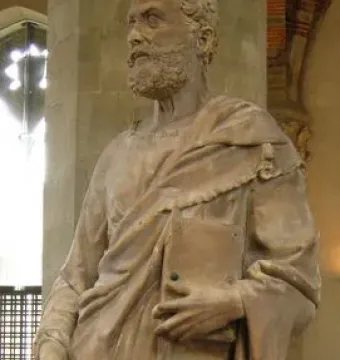
June 2014 © Sailko · CC BY-SA 3.0
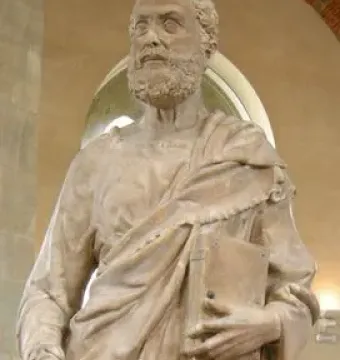
June 2014 © Sailko · CC BY-SA 3.0
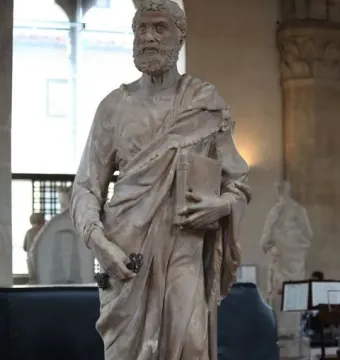
June 2014 © Mongolo1984 · CC BY-SA 3.0
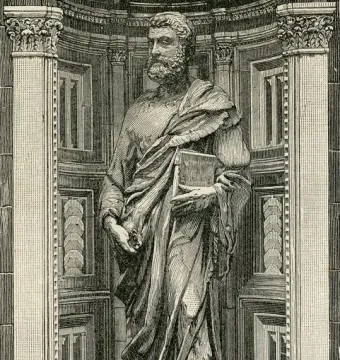
1894 © Giuseppe Barberis · Public domain
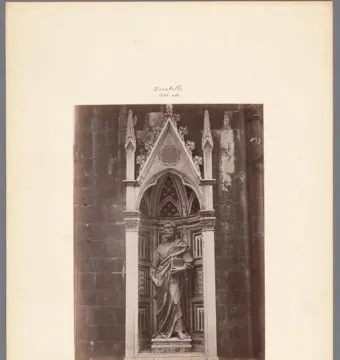
© Rijksmuseum · CC0
Identification | |
| Title | Saint Peter of Orsanmichele |
| Type | Statue |
| Subject | Saint Peter |
Historical context | |
| Series | One of the fourteen statues of the protectors of the Florentine guilds in the exterior niches of Orsanmichele |
| Commissioned by | Arte dei Beccai (the butchers' guild) |
| Date | Around 1412; stylistic comparisons suggest the third decade of the 15th century |
Creator | |
| Attribution | Traditionally attributed to Donatello; contemporary criticism increasingly attributes it to Filippo Brunelleschi |
| Role of Brunelleschi | Sources attribute a role to him in the sculpture's creation |
| Traditional attribution source | Giorgio Vasari, who wrote in the Vite that the work was commissioned to Brunelleschi and Donatello, but that only Donatello executed it and brought it to perfection |
| Attribution basis | Its very high quality; perspective inlays in the tabernacle; stylistic comparisons, including its strong classical character |
| Alternative attributions | Nanni di Banco, Michelozzo, Bernardo Ciuffagni |
Discovery and provenance | |
| Provenance documentation | Documentation for its provenance and authorship is lost |
Location and ownership | |
| Original location | Its original niche in the exterior of Orsanmichele, Florence |
| Current location | Museo di Orsanmichele, Florence |
| Original niche replacement | A copy now fills the original exterior niche |
| Location | Orsanmichele, Florence, Italy |
Physical characteristics | |
| Anatomical features | Thin, sinewy wrists |
| Height | 243 cm |
Materials | |
| Primary material | Marble, described as Apuan marble / Carrara marble; of particularly high quality and low porosity |
| Metal elements | Bronze keys and metal studs on the book; the keys are not original |
| Gilding | No traces of gilding were found; it may never have been gilded |
Appearance | |
| Depiction | Saint Peter shown as an ancient philosopher |
| Head | Bearded |
| Clothing | Toga and cloak with elegant, classical drapery |
| Attributes | Holds a book in the left hand and keys in the right hand |
| Orientation | Faces left toward Via de' Calzaiuoli |
| Viewing emphasis | Best appreciated from the left side or from the front; the right profile is less satisfactory |
| Placement effect | The right shoulder and the whole right side were hidden in the niche |
History and restoration | |
| Removal and restoration | Removed from the tabernacle in 1990 and restored by the Opificio delle Pietre Dure from 1990 to 1992 |
| Restoration support | Supported by the Accademia della Fiorentina and the Macellai Association, in honor of the ancient Arte dei Macellai |
| Preservation | One of the best-preserved works in the Orsanmichele series; the marble's low porosity helped prevent absorption of oils applied to the statues in the late 18th and early 19th centuries |
Significance | |
| Stylistic significance | Strongly classical in character; seen as an early phase of Brunelleschi's development toward the Renaissance, and also as the beginning of Donatello's sculptural research |
| Stylistic influences and comparisons | Brunelleschi's study of ancient sculpture in Rome after the 1401 Baptistery competition; comparisons with the Sacrifice of Isaac relief, the silver altar of Saint James in Pistoia, and Bernardo Ciuffagni's Prophet Isaiah and David |
| Stylistic details | Perspective inlays mixed with archaic elements; the drapery has been described as resembling a piece of wet chamois thrown across the figure |