
Diana of Versailles
Diana of Versailles is a famous statue of the goddess Diana, now preserved in the Louvre in Paris. Made of white marble and about 2 meters tall, it is a Roman imperial copy of a lost bronze original attributed to the Greek sculptor Leochares, probably dating to around 325 BC. Discovered in Italy, its exact provenance is unknown, though the Louvre suggests Nemi. The statue was given by Pope Paul IV to King Henry II of France in 1556, later restored by Barthélemy Prieur, transferred between Fontainebleau, the Louvre, and Versailles, and finally returned to the Louvre in 1798. It is regarded as one of the finest examples of Greco-Roman classical sculpture.
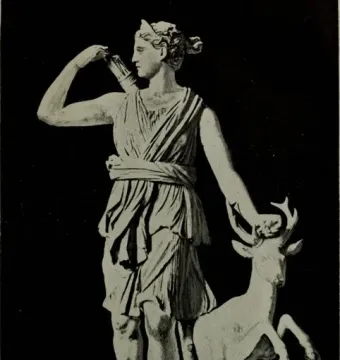
1886 © Virgil; Henderson, John, 1845-1932 · No restrictions
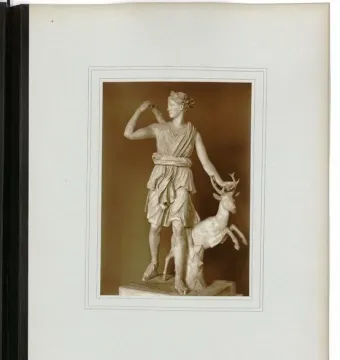
© Braun, Adolphe (1812-1877). Dessinateur. Photographe de l'oeuvre reproduite · Public domain
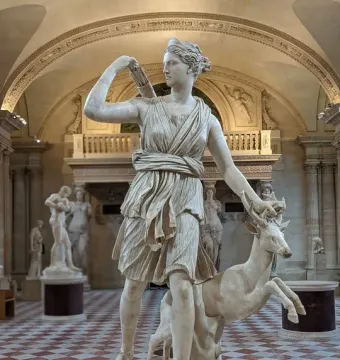
November 2021 © Shonagon · CC0
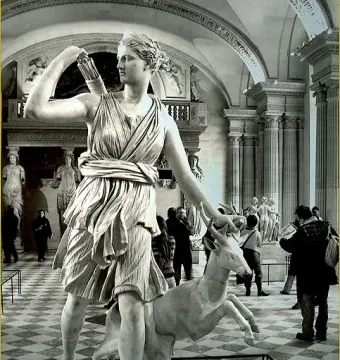
© Copy of Leochares (?) · CC BY-SA 3.0
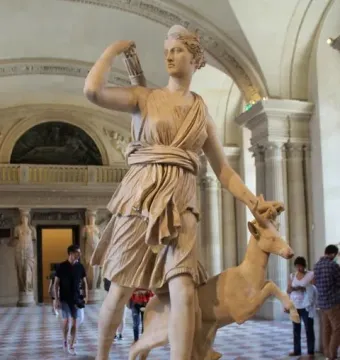
July 2016 © Gary Todd · CC0
Identification | |
| Title | Diana of Versailles |
| Alternative names | Diana de Versalhes; Diana the Huntress; Diana à la Biche; Diane Chasseresse; Artemísia, goddess of the hunt; Artémis, déesse de la chasse; Artemis of the Hunt; Artemide della caccia; Artemide con la cerva; Artemis with a Deer; Artemis on the Hunt; Diana with the Doe |
| Type | Marble statue |
| Subject | The goddess Diana (Artemis), goddess of the hunt |
Historical context | |
| Date of copy | Roman copy of the Hadrianic period, probably the first half of the 2nd century AD; some sources say the 1st or 2nd century AD |
| Original work | Lost Greek bronze original, probably c. 325 BC (around 340–320 BC in some sources) |
| Original attribution | Attributed to the Greek sculptor Leochares; Praxiteles has also been proposed |
Discovery and provenance | |
| Replacement at Fontainebleau | A bronze copy by Barthélemy Prieur was installed in 1605 |
| Transfer to the Louvre | 1602 by Henry IV; returned in 1798 by decree of the Convention during the French First Republic |
| Later location under Louis XIV | Versailles, including the Hall of Mirrors and the Grande Galerie in the Château de Versailles |
| First installation location | Queen's Garden, Palace of Fontainebleau, west of the Gallery of Stags |
| Reason for gift | A subtle but unmistakable allusion to Henry II's mistress, Diane de Poitiers |
| Donation to Henry II | 1556, by Pope Paul IV to King Henry II of France |
| Suggested provenance | Possibly Nemi, where there was once a sanctuary dedicated to Diana |
| Original provenance | Unknown |
| Discovery location | Italy; probably Nemi, but some sources suggest Tivoli near Villa Adriana |
Physical characteristics | |
| Height | 2 meters |
| Size | Slightly larger than life-size |
| Condition | The namesake example is also the best preserved |
Materials | |
| Material | White marble |
| Original material | Bronze |
| Support | A tree trunk supports the left leg |
Technique | |
| Copy type | Roman imperial copy |
Appearance | |
| Pose | The goddess is walking in motion, with her shoulders turned right and hips turned left in an X-shaped composition |
| Left arm | The restored left arm rests on the antlers of a deer; originally it probably held a bow |
| Associated animal | A small deer or doe, sacred to the goddess |
| Clothing | Short Doric chiton with a peplos around the waist, plus a himation or mantle diagonally over the left shoulder and sandals |
| Head adornment | Diadem |
| Hair | Wavy hair gathered at the back of the neck |
| Gaze direction | Looking to the right |
| Drapery style | Fluttering, flowing forms |
| Action | She reaches with her right arm to take an arrow from a quiver carried by a bandolier over her right shoulder |
Iconography and meaning | |
| Interpretation | Diana/Artemis as a huntress in motion; the missing weapon has been seen as turning the image into a more pastoral figure |
Location and ownership | |
| Inventory number | Ma 589 |
| Display location | Galerie des Caryatides, in the center of the Caryatids Room (Room 348 of the Lescot Wing); a dedicated room was specially designed for the statue |
| Collection | Collections of the Louvre Museum |
| Museum department | Department of Greek, Etruscan, and Roman Antiquities |
| Current location | Louvre Museum, Paris, France |
History and restoration | |
| Restoration | Restored by Barthélemy Prieur in 1602 and by Bernard Lange in 1802 |
| Bronze copies | Copied several times in bronze and marble; notable bronze copies were made by Barthélemy Prieur in 1605 and Hubert Le Sueur in 1634 for Charles I of England |
| Marble copy | A marble copy was made by Guillaume Coustou the Elder in 1710 for the Château de Marly-le-Roi |
| Additional decorative elements at Fontainebleau | The 1605 bronze copy stood on a tall Mannerist marble pedestal designed by Tommaso Francini, with bronze hunting dogs and deer heads that spouted water, in a garden surrounded by an orangery |
| Later developments | The orangery was removed in the mid-19th century by Louis-Philippe I; a bronze replacement copy dated 1684 later occupied the Galerie des Cerfs; a miniature was on the Titanic; in 1986 Robert Ballard discovered and photographed the statue on the seabed near the bow of the wreck |
Significance | |
| Reputation | By the mid-17th century it was regarded outside Italy as comparable to works in the Vatican Belvedere and the Borghese Palace; Alexander Murray called it the most important surviving representation of the goddess; it is considered one of the best examples of Greco-Roman classical sculpture and one of France's most valuable treasures |
Other | |
| Comparative findspots and related sites | Comparable statues of the same subject were found at Leptis Magna (present-day Libya) and Adalia (present-day Turkey) |