
Kouros of Apollonas
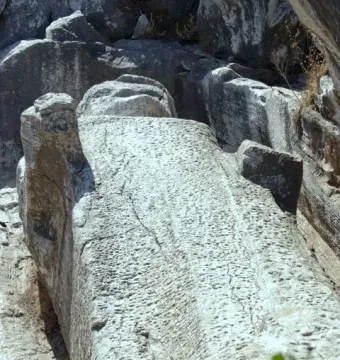
The Kouros of Apollonas, also called the Colossus of Dionysos, is an unfinished statue from the archaic period of ancient Greece. Carved from light gray Naxos marble, it stands 10.70 meters tall and weighs around 80 tons. The sculpture is a kouros dating to the turn of the 7th to 6th century BC. It remains lying in an ancient stone quarry near Apollonas, a small village in northern Naxos in the Cyclades. The figure was cut free on three sides but never completed, apparently because of its great size and weight. Traces in the quarry show the ancient stone-working and transport techniques used there.
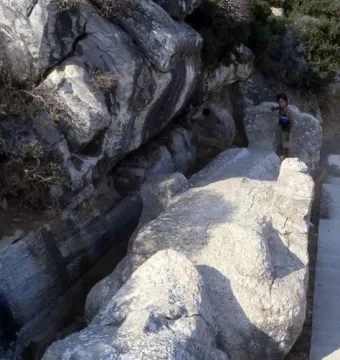
1988 © User:Choliamb · CC BY 4.0
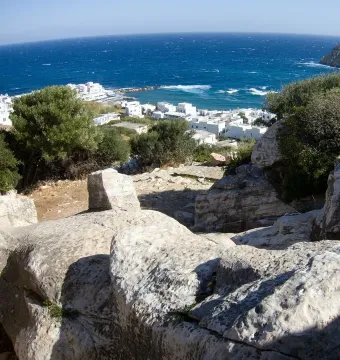
October 2011 © Zde · CC BY-SA 4.0
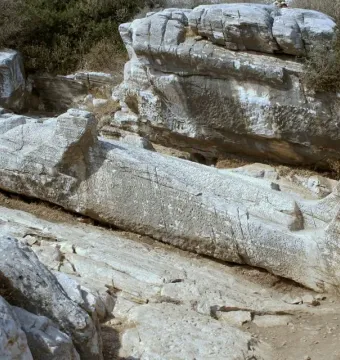
September 2005 © Zde · CC BY-SA 4.0
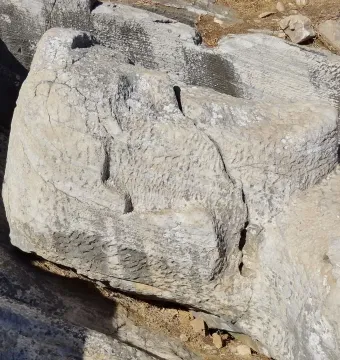
September 2013 © Olaf Tausch · CC BY 3.0
September 2006 © Zde · CC BY-SA 4.0
Identification | |
| Title | Kouros of Apollonas |
| Type | unfinished kouros statue |
| Alternative name | Colossus of Dionysos |
Historical context | |
| Date | turn of the 7th/6th century BC |
| Period | Archaic period of ancient Greece |
Creator | |
| Attribution history | Originally thought to be a statue of Apollo because of its location near Apollonas and the sanctuary of Apollo; named "Statue Apollonis" by Cristoforo Buondelmonti in the 15th century; identified as a statue of Apollo by Ludwig Ross in 1840; reattributed to Dionysus by Wilhelm von Massow in 1932; now classified as a kouros |
Discovery and provenance | |
| Original location | Ancient marble quarry near Apollonas, Naxos, in the Cyclades, Aegean Sea |
| Quarry context | Preserved in the quarry, apparently as the first attempt to move the block; the quarry is a typical surface quarry and one of the oldest in Greece |
Physical characteristics | |
| Plinth | about 50 cm high |
| Cracks | Present, but it is unclear whether they are original |
| Orientation | Lying on its back |
| Setting | On a rough rocky slope |
| Visible carved parts | Body, head with beard and ears, and the beginning of the hair are recognizable; arms are rudimentarily rectangular; the feet had only begun to be shaped |
| Condition | unfinished; roughly carved and block-like |
| Weight | about 80 tonnes |
| Height | 10.7 metres |
Materials | |
| Material | Light gray Naxian marble |
Technique | |
| Displacement | Slants downward toward the north at about 30°, with the east side lifted by 19 cm and shifted 32 cm downhill to the north |
| Quarrying method | The block was cut from the rock on three sides; a rectangular recess was made for inserting a wooden lifting beam |
| Surface treatment | Finishing produced a silky, smooth surface by breaking the marble crystals |
| Tools | Bronze pointed chisels, and probably picks, hammers, double-point tools, finer chisels, and lighter blows in the finishing stages |
| Tool marks | Numerous small point-like holes; wedge holes 5–8 cm wide cut into the back at intervals of 32–37 cm |
| Carving method | Worked from all sides, layer by layer; the rough outline was made first, then the figure was rounded out |
Appearance | |
| Contours | Clearly defined, flat contours |
Iconography and meaning | |
| Depicted figure | An older bearded man, usually interpreted as a kouros; archaic kouroi are generally understood as depictions of Apollo, but this sculpture has been interpreted as Dionysus because of the beard |
| Pose | The right arm would have been extended in front of the body |
Location and ownership | |
| Current location | At the ancient quarry near Apollonas, Naxos |
History and restoration | |
| Documentation of cracks | Cracks are visible in a sketch by Schaubert from 1835 for a copperplate engraving |
Significance | |
| Interpretive significance | The sculpture clearly demonstrates early Greek stone-carving and quarrying methods, which have been compared to Egyptian practice |