
Gero Cross
Gero Cross, also known as the Crucifix of Gero, is an Ottonian work dated to c. 965–970 and regarded as possibly the oldest representation of the crucified Jesus produced north of the Alps. It was commissioned by Gero, Archbishop of Cologne, and carved in oak wood, originally painted and partly gilded. The figure and cross are original, while the surrounding glory dates from 1683. Measuring 187 cm high and 165 cm wide with outstretched arms, it is displayed in a chapel near the sacristy of Cologne Cathedral, where it has been kept since its creation and is the focus of veneration and pilgrimage.
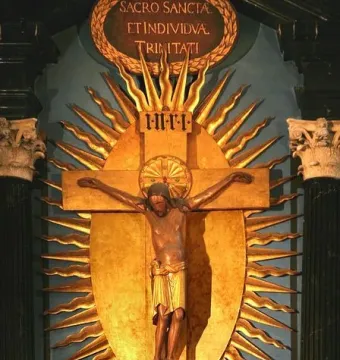
December 2007 © Lothar Spurzem · CC BY-SA 2.0 de
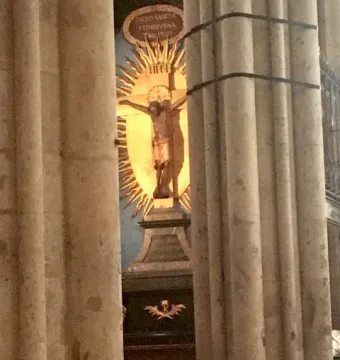
May 2020 © Velopilger · CC BY-SA 4.0
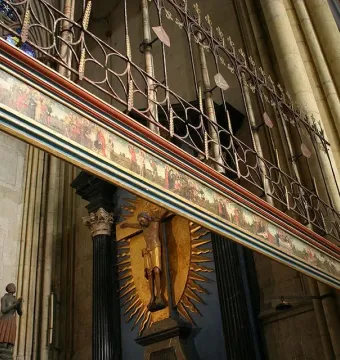
© Elya · CC BY-SA 3.0
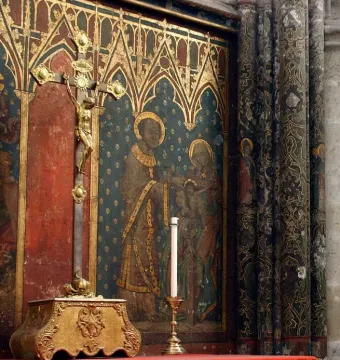
© Elya · CC BY-SA 3.0
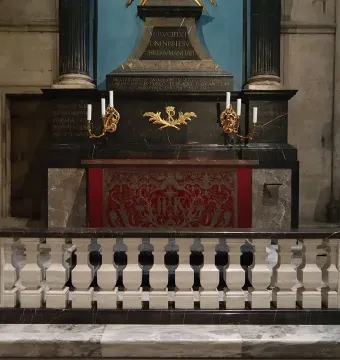
May 2022 © OnwardToThePast · CC BY 4.0
Identification | |
| Title | Gero Cross |
| Type | monumental crucifix sculpture |
| Subject | Christ crucified |
| Alternative names | Crucifix of Gero; Gerokreuz; Gerokruzifix; Cross of Gero; Croce di Gerone |
Historical context | |
| Style / period | Ottonian period, late 10th century |
| Date | c. 965–970 |
| Dating basis | Debated stylistic and scientific analysis; confirmed by dendrochronology in 1976, with the oak probably felled shortly after 965 |
Creator | |
| Commissioner | Probably Archbishop Gero of Cologne; the patron is uncertain |
| Artist | Unknown artist |
Discovery and provenance | |
| Early source | Dietmar (Thietmar) of Merseburg's Chronicle (1012–1018) says it was displayed above Gero's tomb and records a miracle story about it |
| Original display context | Likely installed under the patronage of Archbishop Gero of Cologne |
| Original location | Old Cathedral (Hildebold Cathedral), Cologne |
| Original placement | In the center of the nave above the sarcophagus of Gero, or possibly near the high altar / crossing arch |
| Wood provenance | Dendrochronology indicates the oak originated in Cologne or nearby |
| Place of production | Cologne or the surrounding area |
Physical characteristics | |
| Mounting | From 1683 onward it was fixed in a support; previously it was probably free-standing or lightly attached against the altar wall |
| Height | 187 cm |
| Width | 165 cm across the outstretched arms |
| Dimensions | 2.88 × 1.66 m |
| Scale | Life-size; more than 2 meters tall |
| Original elements | The figure, cross, halo, and cross-pieces are original |
| Later additions | Baroque surround, altar, and golden mandorla added in 1683 |
Materials | |
| Material | Oak wood |
Technique | |
| Surface treatment | Painted and partially gilded; the paint and gilding are later renewals |
Location and ownership | |
| Current location | Cologne Cathedral, Cologne, Germany |
| Display history | It has always been preserved and displayed in Cologne Cathedral |
| Earlier relocation | From 1270 it was installed in the ring of chapels of the new cathedral, probably above the altar of the Chapel of Saint Stephen; by 1351 at the latest it was in the Cross Chapel |
| Current installation | Hangs in the Cross Chapel near the sacristy, against the east wall |
History and restoration | |
| Survival | It survived the 1248 fire and destruction of the old cathedral during demolition work |
| Restoration | Last completely restored in 1900 by Wilhelm Batzem; the intervention is considered damaging by modern conservation standards |
| Documentation | Mentioned again in the 14th-century Vita of Irmgard of Süchteln and in a foundation charter referring to its location |
Iconography and meaning | |
| Stylistic influence | Shows strong Byzantine influence, probably mediated by contacts associated with Otto II's marriage and by artists and craftsmen in Theophanu's entourage; Gero may also have been influenced by his stay in Constantinople |
| Influence on later art | A major model for later medieval crucifixes, especially in 11th-century Germany, and a precursor to later Gothic depictions |
| Iconographic features | The slumped head, twisted body, and different arm heights create a strikingly natural, sorrowful pose |
| Earlier tradition contrasted with | Earlier depictions usually showed Christ upright and triumphant, or alive with open eyes; some Carolingian examples show him looking down at the Virgin |
| Depiction | Christ is shown dead, suffering, human, vulnerable, with a slumped head, lifeless body, closed eyes, and twisted posture |
Significance | |
| Historical significance | Possibly the oldest surviving monumental crucifix north of the Alps and possibly the oldest Western representation of Christ on the cross as dead |
| Art-historical significance | One of the earliest monumental sculptures of the Middle Ages and a fundamental landmark in Western art |
| Art-historical importance | Considered one of the greatest masterpieces of the Ottonian period |
| Devotional significance | Highly venerated and an object of pilgrimage |
Other | |
| Reported legend | Thietmar of Merseburg reports that Archbishop Gero healed a crack in Christ's head by inserting a consecrated host and a relic splinter after prayer |