
Kroisos Kouros
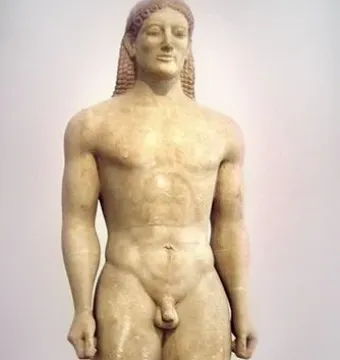
Kroisos Kouros, also called the Kouros of Anavissos, is an Ancient Greek kouros statue made around 530 BCE from Parian marble. It stands 1.94 metres tall and shows the traditional kouros pose: nude, striding forward with the left leg advanced and arms held straight at the sides. The figure has long hair, an impersonal expression, and the faint Archaic smile. Traces of the original polychromy survive, especially in the eyes and hair. Its identification is uncertain, though it is traditionally associated with a funerary base inscribed for a man named Kroisos. The statue was found in Paris in 1937 in the possession of art dealer M. Roussos, rescued by the Greek police, and taken to the National Archaeological Museum in Athens, where it is now displayed.
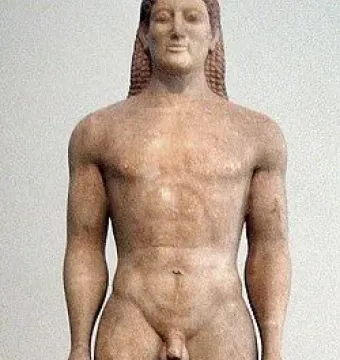
April 2025 © Historiadora del Arte · CC BY-SA 4.0
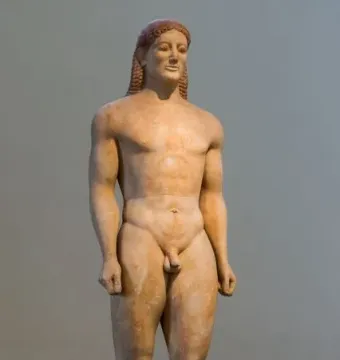
May 2015 © Jebulon · CC0
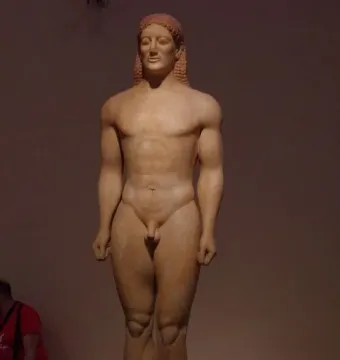
February 2020 © Paolo Villa · CC BY-SA 4.0
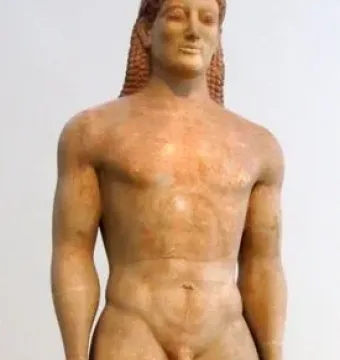
March 2009 © Tilemahos Efthimiadis · CC BY 2.0
· CC BY-SA 3.0
Identification | |
| Title | Kroisos Kouros |
| Alternative names | Kouros of Anavissos; Kouros of Kroisos; Kouros of Creso |
| Type | Kouros statue |
Historical context | |
| Culture | Ancient Greece |
| Period | Archaic period |
| Date | c. 530 BC (broadly 540–515 BC; also given as 6th century BC and c. 530–500 BC) |
Creator | |
| Sculptor | Unknown |
Discovery and provenance | |
| Origin | Anavyssos necropolis, Attica, Greece |
| Discovery date | 1937 |
| Discovery location | Anavyssos, Attica, Greece |
| Discovery history | Identified in Paris in 1937 in the possession of art dealer Michel Roussos (M. Roussos); later repatriated to Greece |
| Repatriation date | 1937 |
| Recovered by | Greek police |
| Post-discovery treatment | Cut into several parts, sawn for transport, and sent to Paris for sale |
| Current location | National Archaeological Museum, Athens, Greece |
| Inventory number | 3851 |
| Discovery context | Discovered during illicit excavations; reportedly illegally unearthed from a burial mound in Anavissos |
Physical characteristics | |
| Missing parts | Left arm, left leg and foot, and right foot were missing; parts of both feet and part of the left leg are still missing |
| Damage | Breaks in the hips, arms, and legs, with small scattered scratches and missing fragments; some damage dates from antiquity |
| Condition | Fragmentarily preserved but unusually well preserved overall; almost complete, now reassembled |
| Scale | Slightly larger than life size |
| Height | 1.94 m |
Materials | |
| Material | Parian marble |
Technique | |
| Surface treatment | Painted sculpture with visible traces of original polychromy, especially on the eyes and hair |
Appearance | |
| Pose | Front-facing nude youth in standard kouros stance, with the left foot advanced and arms held straight at the sides with clenched fists |
| Facial expression | Archaic smile |
| Hair | Long hair falling behind the head and shoulders, with curled fringe and a headband or cap-like arrangement |
| Anatomical treatment | Carefully rendered, emphasized musculature, especially in the legs, with a more organic body treatment than earlier kouroi |
Iconography and meaning | |
| Named after | The name Kroisos comes from the inscription on the base |
| Base | Only the middle part of the inscribed base survives; the base was later discovered and only partly complete |
| Inscription | Four-line epigram on the base: 'Stop and mourn beside the tomb/monument of Kroisos, whom raging Ares destroyed while he fought in the front ranks.' |
| Interpretation | Possibly a portrait of the warrior Kroisos, but more likely a funerary allegory or idealized archetype |
| Function | Funerary commemorative sculpture and grave marker; also described as a funerary votive |
| Depicted figure | A nude young man, identified with Kroisos, a young warrior who died in battle |
Location and ownership | |
| Associated site | Anávyssos necropolis |
History and restoration | |
| Condition at recovery | Found broken into several parts and later reassembled |
| Base discovery | The base was discovered in 1938 and delivered to the museum in 1954; its association with the statue is probable but not certain |
| Association with base | Probable but not fully secure; villagers reportedly said the base and statue came from different places |
| Restoration | Partially restored by filling gaps with plaster and reintegrating missing parts |
Significance | |
| Art-historical importance | One of the most majestic surviving kouroi and a major representative of the Archaic style |
| Stylistic significance | Shows early but advanced naturalism and anatomical accuracy combined with formalism and stylization; considered an early work pointing toward later Classical art |
| Comparative importance | An important reference in debates about the authenticity of the Getty kouros and about whether kouroi are idealized types or individualized portraits |
| Broader scholarly context | Important to the ongoing debate over the meaning and function of archaic kouroi, including funerary, civic, votive, and possible cult uses |