
Riace bronzes
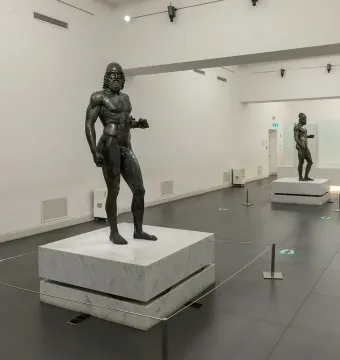
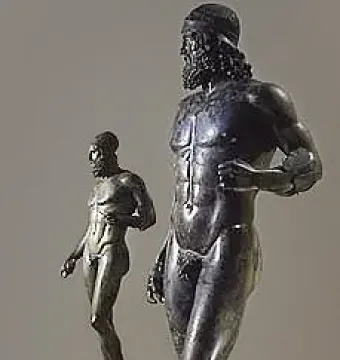
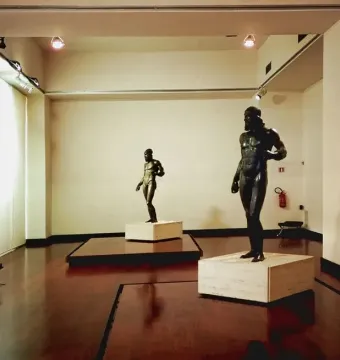
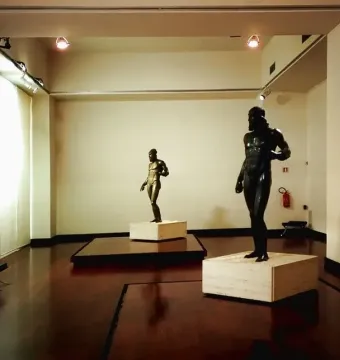
The Riace bronzes are two full-size ancient Greek bronze statues of bearded warriors, cast about 460–450 BC and discovered in the sea near Riace, Calabria, in 1972. Also known as the Riace Warriors, they are among the few surviving full-size ancient Greek bronzes, which were usually melted down in later times. The statues, identified as Statue A and Statue B, were made using the lost-wax casting technique. After conservation, they were placed on public display in Florence and Rome in 1981. They are now exhibited in the Museo Nazionale della Magna Grecia in Reggio Calabria, inside a microclimate room on an anti-seismic platform faced in Carrara marble.
March 2026 © Benjamin Smith · CC BY-SA 4.0
2007 © Me · Public domain
January 2014 © Bronzi_Di_Riace_Statua_A+B.jpg · CC BY-SA 2.5

September 2000 © User:AlMare · CC BY-SA 2.5
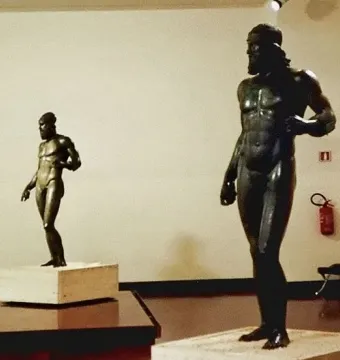
January 2014 © Bronzi_Di_Riace_Statua_A+B.jpg · CC BY-SA 2.5
Identification | |
| Title | Riace bronzes |
| Number of sculptures | Two |
| Alternative names | Riace Warriors; Bronzes of Riace; Bronzi di Riace; I Bronzi di Riace |
| Type | Pair of Greek bronze statues of warriors |
Historical context | |
| Origin | Ancient Greek |
| Artistic period | Transition between the Archaic and Classical styles |
| Date | 5th century BC; individual datings proposed as about 460 BC for Statue A and about 430 BC for Statue B |
Creator | |
| Attribution status | No certain attribution; proposed sculptors include Phidias, Myron, Onatas, Alcamenes, Polyclitus, and Pythagoras of Rhegion |
Discovery and provenance | |
| Distance from coast at discovery | About 200–300 meters offshore |
| Associated context | No wreck site has been identified; architectural remains have been found in the immediate locality |
| Possible earlier history | Some evidence has been interpreted as suggesting they may have been looted from conquered Greece in 146 BC |
| Possible original location | Various hypotheses propose Athens, Olympia, Delphi, Locri Epizefiri, or Reggio |
| Discovery circumstances | Found underwater, apparently after Mariottini noticed the left arm of Statue A protruding from the sandy seabed |
| Discoverer | Stefano Mariottini |
| Discovery depth | About 6–8 meters |
| Discovery location | Off Riace Marina near Riace, Calabria, Italy, in the Ionian Sea |
| Discovery date | 16 August 1972 |
| Possible transport history | They probably ended up on the seabed during sea transport, possibly after a storm; a shipwreck is possible but unconfirmed |
Physical characteristics | |
| Height | About 180 cm; slightly larger than life-size |
| Condition | Exceptionally well preserved and almost intact |
| Appearance | Two nude, bearded male warriors with athletic builds; one appears younger and one more mature |
| Individual distinctions | The statues differ in hairstyle, beard length, and apparent age |
| Original attributes | Originally wore helmets and carried spears and shields |
| Original attachment | Both statues had lead tenons at the feet for fixing them to pedestals |
Materials | |
| Material | Bronze |
| Non-bronze materials | Silver for Statue A's teeth and both statues' eyelashes; ivory and limestone for the sclerae; copper for the lips and nipples |
| Base material | Carrara marble |
Technique | |
| Structural features | Nails with square cross-sections were used to hold the structure in place during casting |
| Casting technique | Lost-wax casting |
| Production studies | Studies of the fusion earth indicate production in Greece, possibly Argo and Laurion |
Appearance | |
| Stylistic features | Idealized geometry combined with apparent realism and anatomically improbable detail |
Iconography and meaning | |
| Subject | Warriors |
| Identification of figures | Not identified with certainty; hypotheses include athletes, gods, or heroes, possibly from the Trojan War period |
| Excluded interpretation | They are not generally considered divinities |
Location and ownership | |
| Current location | National Archaeological Museum of Reggio Calabria, Italy |
| Display setting | Displayed in a microclimate room on anti-seismic Carrara marble bases |
| Associated objects in display room | Testa del Filosofo and Testa di Basilea |
History and restoration | |
| Recovery method | Recovered by the Carabinieri diving unit using an air-inflated balloon |
| 2009-2011 restoration | Moved to Palazzo Campanella for restoration in 2009; the work was coordinated by Paola Donati and Nuccio Schepis and completed in 2011 |
| Conservation history | In the early 1990s the remaining fusion earth was removed; nitrobenzene was used against cuprous oxides; a chemical preservative was later applied inside |
| Return to museum | December 2013 |
| Temporary relocation | Spent three years at Palazzo Campanella during restoration and museum renovation work |
| Museum transfer date | 1981 |
| Post-restoration display | Shown in exhibitions in Florence and Rome before returning to Reggio Calabria |
| Restoration | Restored after recovery; first cleaned in Reggio Calabria, then transferred to Florence in January 1975 for five years of restoration, completed on 15 December 1980 |
Significance | |
| Historical significance | One of the very few surviving full-size ancient Greek bronzes |
| Art historical importance | Among the most significant masterpieces of Greek art and important testimonies to Classical sculptural craftsmanship |
| Cultural significance | Symbols of Calabria, Riace Marina, and Reggio Calabria |
| Reception | Widely reproduced |
| Commemoration | Commemorated by a pair of Italian postage stamps |
Other | |
| Comparative examples | The Charioteer of Delphi, the god from Artemision, Poseidon from the National Archaeological Museum of Athens, and the Cronides of Cape Artemision |
| Documentation | Featured in the first episode of the 2005 BBC documentary series How Art Made the World; Stefano Mariottini was interviewed |
| Research and controversy | The discovery stimulated research into the statues' identity, authorship, dating, and provenance, which remain disputed |
| Discovery controversy | Some accounts claim the official finding records included additional objects and that the statues may have been moved before official recovery; the alleged missing finds are said to have been stolen before recovery |