
Scior Carera
Scior Carera is an ancient Roman marble bas-relief in Milan, Italy, now located on the facade of a modern building at No. 13, next to the Duomo. Dating to the 3rd century, it shows a man in a toga with his right leg slightly forward. The sculpture has lost both its arms and head; the head was replaced in the Middle Ages and was said to represent Archbishop Adelmanno Menclozzi. Its name is a corruption of the first word of an inscription below the statue, attributed to Cicero. In the 19th century, it became known for satirical political messages during Austrian rule and later gave its name to a satirical journal.
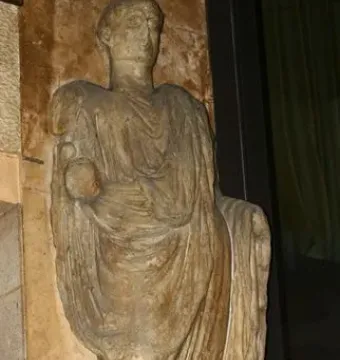
May 2007 © G.dallorto · Attribution
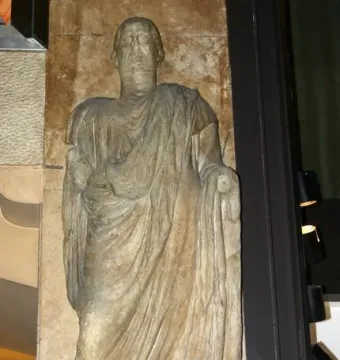
May 2007 © G.dallorto · Attribution
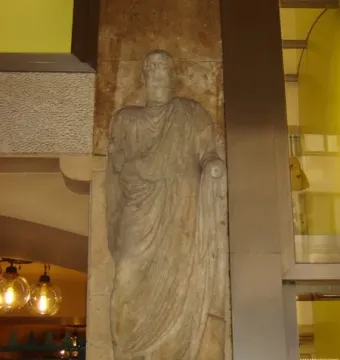
© Robin root~commonswiki (talk · CC BY-SA 2.5
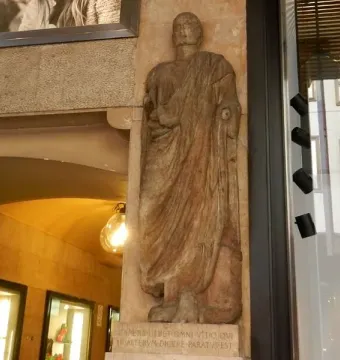
August 2012 © Geobia · CC BY-SA 4.0
May 2007 © G.dallorto · Attribution
Identification | |
| Title | Scior Carera |
| Alternative name meaning | "stone man" in the Milanese dialect |
| Type | Ancient Roman marble high relief |
| Alternative name | Omm de Preja |
Historical context | |
| Date | 3rd century |
| Reuse history | Reused in medieval times |
Creator | |
| Head replacement | The head was added in the early Middle Ages, probably to represent Archbishop Adelmanno Menclozzi (died 956) of the Menclozzi family |
Physical characteristics | |
| Depicted figure | Male figure dressed in a richly draped toga |
| Pose | Right leg slightly advanced |
| Condition | Arms missing; the original head is lost and replaced by a medieval addition |
Materials | |
| Material | Marble |
Location and ownership | |
| Former location | Near the Chiesetta del Corpus Domini, in front of the church of Santa Maria dei Serviti |
| Former location | Via San Pietro all'Orto, near the former church of San Giorgio al Pozzo bianco at the beginning of the present Via San Pietro all'Orto |
| Current location | Milan, Italy, on the facade of a modern building at No. 13 near the Duomo, under the arcades of Corso Vittorio Emanuele II |
History and restoration | |
| Historical repainting | According to Tristano Calco, the statue was annually painted white and black |
| Current placement date | Around 1950, after the changes to Corso Vittorio Emanuele II |
| Earlier recorded location | First recorded on 29 April 1197; still in the same location at the beginning of the 14th century |
| Earlier reported placement | Apparently once placed in the middle of a large square on an elevated pedestal |
| Repositioning | In January 1832 the statue was placed higher above the ground because it had become a Milanese Pasquino |
| Labus detail | Labus mentioned a box placed at its feet |
| Alternative attribution | Giovanni Labus considered it the statue of a municipal magistrate |
| 19th-century identification | In the 19th century the identification with Marcus Tullius Cicero became widespread |
| Stylistic observation | Giorgio Giulini considered the hairstyle and workmanship of the hair certainly not Roman |
| Identification dispute | In 1735 Pietro Grazioli disputed the identification with Adelmanno, citing the Roman toga |
Appearance | |
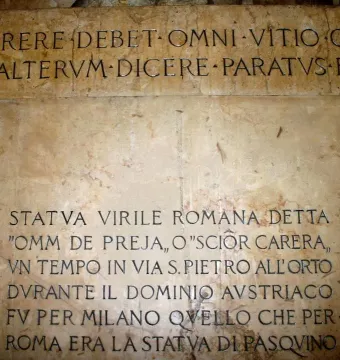
| Epigraph translation | He must be free of every fault who is prepared to denounce another |
| Epigraph | Carere debet omni vitio qui in alterum dicere paratus est |
| Second inscription | A pedestal inscription recalls the former location in Via San Pietro all'Orto and the statue’s role during Austrian rule of Milan |
Iconography and meaning | |
| Possible role in the Five Days of Milan | According to tradition, a message attached to the statue on 31 December 1848 may have helped trigger the tobacco riots that began the Five Days of Milan |
| Political context | Associated with the fight for independence of Milan and with the Austrian domination of the city |
| Interpretation of colors | Giorgio Giulini thought the white and black colors referred to the heraldic colors of the Menclozzi family |
| Historical role | Used in the 19th century for satirical political messages, like a talking statue similar to Pasquino in Rome |
| Popular name origin | From the first word of the inscription, carere |
| Epigraph source | A sentence attributed to Cicero |
Condition | |
| Condition described by Giorgio Giulini | In the 18th century Giulini saw it in a badly damaged state |
Other | |
| Associated publication | The statue gave its name to the satirical journal L'Uomo di pietra, founded by Cletto Arrighi in 1856 and published between 1856 and 1864, and again after 1878 |
| Narrative treatment in a magazine article | In the second issue of the journal, the statue’s adventures were told in the first person |
| Literary reference | In Emilio De Marchi's novel Demetrio Pianelli, Cesarino Pianelli fears ending up in L'Uomo di pietra after a scandal at the Circolo Monsù Travet |
| Character related to the reference | Cesarino Pianelli, brother of the protagonist, is an employee at the Milan post office, a gambler, and a braggart |
| Associated institution | Circolo Monsù Travet |