
Horse's Head of Waldgirmes
The Horse's head of Waldgirmes is part of a gilded bronze Roman sculpture, presumably an equestrian statue of Emperor Augustus. It was discovered in 2009 in a field near the former Roman Forum of Lahnau-Waldgirmes in Hesse, Germany. The forum was a fortified Roman trading place and contains the oldest known stone buildings in Magna Germania. Since August 19, 2018, the horse's head has been on display in the Saalburgmuseum in Saalburg, Germany.
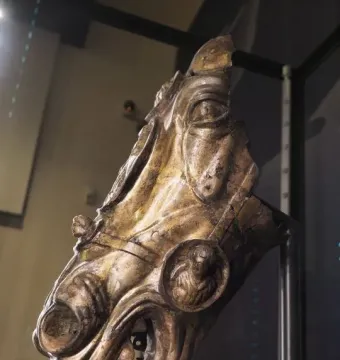
August 2018 © Kreuzschnabel · CC BY-SA 3.0
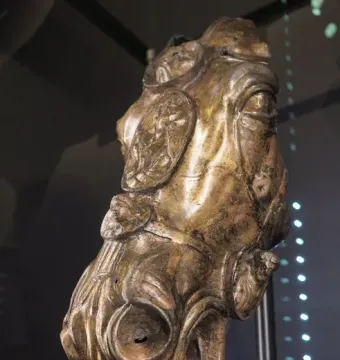
August 2018 © Kreuzschnabel · CC BY-SA 3.0
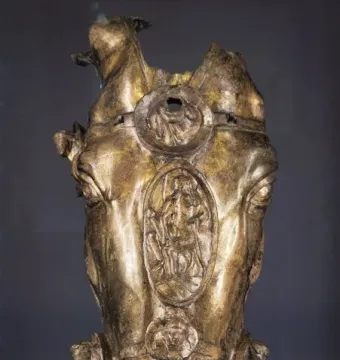
August 2018 © Kreuzschnabel · CC BY-SA 3.0
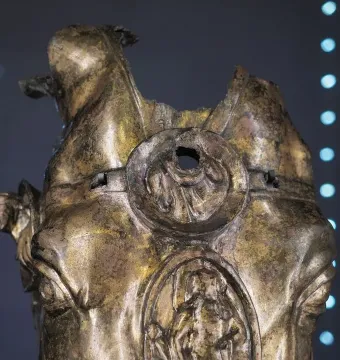
August 2018 © Kreuzschnabel · CC BY-SA 3.0
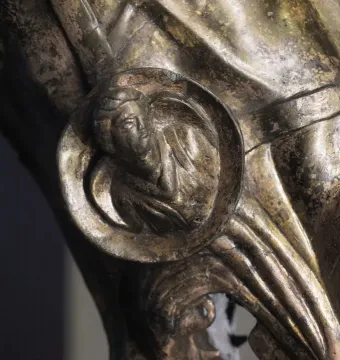
August 2018 © Kreuzschnabel · CC BY-SA 3.0
Identification | |
| Title | Horse's Head of Waldgirmes |
| Alternative name | Horse's Head from Waldgirmes |
| Type | Archaeological find; horse's head fragment |
| German name | Pferdekopf von Waldgirmes |
Historical context | |
| Culture | Roman |
| Associated site | Former Roman Forum of Lahnau-Waldgirmes (Römisches Forum Lahnau-Waldgirmes) |
| Site character | Fortified Roman trading place |
| Site significance | Has the oldest known stone buildings in Magna Germania |
Discovery and provenance | |
| Dating | Probably early 1st century AD; estimates range from 4 BC to AD 16, with some estimates dating it to AD 1 |
| Probable origin | Probably Roman Italy |
| Destruction history | Possibly the statue was destroyed when the settlement was burned down after the Varus battle, and the debris was thrown into the well |
| Associated finds | A left foot and a piece of bridle/harness were found with it |
| Discovery context | Found during archaeological excavations of the former Roman settlement at Waldgirmes |
| Original object | Presumably part of an equestrian statue, most likely of Emperor Augustus; possibly another male member of the imperial family |
| Original location | Probably the forum of the Roman settlement at Waldgirmes, possibly a central square |
| Findspot | In a wooden barrel in a collapsed well shaft about 11 meters deep |
| Legal dispute | Long-running dispute between the state of Hesse and the landowner over compensation for the find; in 2020 the parties reached a confidential settlement |
| Discovery location | A field near Lahnau-Waldgirmes, Hesse, Germany |
| Discovery year | 2009 |
| Compensation | An initial payment of 48,000 euros was made in 2016; the Limburg Regional Court awarded 821,000 euros in July 2018; the expert valuation was about 1.6 million euros; the final settlement amount was confidential |
Physical characteristics | |
| Extent | Surviving horse-head fragment; only the remains of the horse head survived |
| Weight | About 15 kg |
| Length | 59 cm |
| Condition | Well preserved; carefully restored after discovery |
Materials | |
| Material | Gilded bronze |
Technique | |
| Surface treatment | Gilding |
Appearance | |
| Decorative details | A Mars plaque on the bridge of the nose, victory goddesses on the sides, and a bridle decorated with six ornamental discs |
| Stylistic comparison | Strongly similar to the gilded bronze horses of Cartoceto di Pergola, especially in the surviving mane tuft elements |
History and restoration | |
| Restoration | Restored over about one year: cleaned of bronze corrosion products, loose gilding secured, and protected with an acrylic resin coating |
| Restoration cost | 75,000 euros |
Location and ownership | |
| Display location | Saalburg Museum, Saalburg, Germany |
| Display since | 19 August 2018 |
| Berlin exhibition | Bewegte Zeiten. Archäologie in Deutschland, Martin-Gropius-Bau, Berlin, 7 November 2018 to 17 December 2018, held for the European Year of Cultural Heritage 2018 |
| Replica display | A life-size 3D print has been shown at the visitor center since 2022; since August 2023 a full-size reproduction has also been displayed at the Roman Forum Lahnau-Waldgirmes |
Significance | |
| Historical significance | Considered one of the most important archaeological finds in Germany and important for understanding a more settled Roman presence in ancient Germany |
Iconography and meaning | |
| Interpretation | Often interpreted as part of an imperial-cult program of monumental statues in the Roman Empire |