
Hermes Belvedere
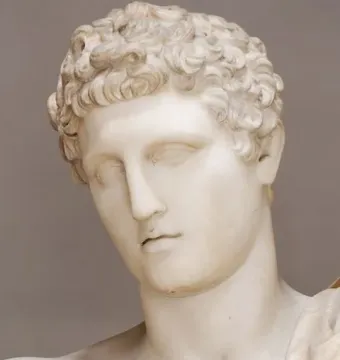
Hermes Belvedere is a Roman marble sculpture from the early 2nd century, now in the Vatican Museums, Museo Pio-Clementino. The 1.95-meter-tall figure is stylistically linked to the Greek art of Praxiteles’ school from the 4th century BC. Found around 1540 in the gardens surrounding the Mausoleum of Hadrian, it was acquired by Pope Paul III in 1543 and placed in the Vatican Belvedere courtyard. The sculpture shows a standing nude man with a melancholy expression and lowered gaze, with a travel cloak draped over his left shoulder and wrapped around his forearm. It inspired many modern artists and was long identified as Antinous before being accepted as a representation of Hermes Psychopompos.
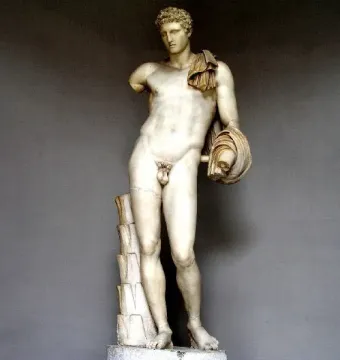
July 2006 © https://www.flickr.com/photos/joaomaximo/ · CC BY 2.0
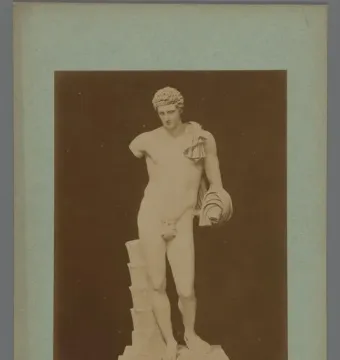
© unknown sculptor; photographer Fratelli Alinari · Public domain
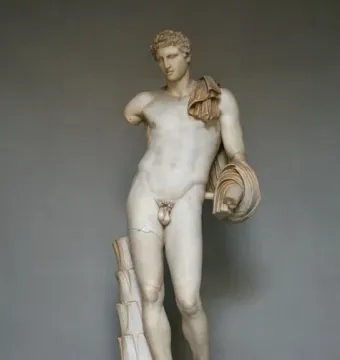
© Jean-Pol GRANDMONT · CC BY-SA 3.0
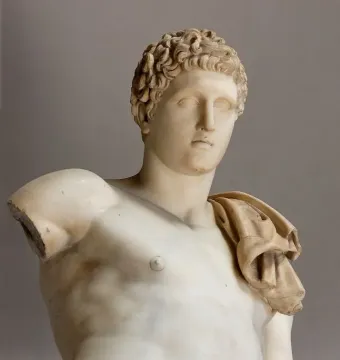
© Unknown artistUnknown artist · Public domain
· CC BY 3.0
Identification | |
| Title | Hermes Belvedere |
| Alternative names | Antinoo del Belvedere; Antinous Belvedere; Antinous of the Belvedere; Lantin; Ermes Pio-Clementino |
| Current identification | Hermes |
| Iconographic role | Hermes as psychopomp (guide of souls) |
| Former identifications | Antinous; Meleager |
| Type | Statue |
| Object type | Roman marble sculpture |
Historical context | |
| Date | Early 2nd century AD, Hadrianic period |
Creator | |
| Stylistic relation | Related to the Greek school of Praxiteles; a familiar Praxitelean type |
| Original work | Roman copy after a Greek original, probably a bronze by Praxiteles or his school |
Discovery and provenance | |
| Discovery date | Around 1540 |
| Discovery place | Near the Mausoleum of Hadrian, probably in a garden near Castel Sant'Angelo; another source gives the gardens surrounding the Mausoleum of Hadrian |
| Purchased by | Pope Paul III |
| Purchase date | 1543 |
| Purchase price | 1,000 ducats |
| Seller | Nicolaus de Palis |
| Original placement after acquisition | Belvedere Courtyard / Belvedere Palace courtyard (Cortile del Belvedere) |
Physical characteristics | |
| Facial expression | Melancholic, downcast gaze |
| Pose | Relaxed contrapposto |
| Subject | A nude young man |
| Scale | Life-size |
| Height | 1.95 m |
Appearance | |
| Clothing / attribute | A chlamys or travel cloak draped over the left shoulder and wrapped around the left forearm |
| Diagnostic attributes | Cloak/chlamys and a serpent around the support tree |
| Support element | Tree support with serpent |
Materials | |
| Material | Marble |
Location and ownership | |
| Current location | Museo Pio-Clementino, Vatican Museums, Rome |
| Inventory number | 907 |
| Collection | Vatican collections |
History and restoration | |
| Later movement | Taken to Paris after the Treaty of Tolentino in 1797; returned to Rome in 1815 after the fall of Napoleon |
Significance | |
| Reception | Immediately became famous and widely celebrated across Europe |
| Copies and reproductions | Numerous copies, casts, engravings, and sketches were made; copied in bronze and marble at Fontainebleau and Versailles; casts also exist in art academies such as Milan and Berlin |
| Notable copies | Hubert Le Sueur's bronze copy was in the collection of Charles I of England before being acquired by Oliver Cromwell; a copy by the Keller brothers entered the collection of Louis XIV; a marble copy was purchased by Peter the Great |
| Artistic influence | Influenced Renaissance and Baroque art; studied and admired by Peter Paul Rubens, Nicolas Poussin, and Johann Joachim Winckelmann; may have inspired the figure of Christ in The Rockox Triptych |
| Rubens's assessment | Praised its beauty and proportions |
| Poussin's assessment | Saw it as a canon of ideal proportions |
| Winckelmann's assessment | Regarded it as a first-class statue, especially admiring the head but criticizing the feet, abdomen, and legs |
| Audran publication | Included by Gérard Audran in his 1683 engravings on the proportions of the human body from the finest statues of antiquity, intended for young sculptors |