
Saint George and the Dragon in Storkyrkan
Saint George and the Dragon in Storkyrkan is a late medieval wooden sculpture in Stockholm, Sweden, depicting the legend of Saint George and the dragon. It is attributed to Bernt Notke and was commissioned by the Swedish regent Sten Sture the Elder. Inaugurated in 1489, it has been described as a high point in Notke’s artistic production. The main group shows Saint George on horseback piercing the dragon with a lance and preparing to strike with his sword, while a subsidiary group depicts the princess in prayer. The sculpture is mainly made of oak, but also includes metal, leather, human hair, coins, jewels, string, parchment, and elk antlers.
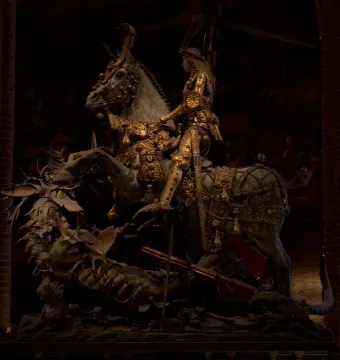
March 2017 © Johan Bakker · CC BY-SA 4.0
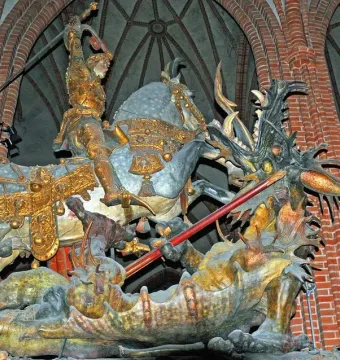
September 2009 © Dennis G. Jarvis · CC BY-SA 2.0
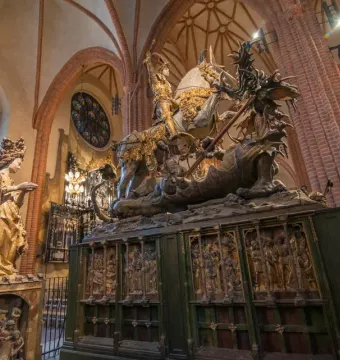
© Jorge Láscar · CC BY 2.0
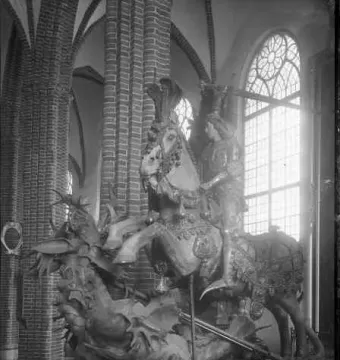
© Harald Faith-Ell · Public domain
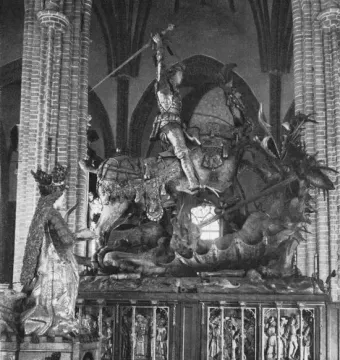
© Unknown authorUnknown author · Public domain
Identification | |
| Title | Saint George and the Dragon |
| Type | Late medieval wooden sculpture |
| Subject | The legend of Saint George and the Dragon |
| Original title | Sankt Göran och draken |
Historical context | |
| Date | 1489 |
| Commissioned by | Sten Sture the Elder, Swedish regent |
| Commissioning context | Commissioned after the Swedish victory over the Danish army at the Battle of Brunkeberg in 1471; Sten Sture had placed his army under the protection of Saint George during the battle |
| Inauguration date | New Year's Eve 1489 |
| Inaugurated by | A papal nuncio |
Creator | |
| Artist activity in Sweden | Bernt Notke was a frequent visitor to Sweden before 1491 and lived there from 1491 to 1497 |
| Attributed to | Bernt Notke or his workshop |
| Workshop location | Lübeck |
Discovery and provenance | |
| Possible original component | A portrait attributed to Bernt Notke of Charles VIII of Sweden, now at Gripsholm Castle, may have been part of the original composition |
Physical characteristics | |
| Expressive character | The central group conveys mythical power |
| Stylistic character | Bizarre silhouette with many gaps and a richly decorated effect |
| Heraldic details | Sten Sture's heraldic insignia appear repeatedly, including at the base; the saint's plume feathers are blue and yellow |
| Horse depiction | The horse is rearing |
| Dragon depiction | The dragon reels under attack and tries to pierce the horse with its claws |
| Saint George depiction | He spears the dragon with a broken lance and raises his sword to strike; his gaze is directed into the distance rather than at the dragon |
| Ground details | Human bones scattered on the ground; baby dragons emerging from cavities |
| Plinth decoration | Eight panels illustrating the legend of Saint George |
| Additional figures | The liberated princess with a symbolic lamb; a praying princess shown apart from the battle scene |
| Main scene | Saint George on horseback fighting the dragon |
| Composition | A central group with several subsidiary figures and attached parts; nearly the whole original group survives |
| Scale | Larger than life-size |
| Total height | 6 metres with the wooden base |
| Height | 3.75 metres |
| Plinth | Wooden plinth |
Materials | |
| Primary material | Oak wood |
| Additional materials | Metal, leather, human hair, coins, jewelry, string, parchment, and elk antlers for the dragon's spikes |
Iconography and meaning | |
| Overall significance | The monument combined religious, political, and funerary meanings |
| Annual ritual use | The figure of Saint George was removed from the horse and carried in procession to the Brunkeberg battle site every 10 October to celebrate the victory and honor Saint George |
| Political meaning | Intended as a victory monument commemorating the Swedish victory over the Danish army at Brunkeberg |
| Funerary meaning | Served as a funerary monument for Sten Sture the Elder; he was buried for a short time at the base of the monument |
| Depicted meaning | Associated with the widespread Scandinavian cult of Saint George and the ideals of chivalry |
Location and ownership | |
| Current location | Storkyrkan, Stockholm, Sweden |
History and restoration | |
| Replicas | Two replicas exist: one at St. Catherine's Church in Lübeck and one at Köpmantorget in Stockholm |
| Stockholm replica | Bronze replica inaugurated on 10 October 1912, the anniversary of the Battle of Brunkeberg |
Significance | |
| Artistic assessment | Described as a high point in Bernt Notke's artistic production |
| Comparison | Philippe Dollinger described it as the Nordic counterpart to Andrea del Verrocchio's equestrian monument to Bartolomeo Colleoni |
| Later influence | It inspired numerous later wooden reproductions of the same subject in Sweden, Finland, and Germany |
| Related works | About 30 related wooden sculpture groups survive in Sweden and more than 20 in Finland; many are in the Swedish History Museum or remain in situ, and many were made by local or unknown artists, with some attributed to Henning van der Heide, Haaken Gulleson, or Henning Roleve |