
Atlantean Figures at Tula
Atlantean Figures at Tula are four anthropomorphic sculptures from the Toltec culture, located on Pyramid B in the archaeological zone of Tula, Hidalgo, Mexico, also known as Tollan-Xicocotitlan. They stand just over 4.5 meters tall and are carved from assembled blocks of basalt. The figures represent Quetzalcoatl as the Morning Star (Tlahuizcalpantecuhtli), dressed as a Toltec warrior and equipped with a butterfly pectoral, an atlatl, darts, a flint knife, and a curved weapon characteristic of this culture’s warrior imagery. They originally supported the roof of the temple at the top of the pyramid, which is how they came to be called atlantes.
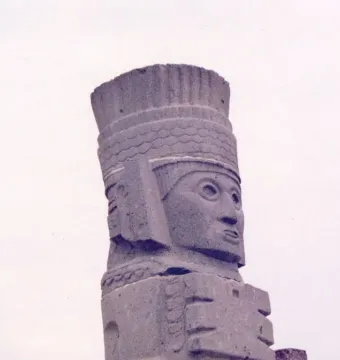
February 2005 © Alejo Trejo · CC BY-SA 3.0
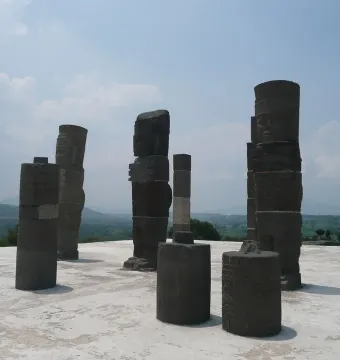
June 2007 © Randal Sheppard · CC BY-SA 2.0
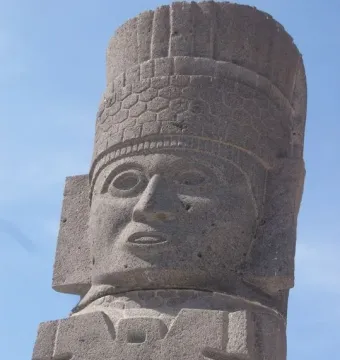
April 2008 © Susana Torres Sánchez · CC BY-SA 3.0
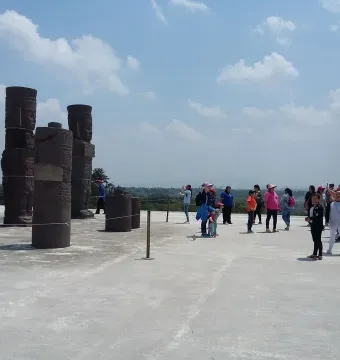
May 2018 © HeyDiallexLoL "Maria de los Angeles" · CC BY-SA 4.0
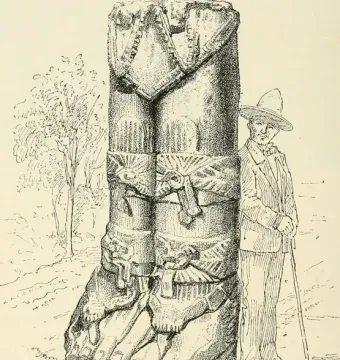
1887 © Internet Archive Book Images · No restrictions
Identification | |
| Title | Atlantean figures at Tula |
| Type | Four monumental atlantean figures |
| Subject | Warrior figures |
| Original title | Los atlantes de Tula |
Historical context | |
| Historical role | Long considered the capital of the Toltec people |
| Historical association | Linked to Toltec remembrance of Teotihuacan culture and to the founding traditions of Tula |
| Associated city | Tula, the ancient Toltec capital |
| Culture | Toltec |
| Historical period | Pre-Columbian Mesoamerica |
| Date | The carving date is unknown; the earliest possible date is around 750 CE |
Creator | |
| Creator | Toltec artisans |
Discovery and provenance | |
| Discovery date | 1940 |
| Discoverer | Archaeologist Jorge Ruffier Acosta |
| Accompanied by | Raimon Galí |
Location and ownership | |
| Location name | Tollan-Xicocotitlan |
| Placement | Standing on the upper part of the Temple of Tlahuizcalpantecuhtli overlooking the main plaza |
| Current location | Tula, Hidalgo, Mexico |
| Original location | Temple of Tlahuizcalpantecuhtli on Pyramid B in the archaeological zone of Tula, Hidalgo, Mexico |
Physical characteristics | |
| Number of figures | Four |
| Dimensions | About 120 × 42 × 37 centimeters |
| Description | Massive anthropomorphic statues of Toltec warriors |
| Height | Just over 4.5 meters |
Materials | |
| Material | Basalt, carved from locally available stone |
| Other materials mentioned | Limestone, sandstone, and volcanic rock are also mentioned as local stone used in the figures |
Technique | |
| Production time | The carving process was very time-consuming |
| Tools | Stone chisels, scrapers, and hammers; smaller and softer stones were used for smoothing |
| Technique | Hand-carved |
Appearance | |
| Depicted figure | Quetzalcoatl as Tlahuizcalpantecuhtli, the Morning Star |
| Depicted objects | Atlatls, darts, flint knives, curved knives, shields, and a gourd-like vessel |
| Depicted attire | Toltec warrior attire with feathered headdresses, butterfly pectorals, belts, maxtlatl loincloths, knee guards, and sandals |
Iconography and meaning | |
| Other symbols | Feathered serpents appear on the sandals; the figures also have tubular ear ornaments and feathered headdresses |
| Weapon symbolism | The curved knife, bifacial knife, atlatl, and darts are warrior and sacrifice-related attributes |
| Butterfly motif | The butterfly pectoral symbolizes the warrior and, in the text, a warrior who dies in battle and becomes a butterfly that accompanies the sun at dawn |
Significance | |
| Stylistic significance | They demonstrate Toltec skill in carving stone |
| Comparative examples | The motif also appears in Olmec reliefs at Potrero Nuevo near San Lorenzo and in Maya sculpture at Chichen Itza |
| Influence | They inspired later Aztec warrior statues, standard-bearers, and chacmools, and the Aztecs used them as a model for legitimacy |
| Name origin | They are called atlantes because they originally held up the temple roof; the name also reflects the European architectural tradition of Atlas-like figures |
| Labor significance | Their long production time suggests they were important to the civilization |
| Cosmological symbolism | Associated with the axis mundi and the four cardinal directions, and described as marking the center and four directions of the universe while guarding the sun |
| Interpretation | They are seen as symbols of Toltec military greatness and as important markers of warrior identity and cosmology |
| Function | Originally supported the temple roof |
Other | |
| Related scholarship | Richard Townsend argued that the Aztecs drew on ancient artistic themes to associate themselves with the great traditions of Mesoamerican antiquity |
| Alternative interpretations | The figures have also been interpreted as commemorating the migration from Aztlan, representing the four ancestral cities of the Valley of Mexico, or representing four individuals who carried Huitzilopochtli to Tenochtitlan as sacred bundles |
| Alternative arrangement in Aztec tradition | A related Aztec group consisted of five warrior statues: one bearded male in the center, three male warriors to the north, east, and south, and one female warrior to the west |