
Pulpit of Sant' Andrea, Pistoia
The Pulpit of Sant' Andrea in Pistoia, Italy, is a masterpiece by the Italian sculptor Giovanni Pisano, completed in 1301. It is often compared with the groundbreaking pulpit in the Pisa Baptistery by Giovanni’s father, Nicola Pisano, and with the Siena Cathedral Pulpit, on which Giovanni had assisted. The work is frequently described as proto-Renaissance, drawing on Ancient Roman sarcophagi and other sources to create an early revival of classical sculpture while still remaining Gothic. Giovanni’s style here moves away from the strong classicism of his father’s work toward a form more influenced by northern Gothic art.
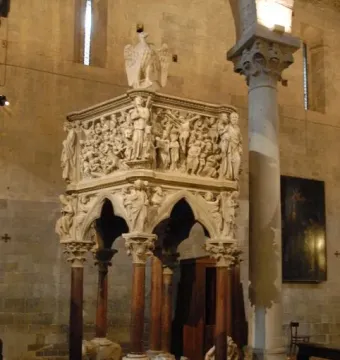
March 2010 © User:Jollyroger · CC BY-SA 3.0
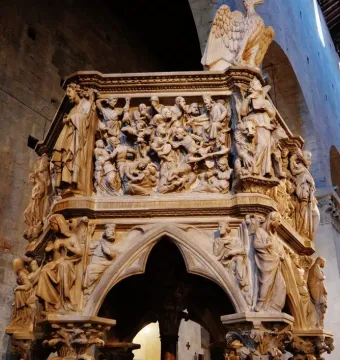
April 2023 © Zairon · CC BY 4.0
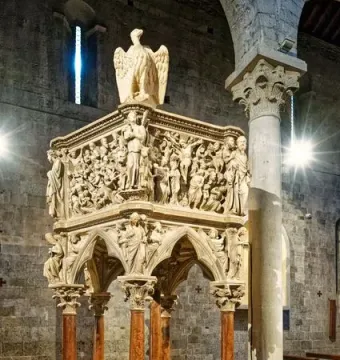
April 2025 © Holger Uwe Schmitt · CC BY-SA 4.0
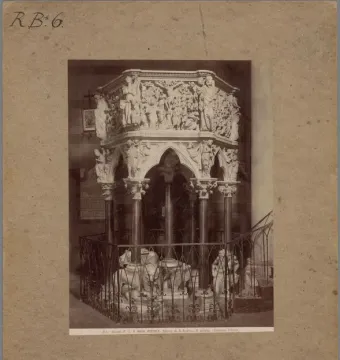
© Rijksmuseum · CC0
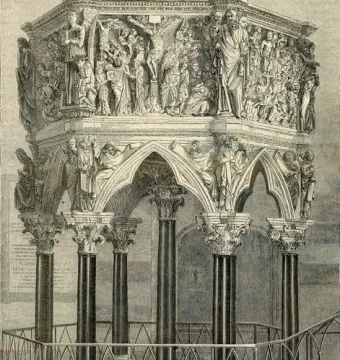
1885 © Émile Théodore Therond · Public domain
Identification | |
| Title | Pulpit of Sant' Andrea, Pistoia |
| Type | pulpit |
Location and ownership | |
| Location | Sant'Andrea in Pistoia, Italy |
| Other lectern location | Bode Museum in Berlin |
Creator | |
| Nicola Pisano relationship | Giovanni Pisano's father |
| Artist | Giovanni Pisano |
Historical context | |
| Commissioner | Canon Arnoldus (Arnoldo) |
| Supervisors | Andrea Vitelli and Tino di Vitale |
| Date | 1298–1301 |
| Workshop collaboration hypothesis | Gerd Kreytenberg proposed that Tino di Camaino, then about 20 years old and a member of Giovanni's workshop, may have collaborated on the Three Magi panel |
| Massacre of the Innocents inspiration | It has been supposed that Giovanni was inspired by German models or by Trajan's Column in Rome |
| Giovanni Pisano's style development | He moved away from his father's strong classicism toward a style more influenced by northern Gothic art |
| Father's style | Strong classicism |
| Influences | Ancient Roman sarcophagi, French ivory carvings, and northern Gothic art |
| Stylistic significance | Represents an early revival of classical sculpture while remaining Gothic |
| Style characterization | Often described as proto-Renaissance; still Gothic |
| Giovanni Pisano's role in related works | He assisted his father on the related pulpits |
| Comparison works | The pulpit in the Pisa Baptistery and the Siena Cathedral Pulpit |
| Possible travel history of Giovanni Pisano | He may have visited France |
| Giovanni Pisano's prior experience | He had worked on his father's projects |
| Giovanni Pisano's age at start of work | about fifty |
| Commission date according to Vasari | 1297 |
Discovery and provenance | |
| Inscription | A Latin inscription on the cornice between the arches and parapets attests Giovanni's authorship, gives the completion date of 1301, names the commissioner Arnoldo, and names the financiers Andrea Vitelli and Tino di Vitale; it also praises Giovanni's skill and says he surpassed his father |
Significance | |
| Assessment | Considered Giovanni Pisano's masterpiece and one of the greatest works of Italian medieval art |
| Art-historical significance | Presented as an unprecedentedly vivid medieval rendering of drama and as a reminiscence of his father's works |
Physical characteristics | |
| Eagle lectern | An eagle lectern rises above the parapet at the corner between the Massacre of the Innocents and the Crucifixion |
| Eagle lectern status | The original eagle lectern is now in the Metropolitan Museum of New York; the lectern on the pulpit is a copy |
| Structure | Seven porphyry columns, including one central column |
| Stairway | The original stairway has been removed |
| Column capitals | Inventive derivations of the Corinthian order |
| Upper arches | Trefoil arches, raised higher and pointed to increase vertical thrust |
| Plan | Hexagonal |
| Scale | Relatively modest in size |
| Column supports | Two columns stand on lions; one is supported by a curved telamon or Atlas figure; one by a lioness with her cub and a leveret; one by a deer in a lion's claws; the central column rests on three winged creatures, identified as a lion, an eagle, and a griffin; the remaining three columns stand on plain bases |
Iconography and meaning | |
| Iconographic program | Five parapets with scenes from the Life of Christ, with allegories in the arches' spandrels or pendentives and full-length Sibyls and Prophets above the capitals |
| Prophets and sibyls | Six sibyls for the pagan world and ten prophets for the Jewish world |
| Parapet scenes | Annunciation; Nativity with the midwives bathing the infant Christ; Annunciation to the Shepherds; Dream of the Magi; Adoration of the Magi; Dream of Joseph; Massacre of the Innocents; Crucifixion; Last Judgment |
| Missing parapet | The sixth parapet is missing because that side provides access to the pulpit |
| Evangelist symbols | The eagle for Saint John, the lion for Saint Mark, the angel or winged man for Saint Matthew, and the ox for Saint Luke |
| Symbolic meaning of base figures | They allude to the double nature of Christ; the lion symbolizes the king of the earth, the eagle the king of the sky, and the griffin immortality, perfection, and Christ's divine and human nature |
Appearance | |
| Sibyl figure | One sibyl turns suddenly, almost fearfully, toward an angel who whispers prophetic revelations to her from behind |
| Relief style | The scenes are crowded and dramatic, with high relief, strong chiaroscuro, and extreme dynamism |
| Three Magi panel | Less dense and more airy than the other reliefs, with the sleeping Magi on the left and Joseph at the bottom right rendered as voluminous figures |
| Massacre of the Innocents | Especially notable for its swirling movement and expressive, deformed figures showing pain, fear, and consternation |
Technique | |
| Background treatment | Some open background areas were originally covered with tesserae |
| Relief technique | Pisano angled the reliefs so the upper parts project farther than the lower parts, and used a running drill for contours and surface details |
Other | |
| Image-captioned subjects | Nursing lioness with her cubs; lion and horse; Atlas; base of the central column; sculpted spandrels; a sibyl; first panel; second panel; third panel; fourth panel; fifth panel; lantern in the form of the Eagle of Saint John; Crucifixion scene; Sibyl and angel scene |