
Pisa Griffin
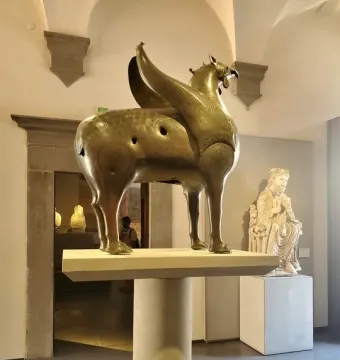
Pisa Griffin is a large hollow cast bronze sculpture of a mythical hybrid creature, half horse and half griffin, now preserved in the Cathedral Museum in Pisa, Italy. It is the largest known medieval Islamic metal sculpture, measuring 107 cm high, 87 cm long, and 43 cm wide. Radiocarbon analysis dates it to between 1085 and 1110 CE, probably made in Islamic Spain, though other proposed origins include Egypt, Sicily, or the Maghreb. The surface is richly decorated with Kufic inscription, stylized feathers, scales, and animal motifs. Its exact purpose remains uncertain, with possible uses including an aquamanile, fountain, incense burner, or musical instrument.
July 2022 © Bärwinkel,Klaus · CC BY-SA 4.0
June 2016 © Tangopaso · Public domain
May 1867 © Enrico van Lint · Public domain
June 2011 © ALoopingIcon · CC BY-SA 3.0
© Memorato · CC0
Identification | |
| Title | Pisa Griffin |
| Type | Large bronze sculpture of a griffin-like mythical creature |
| Subject | A griffin / hippogriff |
| Alternative names | Пизанский гиппогриф; El Grifo de Pisa; Il Grifone di Pisa; Le griffon de Pise |
Historical context | |
| Culture | Medieval Islamic |
| Date | Probably 11th century; radiocarbon analysis suggests 1085–1110 CE |
| Place of origin | Debated; most likely al-Andalus (Islamic Spain), with Sicily also considered possible; Egypt and the Maghreb have also been proposed |
| Possible functions | Possibly an aquamanile, fountainhead, incense burner, musical instrument, or mechanical sound-producing device |
Creator | |
| Creator | Unknown |
Discovery and provenance | |
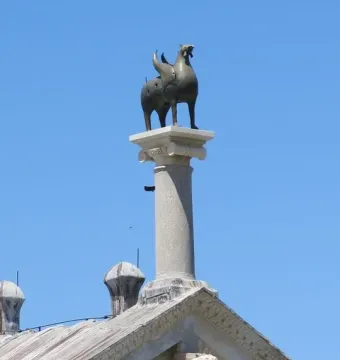
| Removal from former location | Removed in 1828 |
| Replica | A replica later replaced the original on the cathedral |
| Current location | Museo dell'Opera del Duomo (Cathedral Museum), Pisa, Italy |
| Transfer to Pisa | Probably arrived in Pisa in the late 11th or early 12th century, possibly as war booty from Pisa's campaigns against Islamic states |
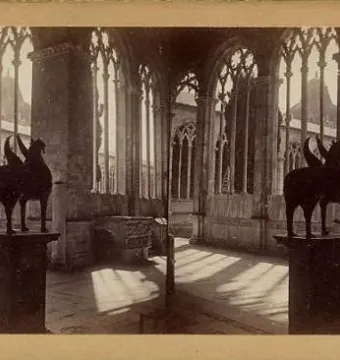
| Former location | Displayed on the roof/pediment above the apse at the east end of Pisa Cathedral, on a platform atop a column |
| Acquisition hypotheses | Possible acquisition events include the 1087 attack on Mahdia and the 1113–1115 campaign against the Balearic Islands |
| Origin note | Its Islamic origin is indicated by the Kufic inscription, but the exact date and place of creation remain debated |
Physical characteristics | |
| Dimensions | 107 cm high, 87 cm long, 43 cm wide |
| Form | Large hollow bronze animal sculpture |
| Openings | Three openings: at the mouth, at the back, and under the belly |
| Interior feature | Contains a spherical bronze vessel inside, open at the bottom and soldered at the back to a thin piece of the same metal |
Materials | |
| Material | Cast bronze (copper alloy) |
Technique | |
| Construction | Wings cast separately and attached with rivets |
| Decoration | Engraved ornamentation |
Appearance | |
| Upper leg decoration | Elaborate teardrop-shaped cartouches with arabesques |
| Hind leg decoration | Birds, probably eagles, depicted on each hind leg |
| Front leg decoration | Lions depicted on each front leg |
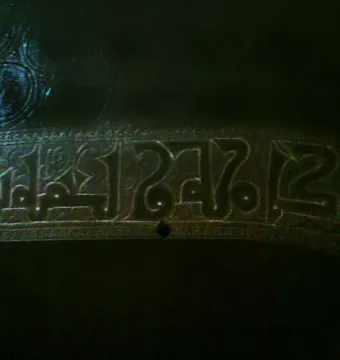
| Inscription | Arabic Kufic inscription around the chest and sides: “Perfect blessing, full prosperity, perfect joy, eternal peace and perfect health, as well as happiness and good fortune for the owner” |
| Back decoration | Plain circles enclosed in two rings on a textured background |
| Chest decoration | Overlapping semicircular scales |
| Wing decoration | Stylized feathers |
| Body | Lion body with wings and mammal-like limbs and toes |
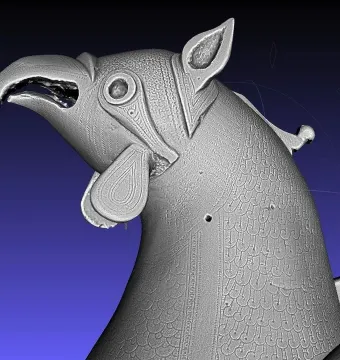
| Head | Eagle head with horse-like ears and rooster wattles |
Iconography and meaning | |
| Interpretive context | A fantastic griffin form may have reduced concerns about idolatry compared with a lifelike animal figure |
Location and ownership | |
| Pisa setting | Part of the Piazza dei Miracoli ensemble in Pisa, facing the Leaning Tower with the Baptistery behind it |
History and restoration | |
| Condition and interpretation | Survived; its original function and origin remain debated |
Significance | |
| Significance | The largest known medieval Islamic metal sculpture |
| Description | Often described as the most famous, most beautiful, and most monumental example of Islamic zoomorphic bronze sculpture |
| Comparative context | Compared with Andalusian palace sculptures, fountains, the Cordoba Stag, the Horses of Saint Mark, and other surviving Islamic bronze animals |
Other | |
| Research project | Included in an ongoing interdisciplinary project with the University of Oxford, the University of Pisa, CNR-ISTI in Pisa, Opera della Primaziale Pisana, and the Istituto Superiore per la Conservazione ed il Restauro |
| Project goals | Precise digitization, a 3D model from scanning, videos, a book, and an exhibition |
| Exhibitions | Berlin (1989); Granada and New York (1992); Brigham Young University, Provo (2012); Madrid (2020) |