
Disc of Theodosius
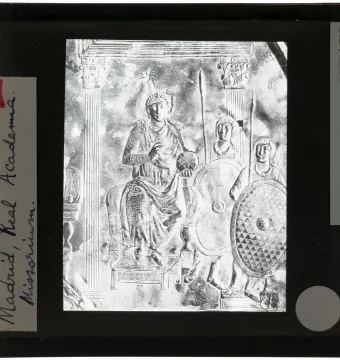
Disc of Theodosius is a silver missorium found in 1847 near Mérida in Spain and now held in the Royal Academy of History in Madrid. Made in 388 to celebrate the tenth anniversary of Theodosius the Great’s reign, it is one of only 19 surviving largitio gifts of this type. The dish is 74 cm in diameter and weighs 15.35 kg. Its relief shows Theodosius enthroned at the center, flanked by his co-rulers Arcadius and Valentinian II, with guards, a palace façade, Victory figures, and a lower scene with a reclining female personification and two cupids. The missorium is broken into two parts and was probably ritually bent before burial.
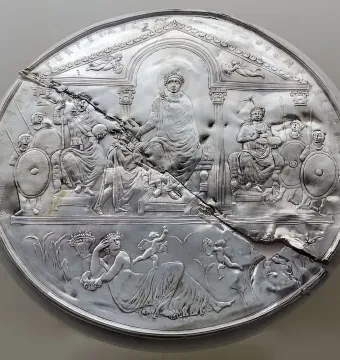
April 2015 © Ángel M. Felicísimo · CC BY 3.0
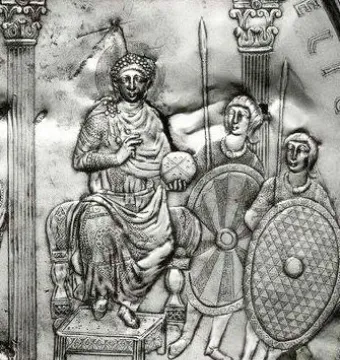
© Italica Res · CC0
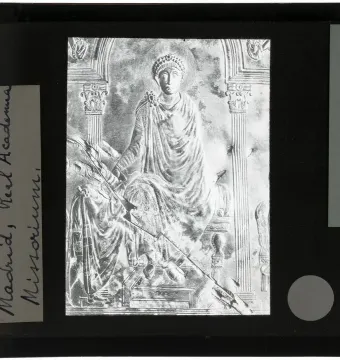
© Unknown · Public domain
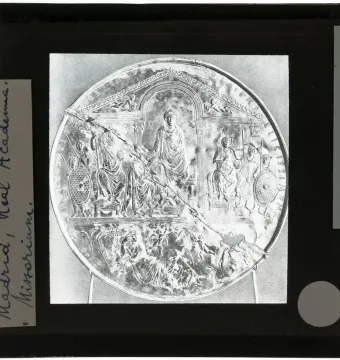
© Unknown · Public domain
© Unknown · Public domain
Identification | |
| Title | Disc of Theodosius |
| Type | Large ceremonial silver dish (missorium); possibly a largitio dish or a clipeus |
| Alternative names | Missorium of Theodosius I; Missorium of Theodosius; Theodosius-Missorium; Plat de Madrid |
Historical context | |
| Date of manufacture | 388 AD; possibly 393 AD |
| Occasion | Probably for the decennalia (tenth anniversary of reign) of Theodosius I; possibly for the quindecennalia (fifteenth anniversary) |
Creator | |
| Place of manufacture | Probably Constantinople |
Discovery and provenance | |
| Discovery date | 25 August 1847 |
| Discovery place | Almendralejo, Badajoz, near Mérida, Spain |
| Discovery context | Found accidentally by a worker in a hoard or treasure of silver objects |
| Associated objects found | Two silver cups were reportedly found with it and are now lost |
| Acquisition by current holder | Purchased soon after discovery by the Real Academia de la Historia |
Location and ownership | |
| Current location | Royal Academy of History (Real Academia de la Historia), Madrid, Spain |
Physical characteristics | |
| Condition | Broken into two parts; bent in half when discovered |
| Decoration technique | Chased and repoussé decoration; hammered/embossed relief detail |
| Weight | 15.35 kg; inscription gives 50 Roman pounds, equivalent to 16.13 kg of silver |
| Dimensions | 74 cm diameter; 4–8 mm thick; base ring 26 cm in diameter and 3 cm thick |
Materials | |
| Material | Silver, with traces of gilding on the inscription and other areas |
Iconography and meaning | |
| Main subject | Theodosius I seated or standing frontally in a monumental imperial scene, shown giving a document or codex to a senior official |
| Associated figures | Arcadius and Valentinian II or Honorius as co-emperors; a smaller official; imperial guards; putti; Tellus or Terra |
| Lower register imagery | A reclining female figure, probably Tellus or Abundantia, with plants, a cornucopia, and two cupids or putti |
| Architectural setting | A monumental arcade or façade with an arched pediment above Theodosius and a flatter entablature above the co-rulers |
| Symbolic features | Halos around the emperors, winged Victories with wreaths in the pediment, and imperial bodyguards identified as Germans by hairstyle, torcs, and shields |
| Interpretation | A hieratic imperial largitio scene linked to ceremonial gift-giving and possibly the traditio legis motif |
Significance | |
| Historical significance | One of the finest surviving examples of late Roman imperial silverwork and imagery; the latest surviving missorium/largitio dish of its kind |
| Rarity | One of 19 surviving examples of this type of imperial silverware |
| Style | Late Antique, classicizing imperial style |
Other | |
| Inscription | 'D(ominus) N(oster) THEODOSIVS PERPET(uus) AVG(ustus) OB DIEM FELICISSIMVM X', possibly XV if the small V above the X is read as 5 |
| Inscription language | Greek for the official weight inscription; the main edge inscription is in Latin |
| Related recipient | Possibly made as a gift for Maternus Cynegius |
| Related recipient context | Maternus Cynegius apparently came from Spain and died shortly after the probable dedication |